Get Full Government Meeting Transcripts, Videos, & Alerts Forever!
Get email alerts on the Comprehensive Plan topic
No spam. Unsubscribe anytime.
Clemson officials, consultants vet 20-year vision and preliminary future land-use map
Summary
City council, planning commissioners and consultants reviewed a draft vision statement, goals and a preliminary future land-use framework for Clemson’s comprehensive plan and asked staff to refine language and maps before a public draft and hearings.
Consultants from House Levine and city planning staff presented a draft comprehensive plan vision, goals and a preliminary future land-use map to a joint work session of the Clemson City Council and Planning Commission, and commissioners and council members asked for clearer, shorter vision language and more specificity in land-use definitions before the plan is released for public review.
The meeting centered on the plan’s aspirational vision for a 20-year horizon and the goals that will guide policy-level recommendations. Josh Kuntz, practice lead with House Levine, read the draft vision aloud: "The city of Clemson will be renowned for its exceptional quality of life, characterized by natural beauty, a welcoming atmosphere and a strong sense of community." Kuntz told members the document is a policy guide, not zoning, and that the future land-use map is intended to guide decisions over the next two decades.
Members emphasized clarity and a concise, repeatable statement to communicate the plan’s purpose. Council member Lillian Boatwright said, "I appreciate because you captured probably all aspects of what we would want to aspire to be as a community," and others suggested extracting a short “bumper-sticker” mission sentence to lead the document. Several participants recommended removing repeated uses of the word “strong” when describing partnerships, to avoid implying the relationship’s current strength rather than an aspiration.
Discussion of specific goal areas followed the vision review. On land use, consultants outlined a palette of categories (low-, medium- and high-density residential; mixed use; corridor commercial; public/semi-public; parks/open space; utilities/transport), and reiterated that the future land-use map is a policy framework distinct from the city’s zoning map. Jacob Peebai, the city zoning codes administrator, and other staff emphasized the map is intended to give clearer guidance for future rezoning and code updates rather than change parcel zoning immediately.
Housing drew debate over wording and intent. The draft includes "mixed-use housing, townhomes, multifamily purpose-built student housing and attainable housing." Several members said the term "promote" felt too directive for student housing; one suggested replacing it with language such as "identify key areas" or "direct/encourage" to clarify intent and avoid the appearance the city is actively seeking student housing development.
On economic development, commissioners recommended calling out growing commercial activity along the SC-93 corridor in addition to downtown revitalization and the Uptown District. Speakers urged adding entrepreneurship and a wider range of employer types to the goals, and suggested the Chamber of Commerce be explicitly referenced as a partner in promotion and visitation efforts.
Transportation and mobility discussion emphasized multimodal access and practical regulation. The consultants recommended collaborating with Clemson University and other partners on transit, and participants raised micro-mobility and low-speed vehicles as issues. Multiple speakers noted enforcement challenges with golf carts and low-speed vehicles and said the city should consider designated parking or return areas for scooters and similar devices. On EV charging, staff and board members said encouraging private developers to install chargers is preferable to the city owning and operating charging infrastructure.
Natural resources, parks and open-space points included protecting tree canopy, preserving access to Lake Hartwell and exploring new access routes to large city-owned properties such as Mountain View. Participants reiterated that preservation language will need specific policies and potential incentives (for example, cluster development or density trade-offs) to be effective within the city’s limited land area.
Cultural resources discussion highlighted the African American museum, the Brooks Center and South Carolina Botanical Gardens as assets the city could promote to increase cultural tourism; participants noted better coordination and promotion—including through the Chamber—would boost use and awareness.
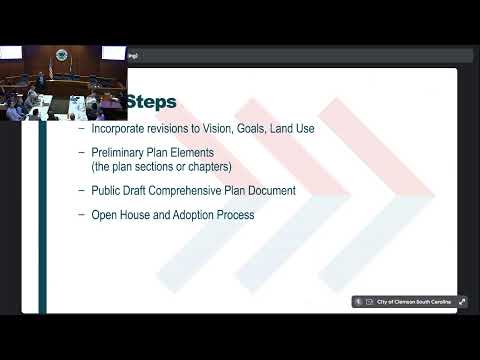
House Levine and staff outlined the next steps: incorporate committee feedback into the vision, goals and land-use framework, produce a public draft with graphics and maps, and then hold open houses and public hearings ahead of formal adoption. Kuntz and staff asked members to submit written comments within the next one to two weeks to inform revisions; the existing-conditions memorandum cited at the meeting was finalized in June 2024 and is posted on the project website.
The work session produced direction to refine wording on the vision and goals, add specificity where terms such as "preservation" and "promote" could be misread, annotate the future land-use map so it is clearly distinct from zoning, and to identify priority corridors (including SC-93) and partner organizations for economic and cultural development. No formal votes were taken; the comprehensive plan remains in draft until public review and adoption processes are completed.