
Clemson advances downtown streetscape plan and small information building; council weighs second-floor cost
Get AI-powered insights, summaries, and transcripts
Subscribe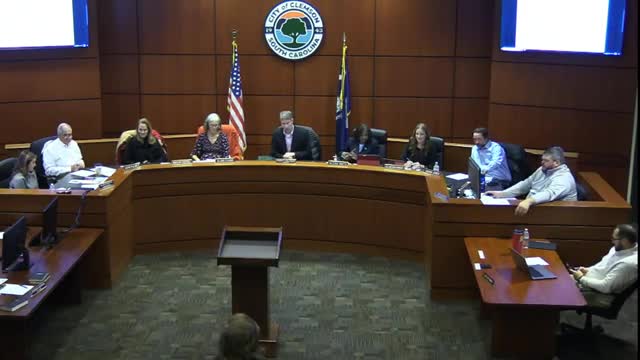
Summary
City staff and consultants presented a refined streetscape plan for downtown Clemson and schematic designs for a new downtown information building, discussing removable bollards, sidewalk materials, parking trade-offs, public restrooms and whether to add a second story shell now or later.
A team of city staff, consultants and the selected contractor updated the Clemson City Council on a refined streetscape plan for the downtown College Avenue corridor and schematic designs for a new downtown information building, and councillors discussed trade-offs including parking, maintenance and whether to construct a future second floor now.
The consultants said the design updates respond to a 2018 downtown master plan and to feedback from merchants and staff. “It’s time to kind of give this area a refresh,” said Daniel Merritt, landscape project manager with Steven Weinstein (transcript: Daniel Merritt). The updated plan widens sidewalks, swaps most decorative pavers for saw-cut or scored concrete to reduce maintenance, reintroduces parallel parking on parts of College Avenue the master plan had removed, and adds removable bollards intended to allow the city to close the street for pedestrian events.
Why it matters: downtown merchants and residents told the design team they needed better lighting, clearer loading zones and more durable sidewalk materials. Council members and staff said the designs aim to balance pedestrian space with business access and event needs while minimizing long-term maintenance burdens.
The presentation included a proposed small building on the site of the old information center. Austin Heckles of Huggins Construction and architect Michael McMillan outlined a single-story structure with a front plaza, storage for event equipment and removable bollards, and public restrooms. The plans show four unisex toilets accessed from Addison Lane, roughly 400 square feet of front lobby that could serve as a welcome area or small exhibit space, and about 524 square feet of storage at the back of the building.
Architect Michael McMillan said the building is intended to “fit nicely within the downtown vernacular” and provide storage for tables, chairs and the bollards so staff can deploy them for events. McMillan described the restroom program as a timed system and said final hours and maintenance logistics remain to be resolved.
Council and staff discussed a recurring question: whether to construct a second floor now as a shelled space or defer it. The architects estimated that adding a second floor as a finished or shelled space would add roughly $400,000–$500,000 to initial costs and noted structural implications. “If we build it without a second floor now, you would not want us to build it with anticipation of adding a second story in the future because of the way that the roof structure would be designed,” McMillan said. He described the decision as effectively “now or never” for structural framing that supports a future second story.
On parking and traffic, the team said the revised plan restores some parallel parking along College Avenue, leaving a net loss of roughly nine parking spots compared with current conditions (the earlier master plan would have removed about 20 spots). The consultants also recommended keeping bicycle travel lanes as shared vehicle-bike lanes (“sharrows”) because the corridor lacks space for a physically separated bike lane.
Other design elements include: a raised crosswalk at North Clemson Avenue; designated loading and short-term delivery spaces to address merchant concerns; and a screen wall and plaza to conceal roll-cart storage and service areas behind businesses. The team also noted a recently discovered contaminated plume under the former information building site; remediation work is proceeding in coordination with the building design.
Funding and schedule: staff said the city has secured a 50/50 matching grant for the streetscape worth $750,000 and will verify grant timing and how it aligns with design decisions. City staff told the council they will bring budget and grant timing details back for discussion at the next meeting.
Council members and downtown merchants raised maintenance and operations questions, particularly for public restrooms, which will require custodial service and daytime hours to be useful. Staff said restroom cleaning would be added to the city’s janitorial contract and that hours will be set to balance cost and public need. Several downtown merchants asked that storage and service access behind the building be concealed and that delivery access be preserved.
Looking ahead: the design team will finalize construction documents after council guidance on the second-floor decision and confirm grant timing. The council asked staff to return with budget options and a timeline for implementation.