Get Full Government Meeting Transcripts, Videos, & Alerts Forever!
Get email alerts on the Short Term Rentals topic
No spam. Unsubscribe anytime.
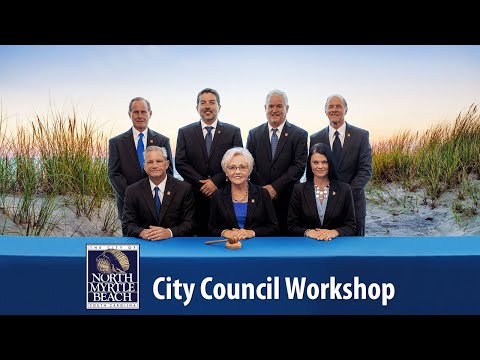
Council workshop examines ‘responsible local agent’ draft for short‑term rentals in North Myrtle Beach
Summary
City council and stakeholders discussed a draft ordinance requiring short‑term rentals to list a local contact (licensed property manager, brokerage, or local owner), a 24/7 phone, and a 1‑hour on‑site response requirement; staff will continue drafting after legal and enforcement concerns.
North Myrtle Beach — At a council workshop on short‑term rentals, staff and local real‑estate representatives outlined a draft “responsible local agent” ordinance that would require every short‑term rental within city limits to list a local contact available 24 hours a day by phone and able to be on site within one hour if needed.
The discussion came during a workshop, which City staff member Ryan emphasized is for “study” rather than immediate action: “The whole purpose of a work session is to study issues. It's not to take action. There's no action gonna be taken today.”
Brandon Cox of Elliott Realty, who presented the draft on behalf of local property managers and real estate stakeholders, said the proposal aims to focus on operational problems the city has identified — primarily parking, noise and trash — while preserving owners’ rights. “Short term rentals are an incredible part of the North Myrtle Beach economy,” Cox said, and many second homeowners support the tax base, he added.
Under the draft described to council, every short‑term rental would designate a responsible local agent who meets minimum professional standards. That agent could be the owner if the owner’s primary residence is within a specified radius of the city and the owner can meet the response requirement. Other compliance paths in the draft include designation of (1) a real estate brokerage whose principal place of business is within the prescribed radius or (2) an individual holding a valid South Carolina property manager license. Cox described the licensing steps generally: training courses, passing a state exam, a background check, and state licensure.
The draft also envisions a publicly accessible registry tying each short‑term rental address to its responsible local agent and contact information so residents and public safety personnel would know whom to call first. Cox said the city would also distribute a “good neighbor” brochure to educate visitors about local rules on parking, noise and trash.
City legal counsel (Mr. Nori) cautioned the council that two legal issues need attention before the draft could move forward. First, he warned that a distance‑based residency requirement could raise interstate commerce concerns because the city sits adjacent to North Carolina: “a court may find that that's too restrictive and that it violates the interstate commerce clause.” He suggested a time‑or‑response‑based test could be safer. Second, he noted a statutory limit on municipal fines: under S.C. Code the city’s municipal court cannot impose the $1,000–$2,000 tiered fines listed in the draft; the statutory cap for municipal fines is $500 (citing S.C. Code section noted in the workshop).
Police and public safety staff described operational limits that shaped council members’ questions. A police representative explained officers generally cannot enter a private residence without consent or a warrant and said officers typically document noise complaints and return later if officers do not hear violations at arrival. That reality prompted council members to press on whether the one‑hour response time is practical; some council members said an hour may be too long to ask police to wait on scene, while staff and the police suggested that the hour requirement could be workable if the ordinance and enforcement approach are refined.
Council members, staff and several public commenters discussed related enforcement and practical details: whether contact information could be published (staff said business‑license application data are protected by state law but are accessible to dispatch and command staff), whether signage at units should be required (the draft does not mandate signage; some council members suggested a small sign could help neighbors), how eviction authority and discretion would work in late‑night house‑party scenarios, and how fines or license revocation could be structured to be enforceable and equitable.
Public commenters — including short‑term rental owners and full‑time residents — urged clarity and balance. Owners raising concerns said owner‑operators should be allowed to serve as their own local contact without having to obtain property‑manager licensure if they live locally and can meet response requirements. Residents described repeated late‑night parties and persistent trash placement as chronic quality‑of‑life problems and urged stronger enforcement tools and clearer complaint pathways.
Council members and staff agreed on next steps: staff will meet with Elliott Realty, other property management companies, homeowner representatives and legal counsel to refine the draft, address legal and enforcement questions (including the fines structure and the residency/time test), and return a revised proposal for further review. No ordinance was adopted at the workshop.
Several quantitative and implementation details from the meeting: • Cox reported that second homeowners account for roughly 79% of property tax collections in the city, leaving permanent residents responsible for about 21% (figures presented as city property‑tax roll proportions by Cox). • The draft’s core operational standards described in the workshop are: 24/7 phone availability, one‑hour on‑site response when requested, and either owner‑local residency within the designated radius, a property‑manager license, or a licensed brokerage with a principal place of business within the designated radius. • The draft categorized violations as major administrative (for example, operating without a business license, failure to pay taxes, or failure to designate a local agent), major operational (failure to respond within the required time), and minor (failure to distribute the good‑neighbor brochure); the draft proposed escalating fines capped at $1,000–$2,000 at higher offense tiers, but city legal staff warned municipal statute limits must be reconciled.
No formal vote or ordinance adoption occurred; the workshop was explicitly a study session and the council directed staff to continue stakeholder meetings and legal review.