Get Full Government Meeting Transcripts, Videos, & Alerts Forever!
Get email alerts on the Stormwater Fee In Lieu topic
No spam. Unsubscribe anytime.
Bluffton staff outline fee‑in‑lieu option for stormwater MEP; council asks for details
Summary
Town staff proposed amendments to the Southern Lowcountry Stormwater Design Manual to allow a fee‑in‑lieu for Maximum Extent Practicable (MEP) water‑quality shortfalls; council asked for clarifications about enforcement, cost basis and whether public projects would be exempt and directed staff to return with refined language and fees in March.
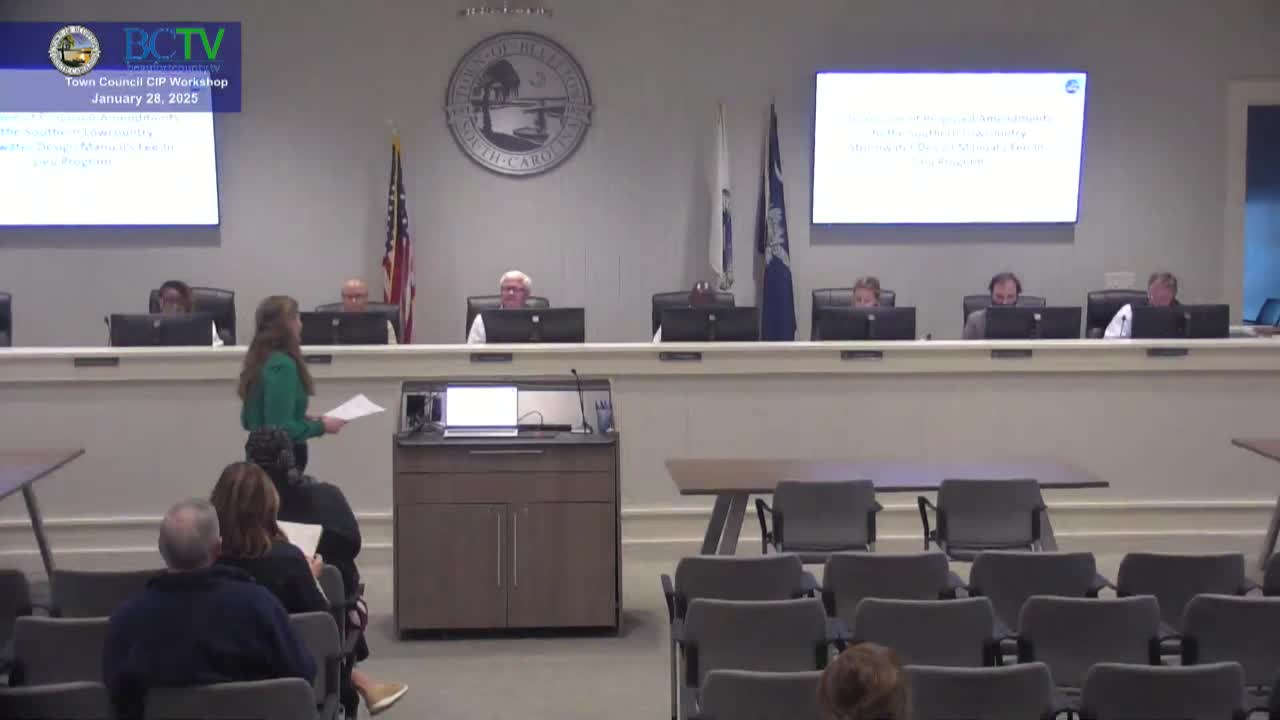
Bluffton staff on Tuesday presented proposed amendments to the Southern Lowcountry Stormwater Design Manual to let developers pay a fee‑in‑lieu when site constraints prevent them from meeting water‑quality treatment requirements under the MEP (Maximum Extent Practicable) process.
The amendments would add a formal fee‑in‑lieu mechanism to the town’s stormwater rules and the Unified Development Ordinance (UDO), with unit costs tied to stormwater retention volume (SWRV) and included in the town’s FY26 master fee schedule, staff said.
Andrea, a watershed staff member presenting the changes, told council, “we are here to discuss the proposed amendment to the Southern Lowcountry stormwater design manual B and LE program.” She said the fee would be calculated by the shortfall in cubic feet of water‑quality volume a site cannot retain multiplied by a unit cost that accounts for land purchase, design, construction and maintenance.
Why it matters: Bluffton is subject to MS4 requirements under the federal Clean Water Act and must require pollutant minimization to the MEP for development and redevelopment. Staff said the fee program would give the town a predictable way to fund water‑quality projects elsewhere in a watershed when a site cannot feasibly meet the water‑quality volume on site.
Council discussion focused on enforceability and fiscal impact. Members asked whether the fee would shift maintenance burdens to the town, how the unit cost is calculated, and whether public projects such as school turf replacements would be required to pay. Andrea said the fee unit cost “includes land, construction, maintenance, design, permitting” and that if a private owner constructs and maintains a best management practice (BMP) on their land, the fee could be reduced. She also said collected fees would come back to council for decisions on how to use them.
Council members and staff repeatedly distinguished water‑quantity controls — detention for the 100‑year storm — from the water‑quality volume targeted by the fee. Staff explained the town’s water‑quality volume target is 1.95 inches of rainfall on the impervious drainage area and that the fee in lieu would only apply to the water quality shortfall, not to quantity/detention requirements.
Council asked staff to provide examples, noting some of the illustrative fee totals in the packet were large (staff gave a turf replacement example in the millions). Members said a high fee can steer developers toward reducing impervious footprint or alternative surfacing instead of paying. Several council members asked that the fee not become an automatic shortcut allowing developers to avoid on‑site mitigation that would harm neighboring properties.
Direction to staff: Council asked staff to refine the draft, confirm the unit‑cost methodology, clarify who would be responsible for ongoing maintenance, and present final ordinance language and master fee schedule entries for first reading in March with implementation targeted for April 1. Staff also noted the item had been discussed at the planning commission and brought back with a recommendation.
No formal vote was taken; council provided direction and requested follow‑up information for the March meeting.
What’s next: Staff will compile revised language, finalize the fee calculation methodology to be included in the FY26 master fee schedule, and return to council for first reading in March and a subsequent reading in April as needed.