Get Full Government Meeting Transcripts, Videos, & Alerts Forever!
Get email alerts on the Wetlands Resilience Ordinances topic
No spam. Unsubscribe anytime.
Bluffton council authorizes $174,004 task order to draft wetlands and resilience ordinances
Summary
The Bluffton Town Council unanimously authorized a $174,004.55 task authorization to engineering firm McCormick Taylor to inventory wetlands, map resilience zones and draft wetland and resiliency ordinances after WAPAC and conservation groups urged action following the U.S. Supreme Court's Sackett decision and local wetland losses.
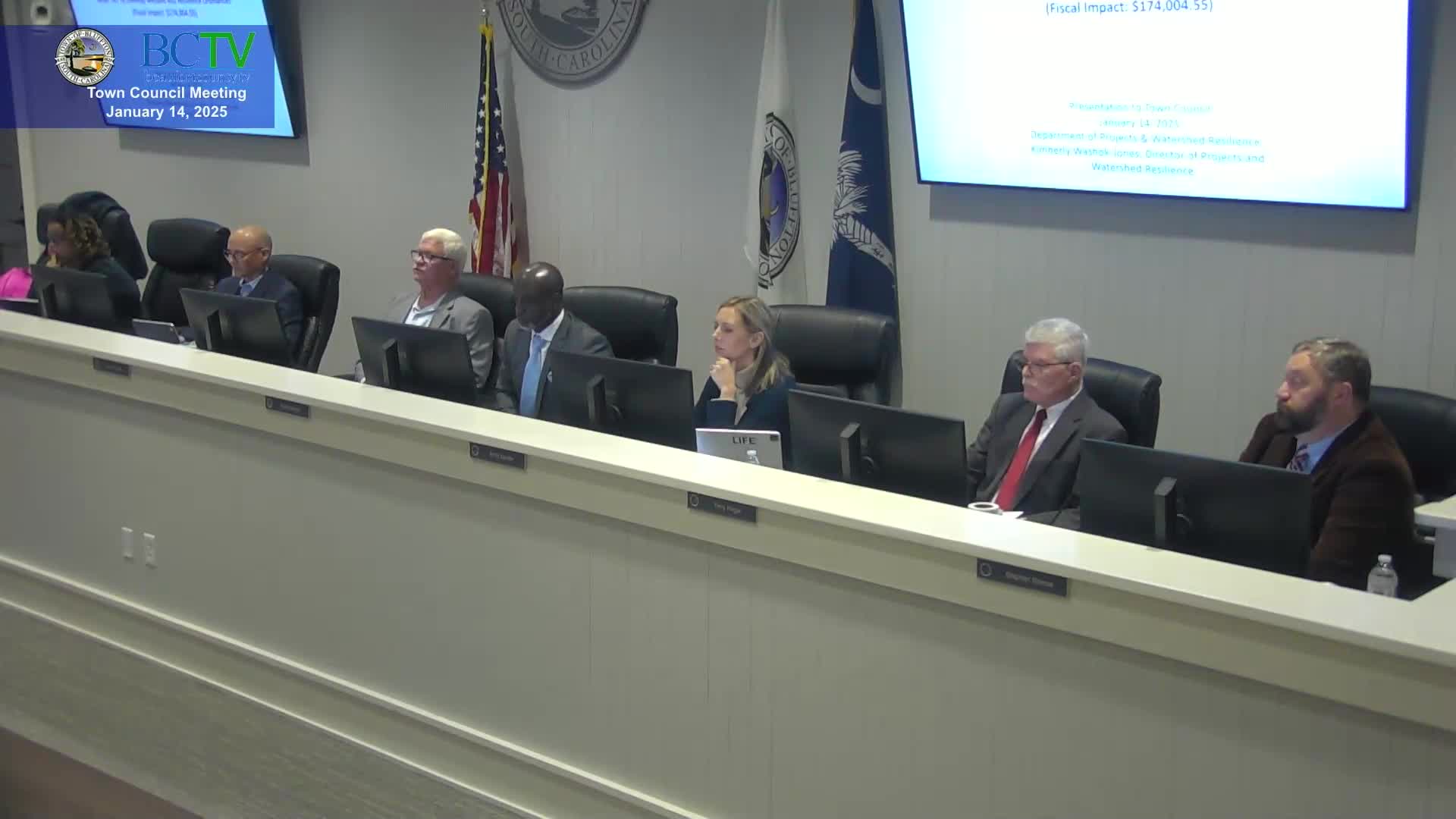
The Bluffton Town Council voted unanimously to authorize the town manager to issue a task authorization to McCormick Taylor Inc. for $174,004.55 to inventory wetlands, map resilience zones and draft local wetlands and resiliency ordinances.
Town staff framed the request as a response to recent legal and scientific shifts. "There is a regulatory gap that currently exists at federal level," said Kim Jones, a town staff member leading the presentation, referring to the U.S. Supreme Court Sackett decision and its effect on federal jurisdiction over wetlands. Jones described a seven-item scope that includes wetland inventory and mapping, applying the town's drainage-study outputs to resilience-zone mapping, and drafting ordinances.
The project stems from recommendations by the May River Watershed Action Plan Advisory Committee (WAPAC). "We urge council to approve the scope of work with McCormick Taylor to develop wetland and resilience ordinances," said Jessie White, South Coast office director for the Coastal Conservation League, during public comment in support of the work. Jones said preliminary Natural Resources work shows the town lost roughly 513 acres of wetlands within a 20‑year period and that the mapping and data collection are the cost drivers of the task order.
Council members pressed staff on process, procurement and scope. Several council members asked why consultants would draft the ordinance language rather than relying entirely on in‑house staff. Jones and other staff said the scientific and legal complexity — and the town's position at the forefront of municipal responses after the Sackett decision — made outside technical help necessary and that pro bono legal support from environmental law groups would be used alongside the consultant work. The consultant budget includes a line for ordinance drafting; staff said the two ordinance writeups total $25,425 of the $174,004.55 fee, with the remainder for mapping and data collection.
Staff estimated a 6–12 month timeline for the work, with public comment and legal review anticipated before final adoption. Jones said the effort will be coordinated with the town's drainage and resiliency studies so the outputs can inform stormwater and development rules.
After discussion the motion to authorize the task order passed unanimously.
The new work is intended to close regulatory gaps at the federal and state level, map locally significant wetlands and resilience zones, and produce draft ordinances the council could later consider for adoption. If adopted, staff said the ordinance and mapping would be used to guide permitting and future restoration priorities.