Get Full Government Meeting Transcripts, Videos, & Alerts Forever!
Get email alerts on the Tourism Strategic Plan topic
No spam. Unsubscribe anytime.
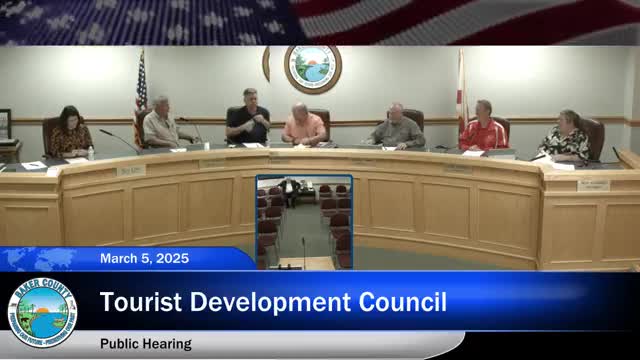
Northstar consultant outlines six‑month tourism strategic plan for Baker County
Summary
Northstar consultant John Wiznet explained a six‑month process for a tourism strategic plan for Baker County, including research studies, stakeholder meetings and a draft expected by July; the county currently uses a 3% lodging tax and a proposed additional 2% would require a voter referendum, participants said.
John Wiznet, a consultant with Northstar, told the Baker County Tourist Development Council that Northstar has a signed contract to develop a tourism strategic plan and outlined a six‑month process that includes research studies, stakeholder meetings and a draft plan expected in July.
"I think I think the issue is not necessarily do you have product, it's gonna be how do we get others to know about that product and to come and stay here," John Wiznet said, summarizing his early observations from a "secret shopping" visit to the county.
Nut graf: The consultant presented research and outreach steps designed to raise visitor awareness, target nearby regional markets and measure return on investment for lodging‑tax expenditures; the work is meant to inform decisions about promotion and potential future bonding of additional local lodging‑tax revenue.
Wiznet described three research components: a situation analysis, a consumer awareness and perception (CAP) study in selected origin markets, and a tapestry study using ZIP codes from hotel stays to profile current visitors. He said Roberto Munoz, Northstar’s vice president of research, will handle the data analysis and that the tapestry study requires only ZIP codes (not names or addresses) reported in aggregate to protect hotel proprietors’ proprietary data.
Wiznet also described stakeholder outreach: a focused session with the commission, follow‑up meetings with hoteliers, government leaders, arts and culture representatives, businesses and citizens, and requests for both "champions and critics" so the plan reflects diverse views. He said the draft plan should be ready in time to review with the council and county leadership in about six months, with a target delivery in July.
Council members raised funding and statutory questions. A council speaker noted Baker County currently collects a 3% lodging tax and that adding an additional 2% would require a voter referendum rather than a county commission vote; the speaker said that change would be at least two years away and would require public education. Wiznet said the plan would include return‑on‑investment projections to help elected leaders evaluate promotional spending.
Wiznet suggested several promotional and visitor‑service tactics discussed during the presentation: targeting day trips from nearby destinations such as Amelia Island and Jacksonville, improving visitor signage and on‑site interpretation at Heritage Village and Shoals Park, deploying QR codes and short guided videos, and using a small set of pilot promotions to "test, try, prove" before scaling up. He also recommended measuring lodging tax ROI to make the case to political leaders.
Next steps explained in the meeting: Northstar will gather research data (including hotel ZIP codes where available), schedule stakeholder meetings within the next month or two, circulate a short survey to board members, and return with a draft plan and recommendations. Wiznet said he will remain available to answer implementation questions after the contract ends.
Ending: The council agreed to provide the consultant with data and access to stakeholders as the project proceeds, and to coordinate with county staff (Sarah) on logistics and data collection.