Get Full Government Meeting Transcripts, Videos, & Alerts Forever!
Get email alerts on the Water Export Regulation topic
No spam. Unsubscribe anytime.
Committee hears bill to limit large-scale export of Missouri water
Summary
At a House Conservation and Natural Resources committee hearing, Sen. Jamie Berger presented a Senate substitute to regulate water exports with a 30-mile buffer, reporting requirements and an end-user definition; agricultural groups and utilities supported it while some witnesses and a public commenter warned exemptions could create loopholes.
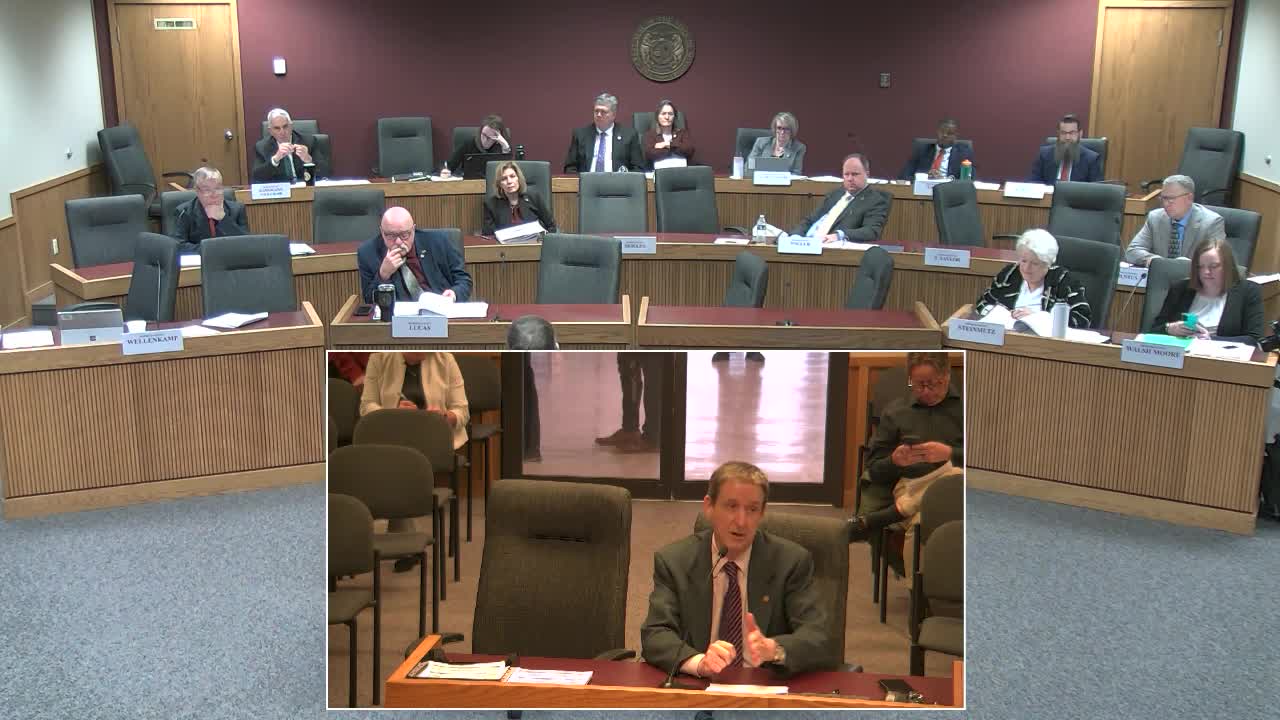
Sen. Jamie Berger presented a Senate substitute for Senate Bill 82 at a hearing of the House Committee on Conservation and Natural Resources, outlining a proposal to give Missouri a formal process to review and restrict large-scale export of the state’s water supplies.
Berger told the committee the measure is meant to “protect Missouri’s interests first, protect Missouri citizens’ existing rights to water for beneficial uses such as farming.” The bill would require exporters to identify an end user, create a 30-mile buffer around exports, add reporting and permitting-type reviews by the Department of Natural Resources (DNR), and instruct the DNR to prioritize Missouri needs if conflicts arise.
The bill’s sponsors and supporters stressed Missouri’s role as a water-rich state and raised recent western shortages as a driver of demand. Casey Wasser of the Missouri Soybean Association said understanding current use is essential and cited testimony that Missourians and businesses “collectively consume 3,200,000,000 gallons of water each day” in the state. Jacob Knable of the Missouri Corn Growers Association and representatives of cattle and rural groups also testified in favor, saying the measure would guard farms, drinking supplies and local economies.
Industry witnesses expressed conditional support. Matt Jesse, director of government affairs for Missouri American Water, said the company worked with sponsors on language to continue serving existing customers and noted the utility already supplies some out-of-state users near the border, including a downstream casino in Oklahoma. Jesse said the bill’s 30-mile exemption “reduces the rate paid by our customers while also protecting our state’s water resources.”
Opponents and at least one public commenter warned the bill could create loopholes. Lisa Pinette of ArmorVine argued the proposal’s exemptions — particularly for bottled water and some cross-border agreements — could allow commercial extraction to proceed legally and make later legal challenges harder. She told the panel that carving exemptions could “allow bypassing statute for the export of their water.”
Kansas City’s Shannon Cooper appeared later to request that longstanding interlocal agreements that supply nearby Kansas communities during droughts remain exempt; he said the city does not intend large-scale commercial exports and urged the committee to preserve the exemption so small communities can be supplied in emergencies.
Committee members asked about enforceability and mechanics. Berger and witnesses said the bill requires applicants to identify an end user (geographic location, plant or facility) in the application and includes reporting mechanisms for cross-border sharing inside the 30-mile buffer. Berger acknowledged several technical reference edits that needed correction and told members the language had been revised after prior failures in earlier sessions to add transparency and an “end-user” requirement.
The committee heard legal context from witnesses: testimony referenced the U.S. Constitution’s commerce clause and court precedent from the early 1980s (referred to in testimony as precedents in 1982 and 1983) that affect absolute bans on interstate water transfers. A witness for the soybean association said the bill was drafted with input from the attorney general’s office to preserve Missouri’s ability to scrutinize exports without violating federal commerce law.
Hearing testimony also noted specifics in the substitute: a reporting requirement for municipalities that currently share water supplies, a 30-mile buffer intended to grandfather many existing cross-border arrangements, and an “end use” definition that proponents say prevents immediate onward transport beyond the defined end user. Supporters framed the bill as a preventive, not punitive, step to preserve groundwater and surface water amid growing interstate demand.
The committee held the hearing and took testimony but recorded no committee vote on the bill at the session’s end. The hearing concluded after rounds of questions and supporting and opposing testimony.
The committee may consider technical reference fixes and potential amendments before voting; no formal committee action occurred during this meeting.