Get Full Government Meeting Transcripts, Videos, & Alerts Forever!
Get email alerts on the Disaster Recovery topic
No spam. Unsubscribe anytime.
United Way’s Long-Term Recovery Group tells commissioners it can repair far more homes for same CDBG‑DR dollars than current county program
Summary
United Way of South Sarasota County updated the Board on long‑term recovery work after recent storms, arguing the Long Term Recovery Group can repair homes at an average cost far lower than the county’s Resilience SRQ program and urging the county to partner with the LTRG for Helene/Milton recovery.
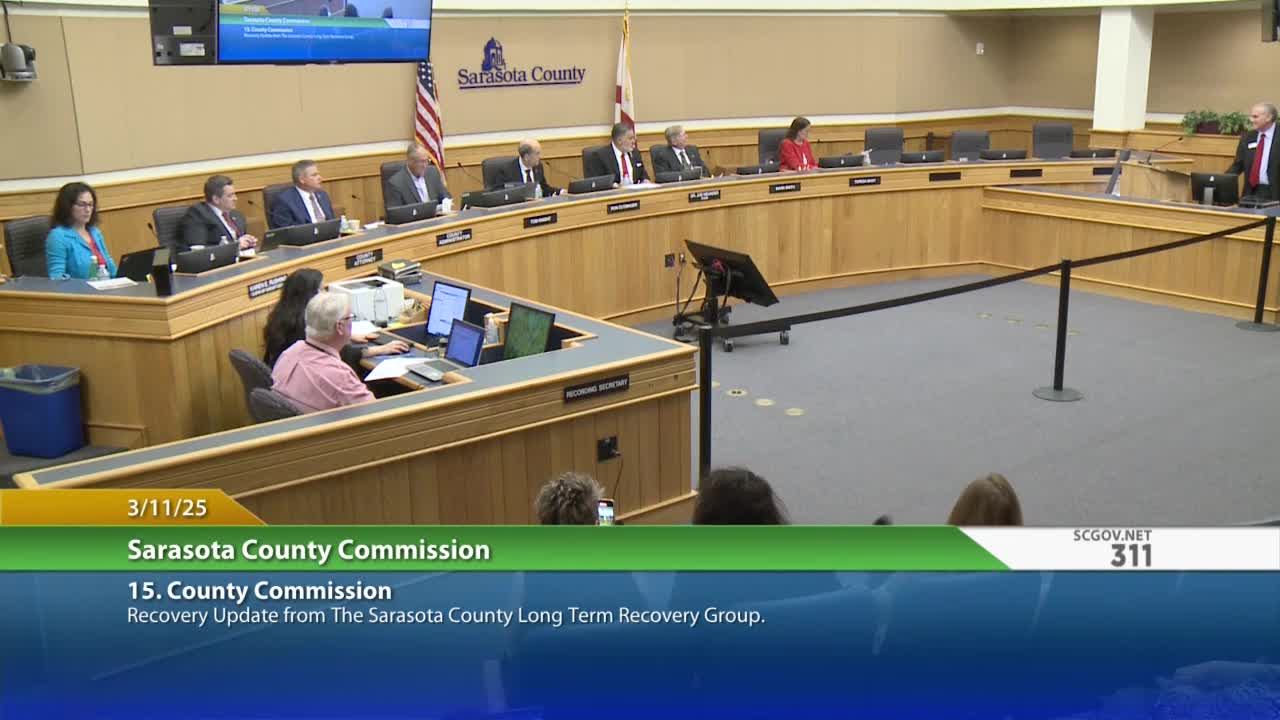
United Way of South Sarasota County and the county’s Long Term Recovery Group (LTRG) presented a progress update to the Board of County Commissioners on March 11, urging a partnership approach to repair and reconstruction after recent hurricanes.
Chris Johnson, chief operating officer at the United Way and lead for the LTRG, said the group has completed 81 rebuilds (Ian cases) with 10 sites in progress and 35 in queue, and credited local foundations, volunteer organizations and in‑kind donations for supporting the work. Johnson said the LTRG operates with a lean administration and leverages volunteer skilled labor and donated materials to keep costs low: “Over the past 2 years, we've been able to repair homes for an average of $7,700 per home,” he told commissioners.
Johnson contrasted that number with the county’s current CDBG‑DR implementation plan for homeowner rehabilitation and reconstruction. He said the county has contracted with an implementation vendor (DSW Homes) under a contract that includes up to $6,000,000 in start‑up/administration and construction costs (capped at $2,000,000 per year), and that the county has also budgeted $10,000,000 for administration and case management. Johnson argued those administrative allocations reduce direct recovery funds: “The county's current strategy projects repairs and reconstruction for approximately 300 homes,” he said, and “the LTRG would be able to repair 2,370 homes with the same funding.”
Johnson urged the board to re‑examine program design to reduce administrative duplication and leverage the LTRG and other local nonprofits and faith‑based organizations. He outlined several client stories to illustrate delays and coordination issues under the county’s Resilience SRQ program — for instance, clients who faced program‑eligibility reversals or deadlines tied to mortgage delinquencies — and said LTRG case managers and volunteer networks can respond faster and at lower cost. Johnson requested county partnership as CDBG‑DR funds for Helene and Milton become available.
County staff present (including Steve Hyde of the Office of Financial Management and Kim, county staff) described federal requirements attached to CDBG‑DR funds: lengthy HUD action‑plan timelines, environmental and lead testing, duplication‑of‑benefits reviews, eligibility documentation, and reimbursement accounting. Steve Hyde explained the procurement processes used to contract implementation vendors and said the $6,000,000 figure includes construction startup and not solely administration; he also noted the complexity of federal compliance and the need for audit trails when the county spends funds and then seeks HUD reimbursement.
The commissioners thanked the LTRG and asked staff to continue coordination; no immediate vote was taken on changing program structure. Commissioners raised concerns about administrative costs, compliance risk and the need to balance fiduciary liability with speed of recovery.