Get Full Government Meeting Transcripts, Videos, & Alerts Forever!
Get email alerts on the Stormwater Regulatory Options topic
No spam. Unsubscribe anytime.
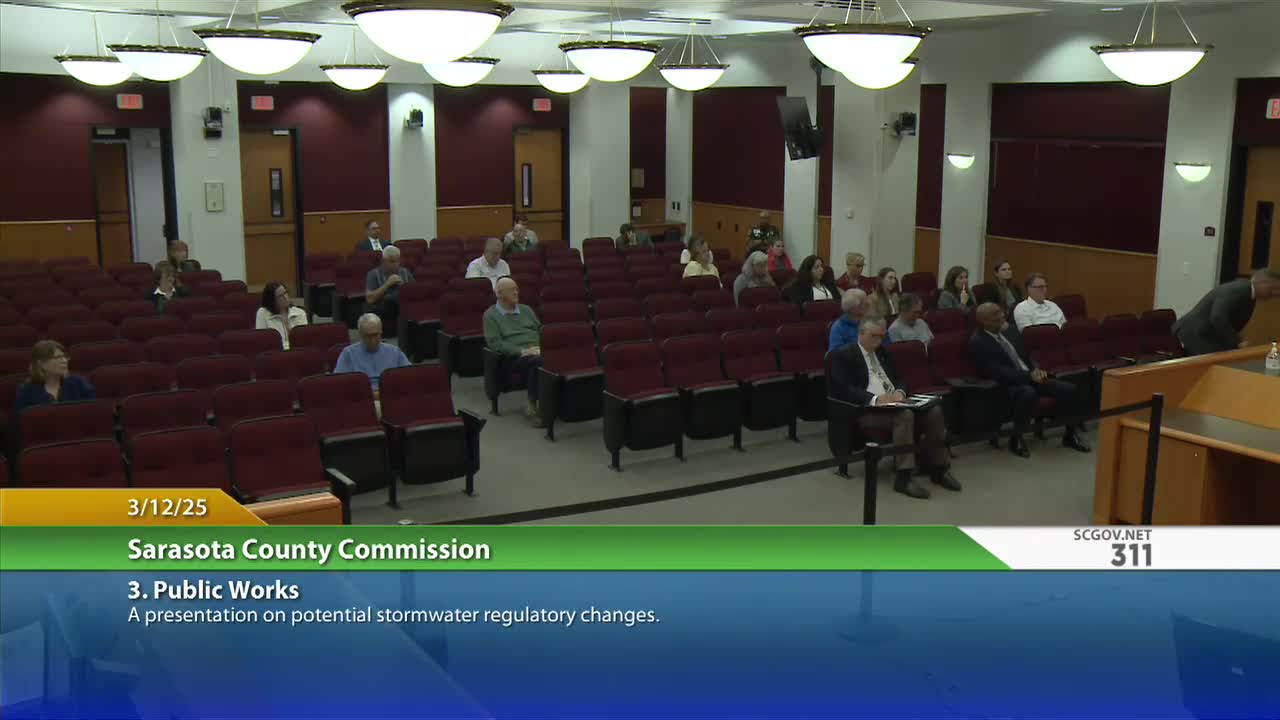
Commission reviews 16 stormwater policy options; asks staff to study public impact and pursue follow-up process
Summary
Sarasota County Public Works presented 16 regulatory and operational options to reduce flood risk, ranging from adopting higher design-rainfall standards to restricting development in high-risk floodplains. The commission asked staff to analyze public impacts and continue with community outreach and legal review.
Sarasota County—s Public Works Department presented a menu of 16 regulatory and operational options on March 12 designed to reduce flood risk countywide. The options ranged from technical changes to design rainfall (including consideration of NOAA Atlas 14 or a 500-year standard) to restrictions on development in high-risk floodplain areas and new build/lot-level requirements for stormwater treatment.
Why it matters: Commissioners and staff emphasized that choices about design standards, freeboard requirements, and whether to regulate future conditions will shape how the county evaluates new development, redevelopment and long-term capital investments. Many options would affect only new development; others could require costly retrofits or raise legal issues involving private property rights.
Options overview Public Works and stormwater staff summarized options including: using higher design-rainfall curves (NOAA Atlas 14 or adding a 0.2%/500-year event), requiring more freeboard for structures, adopting low-impact development (LID) Best Management Practices more broadly, applying a safety factor to stormwater calculations, requiring no increase in runoff volume after development, setting minimum culvert sizes, tightening drainage easement widths, and restricting development in the highest-risk floodplain zones. Staff also noted issues related to implementation time, legal risk and staff capacity for enforcement.
CRS and short-term steps Stormwater staff highlighted the county—s participation in the National Flood Insurance Program—s Community Rating System (CRS). Staff said several of the options could generate CRS points that lower flood-insurance premiums for county policyholders if implemented. The department is in the middle of a CRS audit and is pursuing prerequisites that could raise the county rating and result in deeper insurance discounts.
Board direction After discussion the commission voted unanimously to ask staff to continue detailed evaluation and public outreach on the options. Commissioners repeatedly asked staff to prepare an implementation pathway that distinguished measures applicable to new development from those that would require retrofit or legal/fiscal mitigation for existing neighborhoods. Several commissioners said they were open to strengthening standards for new development but concerned about unintended consequences for homeowners and affordable housing if rules were applied to existing lots.
Next steps Staff will perform legal and fiscal reviews, estimate costs and staffing needs for any proposed changes, and pursue a public engagement process (workshops in each watershed) before returning to the commission with draft regulatory language and program costs. Staff said some options could be implemented sooner as operational changes while others would take longer because they require code or comprehensive-plan changes, model updates, or state coordination.
Sources: Public Works presentation and discussion at the March 12, 2025 Sarasota County Board of County Commissioners meeting; Paul Seminek, stormwater senior manager; Spencer Anderson, county engineer.