Get Full Government Meeting Transcripts, Videos, & Alerts Forever!
Get email alerts on the Water Management Iraqation Efficiency topic
No spam. Unsubscribe anytime.
Agricultural Affairs committee hears overview of Idaho water law, irrigation efficiency and research priorities
Summary
The Senate Agricultural Affairs Committee heard presentations from state water officials, researchers and irrigation industry representatives on Idaho water rights, irrigation-modernization tradeoffs and research priorities, including effects on the Eastern Snake Plain Aquifer and next steps for monitoring and recharge.
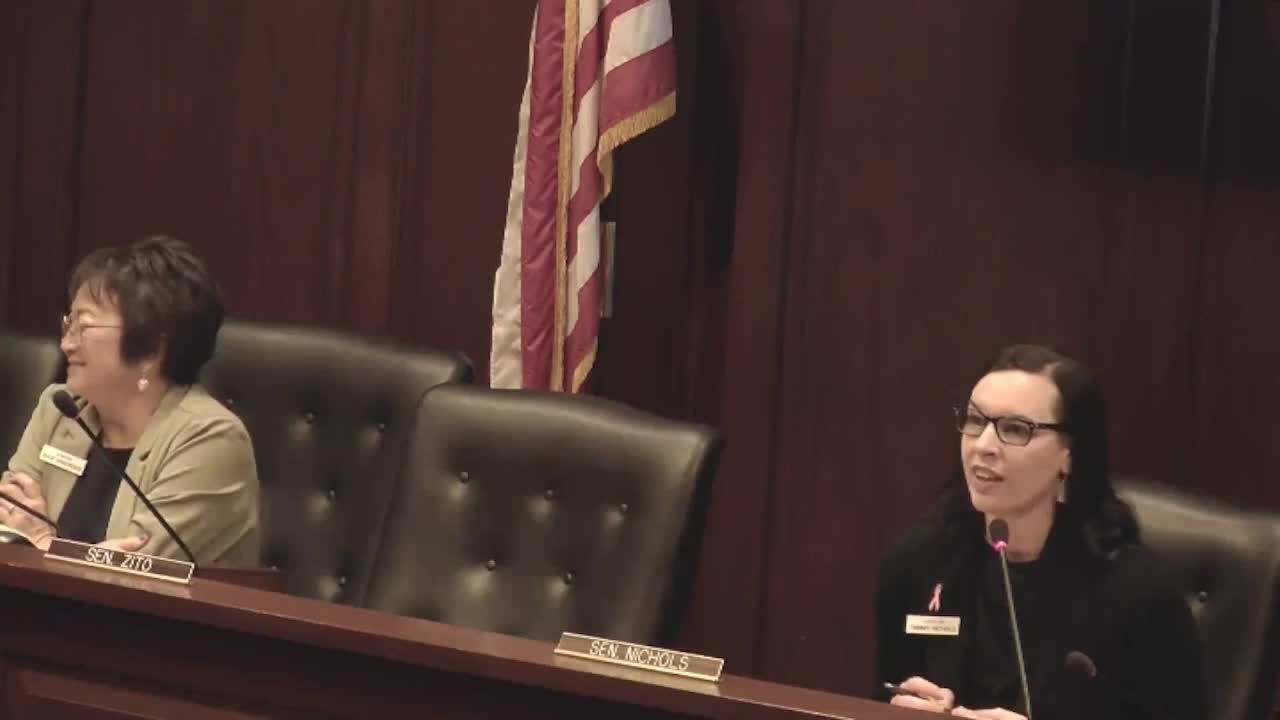
The Senate Agricultural Affairs Committee heard a series of briefings on water rights, irrigation efficiency and research needs from state and industry speakers during a committee meeting.
Deputy Director Shelly Keene of the Idaho Department of Water Resources told the committee that “a water right confers ownership of an entitlement to use the public water for a specific purpose called a beneficial use,” and gave a high-level overview of Idaho water law, permitting, adjudication and administration. Keene noted that most users obtain rights through the statutory permitting and licensing process administered by IDWR, that rights carry priority dates under the prior-appropriation doctrine (“first in time is first in right”), and that general stream adjudications—most notably the Snake River Basin Adjudication—remain a major tool for confirming priorities and quantities.
Keene described recent legislative changes and administration tools the department uses when water supply is limited: she referenced Senate Bill 1083 (the session’s domestic/stock filing exemption), the director’s authority under Idaho Code to impose moratoria on new appropriations, and groundwater management areas that allow measurement, reporting, curtailment and management planning. She said work is under way to form additional water districts and to administer surface and groundwater conjunctively in basins tributary to the Eastern Snake Plain Aquifer (ESPA). Keene said the director is traveling to talk with water users in the ESPA tributary basins about that conjunctive management process.
David Hokema (Department of Water Resources) described how on-farm irrigation modernization changes the balance between irrigation efficiency, crop yield and incidental recharge to aquifers. Using schematic examples, he explained that moving from furrow/gravity irrigation to pressurized sprinklers or pivots typically increases field application efficiency (50–65% for gravity, 60–85% for sprinkler, roughly 80% typical for pivots). He said higher on-farm efficiency increases evapotranspiration (crop water use that produces yield) and reduces incidental recharge—water that historically percolated below the root zone and returned to aquifers and rivers.
Hokema highlighted the ESPA as an example: efficiency gains and canal lining in some areas have markedly reduced return flows to the Snake River and the discharge that supports downstream reaches such as Thousand Springs and the Swan Falls minimum flow. He illustrated how return flows from the Twin Falls Canal Company have trended lower in recent seasons and warned that reduced return flows make conjunctive management and mitigation actions (rental storage, managed aquifer recharge) more important. He summarized the trade-off succinctly: “When you apply irrigation efficiency and surface water, you get less water downstream.”
Kendra Kiser, director of the Idaho Water Resources Research Institute (IWIRI) at the University of Idaho, said IWIRI is rebuilding its program to coordinate water research statewide, to train students, and to translate research into usable information for communities and managers. Kiser described a recent IWIRI workshop that cataloged research needs related to irrigation modernization and its watershed-scale impacts; she said the institute currently distributes roughly $150,000/year in federal USGS funds competitively to Idaho universities, that the university currently covers her position, and that IWIRI seeks additional sustained funding to hire staff and execute a multi-year research agenda.
Paul Arrington of the Idaho Water Users Association told the committee irrigation districts, canal companies and groundwater districts remain crucial to delivering water to farms and to organizing collective responses. He reiterated that tools used across basins include managed recharge, cloud seeding and conservation, and cited cloud-seeding studies that have estimated seasonal yield increases in the roughly 8–15 percent range depending on conditions. Arrington emphasized that many fixes are expensive and will require state support and broad cooperation.
Casey Garrett of Aqua Irrigation Technologies described onsite irrigation technologies used in western Idaho’s specialty-crop sector, focusing on drip systems. Garrett explained field filtration requirements, emitter design, automation and end-of-season handling: drip tape requires fine filtration and on-farm pump/filter stations; tape is removed and rolled at season’s end and sent for recycling; Garrett estimated his company moves tens of semi-truck loads of tape into the region each year and stressed costs and labor savings as key adoption factors. He said drip is typically used on smaller, higher-value fields (onions, hops, specialty vegetables) and noted the systems’ capital and operational requirements.
Committee members asked for follow-up information on several technical items, including historical groundwater-level mapping, the measured travel rate of water through aquifers in the Upper Snake region, and how IWIRI plans to prioritize research. IDWR staff said they would provide links or follow-up materials.
Why it matters: committee members and presenters framed the issue as a policy and management question—how to support agricultural productivity through irrigation modernization while recognizing that improved field efficiency reduces incidental recharge, alters river flows and changes how conjunctive surface/groundwater administration must be implemented. Several presenters and legislators flagged the need for research, monitoring and funding to manage those trade-offs.
The committee did not take formal policy votes on water measures at this meeting; presenters and staff were asked to provide further information to the committee.