Get Full Government Meeting Transcripts, Videos, & Alerts Forever!
Get email alerts on the Elections Qualifying topic
No spam. Unsubscribe anytime.
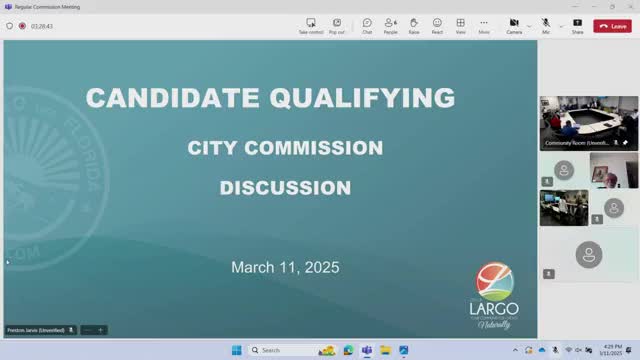
Commission discusses changing candidate qualifying rules; consensus leans to keep 200 petition cards and start distribution March 15
Summary
City staff briefed the commission on Largo’s candidate qualifying rules and commissioners directed staff to prepare ordinance language backing card distribution up to March 15 while keeping the 200‑petition requirement.
City staff briefed the commission on Largo’s candidate qualifying requirements and solicited direction to prepare ballot or ordinance language.
Diane (city clerk) reviewed the current rules in Largo’s charter: candidates must submit 200 signed petition cards from registered Largo voters; charter language allocates a 60-day period for distribution (15-day formal qualifying plus 45 days prior distribution) and no qualifying fee. Diane said the 60-day/200-card approach dates to the 1970s and noted the city has about 60,000 registered voters. She and legal staff summarized how peer cities handle qualifying: some require petition cards only, others offer a fee-or-petition hybrid, and some set higher card counts; Clearwater, for example, requires 250 cards.
Clerk staff discussed election scheduling and cost: a standalone municipal election would require contracting with the Supervisor of Elections (previous estimate cited was about $133,000); delaying changes to a future charter review committee remains an option. Diane and legal staff outlined the charter-amendment process: staff would draft an ordinance with ballot language, the commission would adopt it after two readings, and the ballot question would be scheduled for a future election; any change enacted in 2026 would affect candidate qualifying for 2028 elections.
Commission discussion was extensive. Commissioners raised several concerns: the burden of collecting signatures in hot weather and the difficulty of collecting personal data on petition cards, the equitable access argument for a petition-based route (lower-income candidates can qualify without a fee), and the observation that when given a choice candidates typically pay a fee rather than gather signatures. Several commissioners argued for a hybrid approach (fee plus reduced-card option), while others preferred retaining 200 cards but expanding the period for collecting signatures.
By the end of discussion the commission asked staff to draft an ordinance reflecting consensus to move the start date for card signing earlier in the year (suggested March 15 or the nearest business day) and to keep the 200-card requirement for qualification. Commissioners also asked staff to include options in the draft ordinance (for example a hybrid fee/cards model and different fee levels) and to return with clear ballot language and implementation dates. Diane and legal staff said they could prepare ordinance language and that the commission would consider it at two readings with ballot placement to be set according to the Supervisor of Elections’ calendar.
Ending
Staff will prepare ordinance language implementing the commission’s direction (March 15 start for card distribution; retain 200 signed petition requirement) and present options for fee/card hybrids and timing in a forthcoming ordinance for two readings.