Get Full Government Meeting Transcripts, Videos, & Alerts Forever!
Get email alerts on the Historic Preservation Post Hospital Demolition topic
No spam. Unsubscribe anytime.
Missoula commission denies demolition permit for Fort Missoula post hospital
Summary
The Missoula Historic Preservation Commission voted 5-0 to deny a permit to demolish the Old Post Hospital at Fort Missoula, citing insufficient evidence that demolition is the only viable option and concerns about demolition-by-neglect, missing structural and environmental documentation, and unexamined preservation funding strategies.
The Missoula Historic Preservation Commission on March 5 denied a historic preservation permit that would have allowed demolition of the Old Post Hospital (Building 9) at 3255 Lieutenant Moss Road in the Fort Missoula Historic District.
The commission voted to deny the application after multi-hour public testimony, staff analysis, a developer presentation asserting economic infeasibility, and lengthy commissioner questioning about structural reports, environmental documentation, and whether the owner had made a bona fide effort to pursue alternatives to demolition.
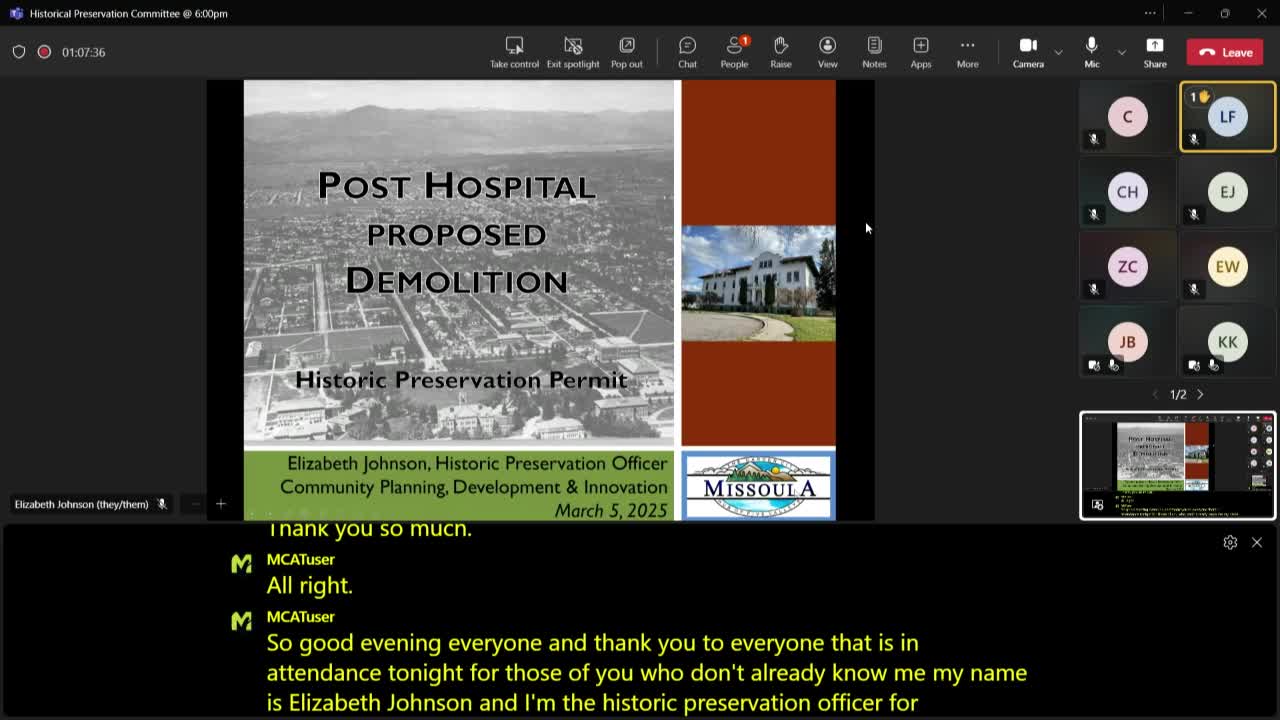
Staff recommended preliminary approval with conditions, concluding the applicant had submitted an economic analysis, a structural assessment, and evidence that it had marketed the building for sale. Elizabeth Johnson, Missoula’s historic preservation officer, summarized those submittals and the applicable review standard in Missoula Municipal Code Title 20.85.085(j). She noted the application package included an economic feasibility analysis by Stevenson Company, a third-party review, a structural assessment by Architecture of Belonging, environmental assessment materials, and documentation that the property had been marketed for 90 days, as required.
The developer and property owners told the commission the building is not economically viable to rehabilitate. David B. Gray, principal architect at DVG Architecture and Planning, representing FAE Missoula Hospital LLC, said the post hospital has “no viable economic life” and that renovation estimates were well above likely market value. He and project consultant Thomas G. Stevens presented figures showing multi-million-dollar rehabilitation costs and negative return-on-investment calculations. Gray summarized: “The building is no longer financially feasible to preserve and adaptively reuse.”
Preservation advocates and several public commenters disputed that conclusion and raised other concerns. Jared Schitz of Preserve Historic Missoula said the application showed “holes” in the developer’s funding outreach and called some responses to funding inquiries “dismissive.” Preserve Montana’s Jenny Buettgenberg urged denial and said state and federal historic tax credits and grant programs had not been adequately considered. Tate Jones of the Northern Rockies Heritage Center and others warned the hospital is part of a nationally significant historic district and said demolition would harm the district’s integrity.
Commissioners focused on several issues during questioning: whether the owner’s actions amounted to “demolition by neglect” under the code (for example, deteriorated roofs, broken windows, and ineffective waterproofing), the completeness and currency of the structural and environmental evidence submitted, and whether preservation incentives and nonprofit partnerships had been meaningfully pursued.
Key factual details from the record: staff cited an applicant cost estimate in the application materials of roughly $9.1 million to renovate to a low-to-average finish, and third-party analyses estimating a multi‑million-dollar excess of cost over likely post‑rehabilitation market value. The applicant listed the property for sale for $10 with an offered relocation credit of up to $100,000; staff reported the owner received inquiries but no formal offers. The owner’s reported ongoing carrying costs included listed property tax expense in the application materials (figures in the record: approximately $47,714 for the most recent year and a reported cumulative tax burden since 2021). The applicant reported net negative cash flow since purchase.
Several commissioners said the application had gaps that mattered to the “bona fide effort” and mitigation analyses required by the code. Commissioners repeatedly asked for a current structural-engineer–stamped assessment and for more recent environmental/asbestos documentation; those items were not in the packet at the time of the hearing. Commissioners also questioned whether the application adequately analyzed federal and state rehabilitation tax credits and other funding strategies intended to make large rehabilitation projects feasible. Gray and the owner’s financial consultant said even with tax credits or grants, the economics would not produce a bankable project because a completed building’s market value would remain far below estimated rehabilitation costs.
After discussion the commission made a motion to deny the demolition permit. In public comment on the motion, an attorney advising members urged the commission, if it denied the permit, to prepare written findings of fact and conclusions of law for the record; staff confirmed it would prepare the written decision documenting the specific reasons for denial.
The commission’s formal action was recorded as a motion to deny the historic preservation permit for demolition of the Old Post Hospital; the motion passed 5–0. Commissioners recorded as voting in favor of denial were Felicetti, Herzog, Williams, Vickenhauser, and Struckle. The commission instructed staff to prepare the written decision and supporting findings for the official record.
Why it matters: the Old Post Hospital is a contributing resource within the Fort Missoula Historic District, a property listed in the National Register of Historic Places with a period of significance dating from 1877 to 1947. The commission’s decision preserves the structure pending further steps and clarifies the evidentiary standard the commission expects for any future demolition request — including up-to-date engineering, environmental documentation, clearer demonstration of exhausted preservation funding options, and stronger evidence about any alleged owner-created hardship or demolition by neglect.
The developer and owners may pursue final review steps allowed by Title 20 or pursue appeals available under local law; the commission’s denial was recorded with staff to prepare written findings that will be added to the administrative record.