Get Full Government Meeting Transcripts, Videos, & Alerts Forever!
Get email alerts on the Urban Forestry topic
No spam. Unsubscribe anytime.
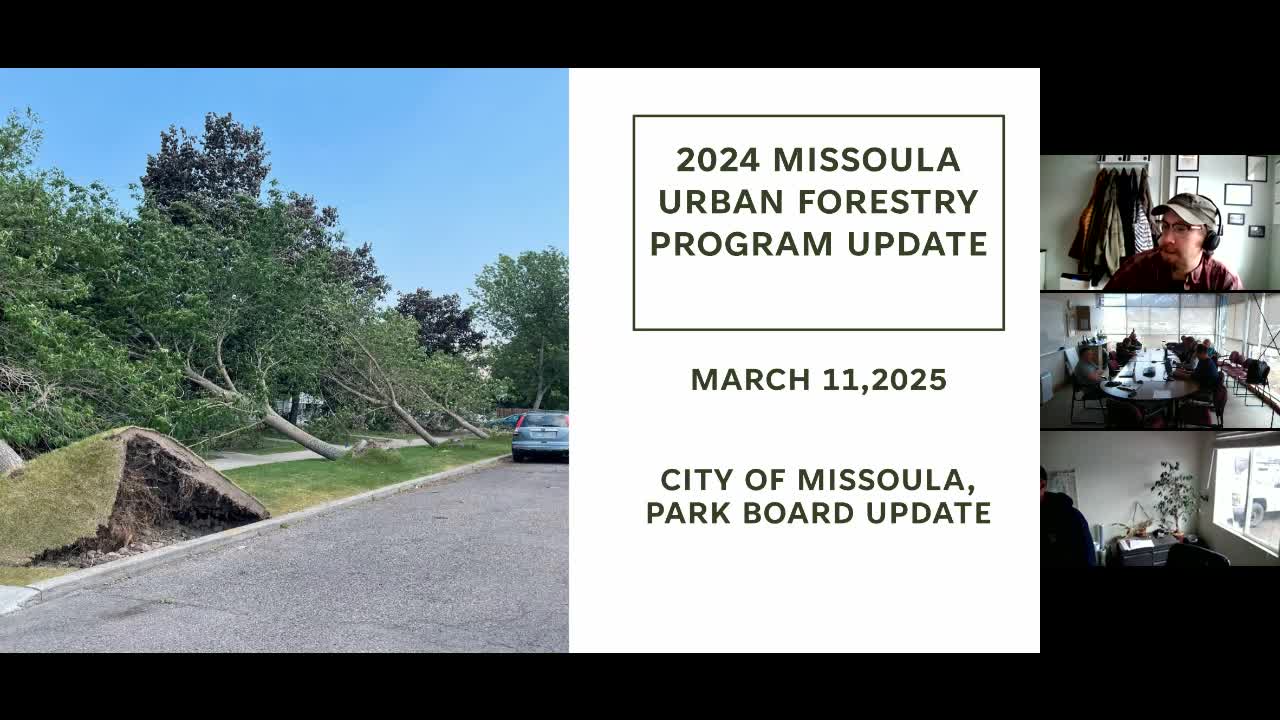
Missoula urban forestry staff detail storm damage, recovery costs and staffing needs
Summary
City urban-forestry staff told the Parks and Recreation Board they identified thousands of storm-damaged public trees after a July wind event, have begun removal and hangar treatments, and expect significant unfunded restoration and staffing needs as FEMA and insurance cover limited costs.
Ben, the city’s urban forestry lead, told the Parks and Recreation Board that an intense wind event last July caused widespread tree damage across the city and that recovery will be large, slow and partly uninsured. “We’ve identified over 7,000 individual trees,” he said, adding the figure covers public trees with broken or hanging branches.
The assessment and recovery work has been prioritized into immediate hazard mitigation, hangar treatment (removing broken hanging branches), and full removals for trees that meet hazard or FEMA criteria. Nut graf: The event damaged an estimated share of Missoula’s public tree population, generated tens of thousands of cubic yards of debris and pushed the city to add temporary contracts, revise data collection and accelerate hiring — while leaving restoration work that FEMA or other sources will not cover.
City staff described the scale and costs in detail. Park and forestry contractors have removed several hundred trees so far; Ben reported contractors have removed “over 400 trees” under the right-of-way contract, with an additional roughly 80 removals reported under the park contract. Park staff estimate total tree losses may reach roughly 650 trees once stump removals and privately cleared trees are fully counted. The city reported approximately 88,000 cubic yards of post-grind debris at public processing sites; staff said grinding and hauling alone total about $1.8 million, and removal and hangar contracts approach $1 million to date.
Ben said FEMA will fund only some hangar removal work and reimburse at about 75% for eligible right-of-way work, leaving a local share for the city. He also noted that tree stumps and much of long-term restoration pruning and replanting are not FEMA-eligible and will require separate funding. The city’s insurance provider (MMIA) covers park assets under a different process; staff said parks will file insurance claims where applicable but that substantial restoration costs remain.
Staff described problems with early data collection and how that has affected contracting timelines. Volunteers, out-of-state mutual aid crews and contractors collected damage data using mixed methods; staff said that produced duplicates and gaps and made validation slow. “If we had to do it all over again, I would tag every tree,” Ben said of field marking and validating damaged trees for contractors.
The storm exposed staffing gaps and prompted a near-term hiring push. Staff highlighted a recent budget enhancement that funded the city’s first full-time tree inspector; Robert Edwards, an internal hire, moved from an Arborist Technician Assistant role into that inspector position. The crew also experienced turnover but expected three new field hires (named in the meeting as Cody, Tom and Kenny) to start within weeks. Staff said Christopher Gray is the only currently active certified field arborist on staff.
Program priorities for the coming year include completing the tree inventory, finishing standard operating procedures and onboarding for new hires, quantifying backlog service requests, and seeking funding for unfunded restoration tasks including stump grinding, restoration pruning and boulevard replanting.
Staff stated additional lessons learned for future emergency response: designate public “push” sites (drop locations) in advance, standardize mutual-aid and vendor agreements, track equipment and labor hours during response to support FEMA match claims, and build a clearer chain of command for data collection and contractor validation.
Ending: City staff asked the board to expect public interest to rise as restoration moves beyond FEMA-eligible scope. They said work on inventory, procedures and staffing will continue this year and that the board and the public will see further updates as contracts wrap up and as grant/funding conversations continue.