Get Full Government Meeting Transcripts, Videos, & Alerts Forever!
Get email alerts on the Forestry And Fuels Reduction topic
No spam. Unsubscribe anytime.
Missoula plans expanded forestry work: Marshall Grade, Dean Stone and a new state grant pre-proposal
Summary
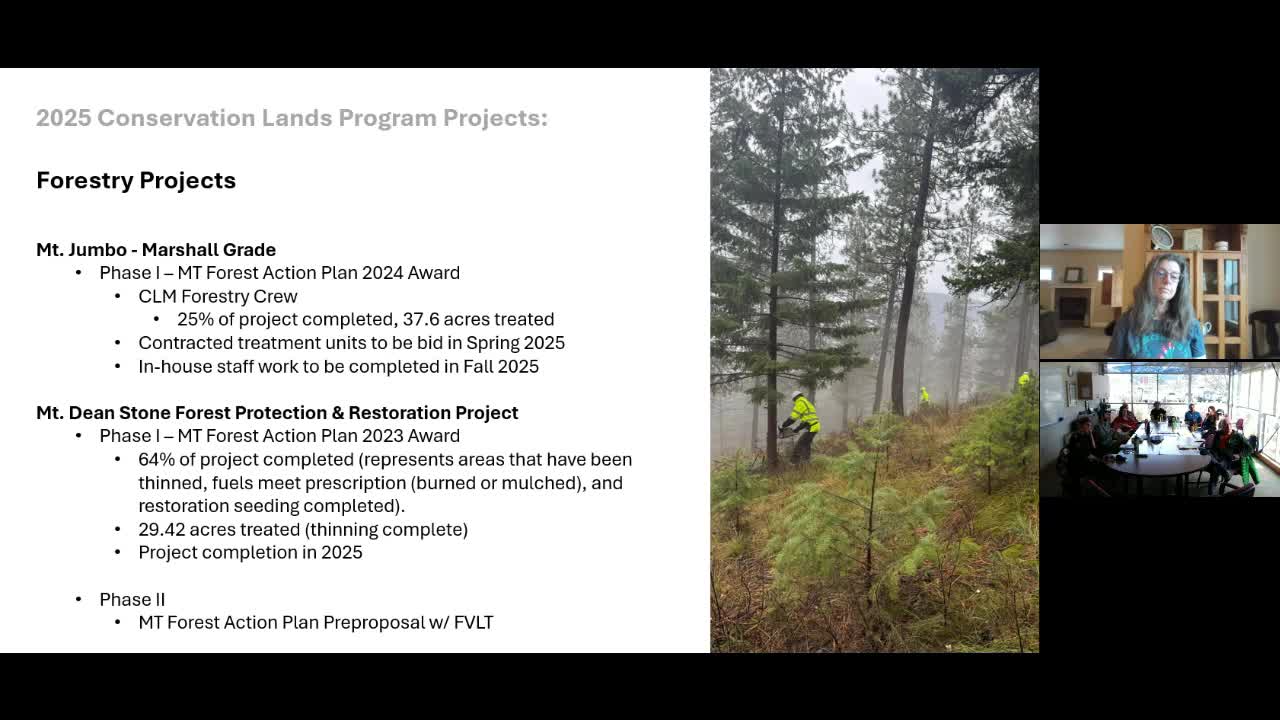
Staff outlined forestry and fuels-reduction work this season, including continued treatments on Mount Jumbo, contracted thinning on Marshall Grade and a $150,000 state grant previously awarded; they also submitted a $436,000 pre-proposal for wider restoration.
Missoula staff told CLAC the conservation lands program will continue expanded forestry and fuels-reduction work this year, blending in-house treatments and contracted thinning.
Peter, program specialist, said crews recently completed or are finishing work near the summit of Dean Stone and that the program will contract approximately 53 acres this summer on the upper portion of Marshall Grade with work to begin after bids are awarded. He said a prior $150,000 Montana Forest Action Plan grant funded much of the initial Mount Jumbo/Marshall Grade work and that the city is now applying for additional state funds.
Peter described a recent pre-proposal for $436,000 that would shift treatment near towers and residential areas from critical-infrastructure prescription to broader forest restoration prescriptions. He said the area includes private parcels adjacent to city land and that the request is to expand the treated footprint to reduce wildfire risk and restore forest condition.
Staff said the city also intends to use a combination of staff season extensions and contractor crews to complete pile burning and follow-up activities. Committee members asked about volunteer field trips to view treatment sites; staff said they can accommodate field visits but they require longer travel time and scheduling.
Why it matters: The increased in-house forestry capacity, several contract packages and grant applications indicate the program is prioritizing fuels reduction and forest restoration to mitigate wildfire risk near residences and infrastructure. The work is largely state-funded and staff said it is not federal money.
Peter said the forestry work is a fast-growing part of the program and that staff expect continued grant-driven expansion this year.