Get Full Government Meeting Transcripts, Videos, & Alerts Forever!
Get email alerts on the Immigration Enforcement 287g topic
No spam. Unsubscribe anytime.
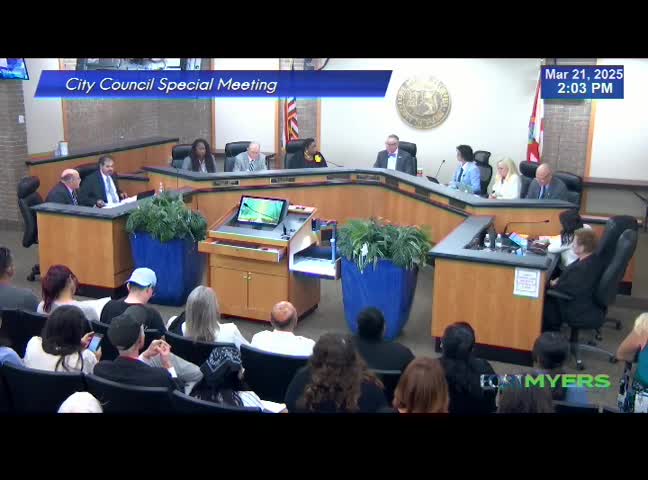
Fort Myers City Council approves ICE memorandum of agreement after hours of public comment
Summary
The Fort Myers City Council voted 7-0 on March 21 to approve a memorandum of agreement between the Fort Myers Police Department and U.S. Immigration and Customs Enforcement that would allow trained local officers to perform certain federal immigration-enforcement functions.
The Fort Myers City Council voted 7-0 on March 21 to approve a memorandum of agreement between the Fort Myers Police Department and U.S. Immigration and Customs Enforcement that would allow trained local officers to perform certain federal immigration-enforcement functions.
The vote came after more than five hours of public comment and repeated questions from council members about the agreement’s scope, training requirements and potential liabilities. Council member Berson moved the measure; Council member Watkins Brown seconded it. The motion passed on a roll-call vote of seven yes, zero no.
Why it matters: supporters say the agreement gives local officers a tool to act when they encounter people subject to federal immigration detainers; opponents say it will erode trust in policing, invite lawsuits and prompt racial profiling. State and federal officials, lawyers and dozens of residents urged the council to weigh legal exposure and community impact before acting.
The agreement and the council debate Deputy Chief Victor Medeco of the Fort Myers Police Department described the arrangement as training and a certification process: “This is just a tool. It’s training for officers so that when we come into contact with these individuals…we’re able to act on them ourselves instead of waiting and calling for an ICE agent,” he told the council. Medeco said the department has not fixed a number of officers who would receive the training and that staffing choices would be made after the document is signed and the training is scheduled.
State Representative Jenna Persons Mullica, who flew in from Tallahassee, urged the council to approve the memorandum and said the issue of immigration policy had already been decided in the state legislature: “This is not a policy discussion or policy issue before you all today,” she said, while urging support for the cooperative tool brought to the council by the police chief.
Dozens of residents, lawyers and advocates urged the council to reject the task-force model of a 287(g)-style agreement. Emmanuelle Casimir, an immigration attorney and former assistant public defender, warned of chilling effects on public safety: “Do we want a society where police arrest first, ask questions later, where families live in fear even when they have legal status?” she asked.
Speakers raised three recurring concerns: 1) scope and authority — several public commenters and at least one council member noted language in section 5 of the agreement that grants officers the “power and authority to interrogate any alien or person believed to be an alien” and to arrest without a warrant in certain circumstances; 2) cost and staffing — commentators cited municipal experiences in other states where localities absorbed unanticipated millions in program costs; and 3) civil-rights risk — many witnesses said the agreement would discourage immigrant victims and witnesses from contacting police.
Legal and procedural questions City Attorney Ali advised the council that cooperation with federal immigration authorities is lawful and that the memorandum is an implementable tool; the city attorney recommended support for the cooperation. Multiple council members said they lacked clarity before the first vote earlier in the week and raised questions again on March 21 about which use-of-force policy would apply, whether body cameras would be required during immigration functions, whether officers would act under ICE or city supervision while performing federal functions, and what ICE’s certification criteria are.
An attorney-general letter cited publicly in the meeting urged local compliance with state immigration directives and warned of possible enforcement steps; the city attorney said the letter is persuasive but not a court ruling and that the legal landscape remains contested. Several speakers and local attorneys said entering the agreement is optional for municipalities that do not operate county detention facilities and cautioned that litigation is likely either way.
What the document does and does not specify The memorandum provides for training, certification and permitted duties for participating officers if they meet ICE and departmental requirements. Deputy Chief Medeco said officers who complete the certification would return to their regular assignments but could perform federal immigration-related functions when they encounter detainers or other federal immigration matters. The council asked but did not receive a firm timetable or number of officers to be trained. The agreement includes a nondiscrimination clause and references ICE policies and federal civil-rights statutes; opponents noted that contractual protections do not eliminate the risk of discriminatory enforcement in practice.
Public reaction and next steps Public comment speakers represented a wide range of community groups — immigrant-rights organizations, veterans, attorneys, business owners and faith leaders — and most urged the council to delay or reject the agreement. Several speakers cited local demographics, economic contributions from immigrants and concerns that day-time meeting times prevented many working residents from attending. Supporters of the memorandum argued it was a lawful tool to help address violent crime and to enable local officers to act when federal agents are not available.
Council action was limited to adopting the memorandum; the record shows no further binding direction to implementor departments beyond normal training and command-level planning. Deputy Chief Medeco said command staff will return with operational details if the agreement is executed. The city manager and police command will handle implementation details including training schedules and officer selection.
Votes at a glance - Motion: Adopt the memorandum of agreement between U.S. Immigration and Customs Enforcement and the Fort Myers Police Department (agenda item 1.1). - Mover: Council member Berson. Second: Council member Watkins Brown. - Vote: Berson — yes; Banc — yes; Brown — yes; Geraldo — yes; Watson — yes; Boschett — yes; Mayor Anderson — yes. Tally: 7 yes, 0 no. Outcome: approved.
The council meeting record shows continuing disagreement among residents, council members and legal advisers over how broadly the memorandum would empower local officers and the degree of legal risk the city assumes. Implementation will hinge on training details, selection criteria for participating officers, and whether future litigation or state action changes the legal landscape.