Get Full Government Meeting Transcripts, Videos, & Alerts Forever!
Get email alerts on the Police Ice Moa topic
No spam. Unsubscribe anytime.
Fort Myers council approves memorandum of agreement allowing limited FMPD cooperation with ICE after lengthy public backlash
Summary
The Fort Myers City Council voted to approve a memorandum of agreement between the Fort Myers Police Department and U.S. Immigration and Customs Enforcement (ICE) after a lengthy public comment period that featured dozens of residents urging the council to reject the partnership.
The Fort Myers City Council voted to approve a memorandum of agreement between the Fort Myers Police Department and U.S. Immigration and Customs Enforcement (ICE) after a lengthy public comment period that featured dozens of residents urging the council to reject the partnership.
Supporters of the MOA, including city staff and the police department, told the council the agreement would give trained officers the authority to process immigration‑related custody in situations that arise during criminal investigations when federal agents are not immediately available. City Attorney Grant Alley said the arrangement “would be consistent with precedent on cooperation with state and federal law enforcement for decades.”
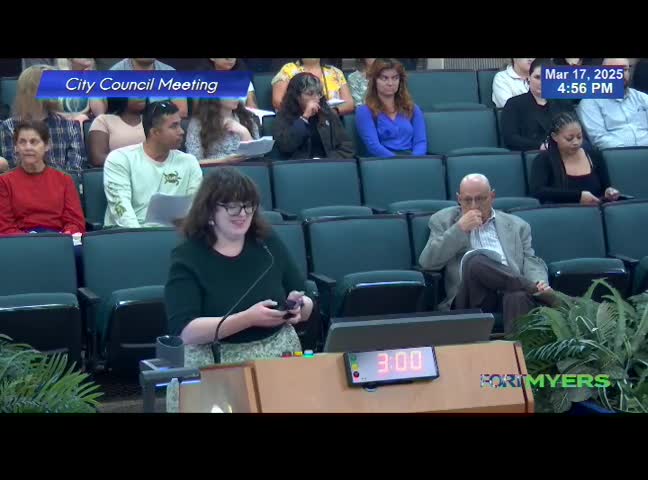
The MOA drew more than two hours of public testimony, nearly all opposing. Lucy Perkins Weigel, a resident, cited the Statue of Liberty and told the council, “What I care about is if they are safe and sound and if they are treating our other neighbors with dignity and respect.” Megan Emery, another speaker, warned the council that “Law enforcement cannot protect a community that does not trust them.” Multiple other residents described fear of racial profiling, the risk that victims and witnesses would stop contacting police, and local economic dependence on immigrant labor.
Fort Myers Police Chief Jason Fields said the agreement is intended to be limited and operational, not a new “immigration task force.” “This topic is very emotional,” Fields said; “we might see some revisions.” He described plans for selecting and training specific officers, running security clearances and using federal policies for operation when ICE supervision applies. City Attorney Alley added that officers who are individually approved to perform ICE functions would receive federal immunities in addition to existing state and local protections.
Speakers who opposed the MOA cited research and local experience. Madeline Holiday described two recent encounters she said illustrated a risk of profiling and improper handling: in one she said officers dismissed a robbery victim of Guatemalan descent; in another, she described overhearing an officer call a Hispanic family “illegals” during a parade. Patricia Zimmerman of Lee Interfaith for Empowerment urged the council to increase funds for affordable housing instead of entering agreements that “open doors to racial profiling.”
Council debate reflected the public split. Several council members sought more time, training details and written safeguards; others argued the city should cooperate with federal partners and that the MOA would help with processing cases that currently cannot be completed because ICE cannot respond quickly. The item had been moved off the consent agenda for discussion (it appeared on the city manager agenda as item 7.14).
Council voted to approve the MOA. The vote carried after a roll call; the recorded tallies were announced by the clerk and the motion was declared carried. City staff said they would proceed with the training, credentialing and implementation steps outlined in the agreement, and that ongoing reporting and review would follow as the program is implemented.
The council did not adopt additional written restrictions on how officers would be selected beyond the MOA language; councilmembers asked staff to return with implementation details, training outlines and metrics for monitoring community impacts.
What happens next: the police department will nominate officers for ICE training and security clearance, the city will run required administrative checks and staff said they expect further operational guidance and potential revisions as the program begins. Public commenters and several council members said they will track outcomes closely and seek regular updates to the council.
Votes at the meeting on this item were final; staff and the police department said they will provide additional implementation specifics in follow‑up agenda materials.