Get Full Government Meeting Transcripts, Videos, & Alerts Forever!
Get email alerts on the Zoning Rewrite topic
No spam. Unsubscribe anytime.
Consultants outline timeline, themes and public input for Janesville zoning and subdivision recodification
Summary
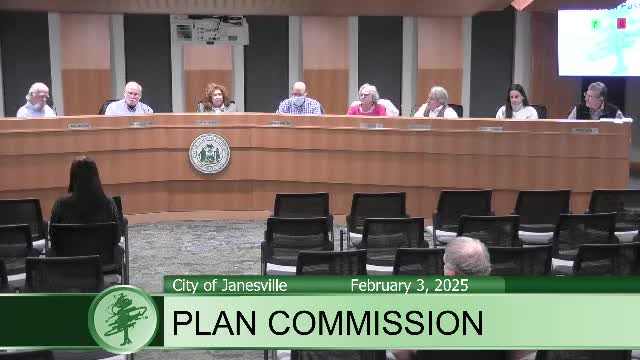
Consultants from Grama presented Feb. 3 an update on Janesville's zoning and subdivision recodification, outlining public input, key themes and a month‑by‑month schedule for drafting the new ordinances toward an anticipated summer/early fall 2025 adoption.
Consultants from Grama and subconsultants presented an overview Feb. 3 of the effort to recodify Janesville's zoning and subdivision ordinances and described themes, public engagement results and a draft schedule leading to adoption in mid‑to‑late 2025.
Craig Huebner, urban planner with Grama, led the presentation alongside Doug Seymour (Grama). Huebner said the rewrite began in 2024 and that the expected end product is a new zoning ordinance, subdivision ordinance and sign ordinance, with adoption expected in summer or early fall 2025. Huebner summarized public engagement to date: staff meetings, focus‑group interviews, an open house held last fall, and an online community survey that ran mid‑November to early December and received "just over 30 responses," he said.
The consulting team said four overarching themes emerged from engagement and their audit of the existing code: reduce complexity and improve readability; accommodate greater housing variety and density without sacrificing neighborhood character; update citywide standards such as parking and landscaping; and add graphics and tables to make regulations easier to interpret. The team described specific policy topics they will draft and bring to the commission, including accessory dwelling units (ADUs), narrower lot options, 0‑lot‑line development, form‑based design options, flexible parking standards (including bicycle/EV/shared parking), and standards for cottage courts and infill development.
Huebner then reviewed a draft table of contents and a month‑by‑month schedule for presenting draft articles to the plan commission (March through August), with the zoning map review and potential remapping proposed for July 2025. He emphasized the process would be iterative and that draft articles would remain in draft form until adoption.
Commissioners asked procedural and substantive questions about timing, how public input and the comprehensive plan would be carried forward into draft code, the relationship between zoning dimensional standards and subdivision street cross sections, and whether remapping would result in property rezonings. Dwayne said remapping commonly results in rezonings and that the city would provide opportunities for review and comment; he also said nonconforming properties and existing conditional use permits would be addressed in the rewrite.
Commissioner Jackson, among others, asked how the changes would address community concerns about affordability and NIMBY opposition; the consultants said the draft code would provide tools to allow different housing types (which can affect affordability) but that market forces and separate policy decisions influence whether such housing is actually built. Commissioner Markline and others asked for more lead time to review draft materials; several commissioners asked that draft sections be distributed at least with the meeting agenda or preferably a week before meetings.
Gail Price, speaking for the Builders Association, said the rewrite will shape decades of development patterns and urged ongoing builder participation; she asked that drafts be provided to stakeholders for review. Staff said the project page and materials would be posted online and that a second community open house is planned for spring 2025. The consultants said they were encouraged by community support for allowing a wider range of housing types but acknowledged that details can be contentious when specific properties are affected.
No formal action was requested or taken on the recodification presentation; the commission will receive monthly draft articles and opportunities for input as the consultant and staff produce proposed code language.