Get Full Government Meeting Transcripts, Videos, & Alerts Forever!
Get email alerts on the Housing Adu topic
No spam. Unsubscribe anytime.
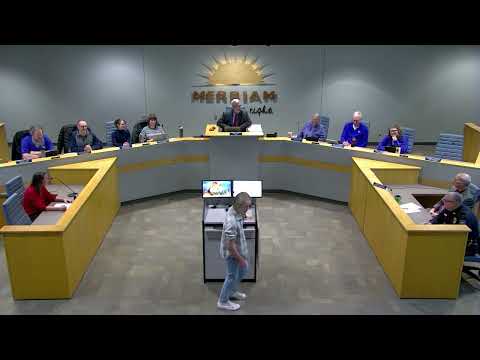
Merriam council approves ordinance allowing accessory dwelling units in single-family zones
Summary
The Merriam City Council unanimously approved an ordinance to permit accessory dwelling units (ADUs) in single-family zoning districts, adding owner-occupancy and impervious-surface limits and allowing detached and attached units.
The Merriam City Council on Tuesday voted 7-0 to adopt an ordinance amending city code to allow accessory dwelling units, or ADUs, in single-family zoning districts.
The ordinance, presented by Brian Dyer, community development director, authorizes both attached and detached ADUs on the same lot as a principal single-family dwelling and requires the property owner to occupy either the principal or accessory unit. "Accessory dwelling unit is a unit that is secondary to the principal unit of single family home and located on the same lot as a single family home," Dyer said during his presentation.
The council and staff said the ordinance includes several limits intended to preserve neighborhood character and reduce stormwater impacts. New detached ADUs must have separate utility connections; combined principal-and-ADU development may not exceed 75% impervious surface coverage; existing driveways may count toward ADU parking so that an additional driveway will not automatically be required; and the ADU must be on the same parcel as the principal dwelling. The ordinance places the new ADU rules in Chapter 74, Article 8 (accessory structures) of the Merriam code.
The council and planning commission discussed how short-term rentals (STRs) would be handled. Dyer said ADUs may operate as STRs only after obtaining the city's landlord license and STR license and that such rentals would be subject to the ordinance's standard STR buffer requirement: "For an STR, it would also have to ... apply for an STR license ... it would be subject to the thousand foot buffer," Dyer said. Councilmember O'Hara asked whether studio units fit the required sleeping-area language; Dyer said staff and the planning commission concluded studios are compatible with the adopted language.
The measure followed a planning commission process: staff presented ADU options in September, the commission was instructed to draft an ordinance, held a public hearing Dec. 4 and unanimously recommended approval. Councilmember Sanders moved to concur with the commission and approve the ordinance; the motion was seconded and carried 7-0.
Why it matters: the ordinance creates a local path for small accessory housing units that can increase housing options while imposing owner-occupancy and physical limits the city says will protect single-family neighborhood character. The council did not adopt additional local restrictions on STRs beyond existing licensing and buffer rules.
What happens next: the ordinance is adopted as written; implementation will depend on building permits, utility provider coordination for separate services on detached ADUs and enforcement of landlord/STR licensing when applicable.