Get Full Government Meeting Transcripts, Videos, & Alerts Forever!
Get email alerts on the Sanitation History Waste Management topic
No spam. Unsubscribe anytime.
‘Trash talk’: Franklin County history presentation traces Ottawa’s 19th–20th century sanitation challenges
Summary
A historical presentation at the Jan. 29 city meeting recounted Ottawa’s early water and waste systems, outbreaks linked to Skunk Run, improvised dump sites, and the evolution to a sanitary landfill and county transfer station.
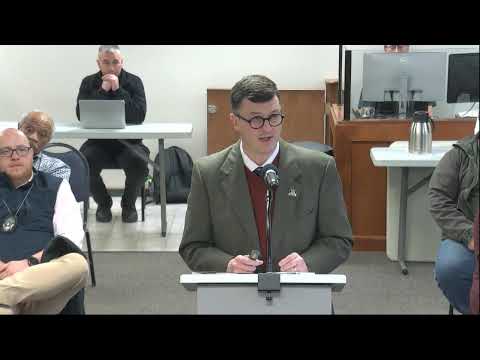
At the Jan. 29 Ottawa City Commission meeting, a presenter gave a detailed history of the city’s water supply and waste-disposal practices from the late 19th century through the mid-20th century, highlighting public-health risks and the political resistance to paid trash services.
The presenter described the 1884 Sanborn map showing wells and outhouses across the city before centralized water and sewer systems. She noted discoveries such as a nearly complete mastodon skeleton found in the 800 block of Main Street and said that, before municipal services, residents relied on private wells and outhouses. By 1888, the presenter said, the city began installing water and sewer lines; however, attachment to those systems was not mandatory and outhouses remained common through World War I.
The presentation tied poor sanitation to disease: the presenter said that in 1910 nearly a quarter of typhoid cases in Franklin County were linked to Skunk Run. She outlined a sequence of makeshift dumps — at Pontiac and Cherry Streets and other riverbanks — and described repeated public complaints. A municipal dump that grew beyond its intended acreage, spontaneous dumps on private land, and the city’s difficulty establishing regulated disposal were chronic problems into the early 1900s.
The city considered an incinerator and later experimented with contracted private collectors. The presenter said an April 1912 citywide cleanup marked an early organized effort to remove refuse; later, an old quarry at North Cedar and Logan Streets was filled and converted into park and residential space. She also recounted mid-20th-century debates over a sanitary landfill, noting a 1956 ballot measure that rejected a city-provided trash service because many residents did not want to pay for the system.
The presenter concluded by connecting history to present-day concerns, saying county-level disposal and recycling efforts, conservation work and recent recycling access had improved outcomes but that questions about trash and roadway dumping still appear on county agendas.
The presentation accompanied a Kansas Day proclamation and was described by one speaker at the meeting as “trash talk.”