Get Full Government Meeting Transcripts, Videos, & Alerts Forever!
Get email alerts on the Mha Evaluation topic
No spam. Unsubscribe anytime.
Seattle briefing: MHA’s role and an outside evaluation — consultants urge fee recalibration, faster timing of payments
Summary
City planning staff, the mayor’s office and outside consultants briefed the Select Committee March 29 on Mandatory Housing Affordability (MHA), how it would apply under the 1 Seattle plan and findings from a five‑year evaluation.
City planning staff, the mayor’s office and outside consultants briefed the Select Committee on the Comprehensive Plan March 29 on Mandatory Housing Affordability (MHA), how the program would be applied under the proposed 1 Seattle comprehensive plan, and an independent five‑year evaluation of MHA outcomes.
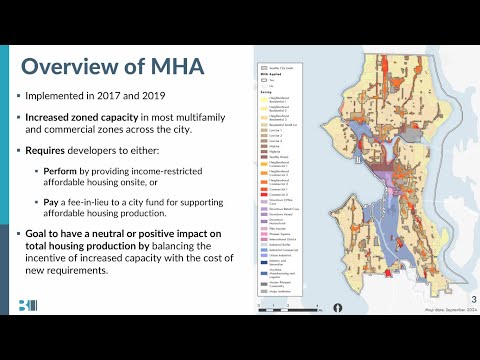
“Mandatory housing affordability” is a city program that requires new development in many multifamily and commercial zones either to include affordable units or to pay an in‑lieu fee that the city uses to fund affordable housing, Jeff Wendland of the Office of Planning and Community Development told the committee. Under current practice, MHA is added when an up‑zone expands development capacity; higher up‑zones generally carry larger MHA requirements.
The executive recommended retaining MHA where the proposed plan creates neighborhood centers, expanded urban and regional centers and frequent‑transit corridors — a change staff said would increase the acreage subject to MHA by about 21 percent — but not applying MHA across the broader neighborhood residential (formerly single‑family) zones. Staff told the committee the rationale for that exception includes two points: first, HB 11‑10 already allows a built‑in density bonus for middle housing in NR zones (for example, up to six units on some lots when at least two are affordable), and second, the city’s consultant work suggests many small parcels in the NR proposal are unlikely to be economically feasible for middle‑housing construction with an additional MHA requirement.
Staff cited an Eco Northwest analysis estimating roughly 19 percent of parcels in the proposed NR areas would be feasible candidates for redevelopment under the middle‑housing rules. The executive argued that adding a relatively large inclusionary requirement to small‑scale projects could make middle‑housing infeasible and slow the production of the new housing types the state law aims to encourage.
Burke Consulting and Hartland Consulting presented the independent five‑year MHA evaluation. Kevin Ramsey of Burke said a central test for the program has been whether MHA could generate affordable housing revenue without reducing overall market‑rate housing production. The consultants found the program produced significant affordable housing funding and that payment revenues and city leveraging helped produce thousands of affordable units over the program’s first five years, but they also reported that market conditions have changed materially since fee levels were set.
Consultants summarized key findings: development economics that prevailed in 2019 have shifted. Rising construction costs, state and local code changes, post‑pandemic supply‑chain impacts, and higher interest rates have combined so that, for a “typical” mid‑rise project modeled in their analysis, a project that penciled in 2019 would often not meet feasibility thresholds in 2024 even without MHA. Consultants showed modeled examples in which the internal‑rate‑of‑return thresholds developers typically require (the consultants used a typical 15–20 percent return target) moved many projects below feasibility between 2019 and 2024.
The report also reviewed how developers comply with MHA: roughly 95 percent of projects subject to MHA have chosen the in‑lieu payment rather than building on‑site affordable units; the projects that did perform on‑site typically served lower‑income households (60 percent area‑median income) and required long affordability covenants. The Office of Housing and other city funds then combine MHA proceeds with other revenue to finance affordable buildings; consultants and staff said, combined with other sources, MHA‑leveraged funds helped produce about 4,700 affordable units from the program’s inception through the latest reporting period (consultants noted those units are produced with multiple funding sources, not MHA alone).
Given the changed market, Burke and Hartland recommended a menu of adjustments to keep MHA producing affordable housing while avoiding unintended reductions in housing production. Key recommendations presented to the committee included:
• Recalibrate fees on a recurring basis: replace a simple inflation index with periodic feasibility studies that test how fee levels affect prevailing product types and market conditions in different areas of the city. Consultants said the average MHA fee in citywide modeling rose from roughly $22 per built square foot in 2019 to about $28 per built square foot in 2024 (the precise fee varies by zone and market‑strength area).
• Adjust the timing of payments: consider moving some fee obligations closer to project financing milestones (for example, permit issuance or certificate of occupancy) so developers do not need to front large sums before construction financing or equity is in place. Consultants described cases where projects faced multi‑million‑dollar payment obligations well before financing closed.
• Streamline permitting and design review for MHA‑subject projects: shorten review timelines and reduce uncertainty that increase carrying costs and financing risk, particularly for small developers.
• Encourage performance and lower administrative barriers: explore options so that on‑site affordable units are a more attractive and feasible option (for example, allowing performance units to count toward other incentives such as multifamily tax exemptions in some cases, or reducing administrative burdens for small developers).
Committee members asked many clarifying questions about the consultants’ assumptions, whether other cities tie exemptions to unit thresholds, and the degree to which MHA revenues would continue to be a significant share of affordable‑housing funding as other city sources (for example, the levy and JumpStart payroll expense tax) rise. Staff acknowledged MHA revenues are one of many funding sources and that projections show other sources increasing; they also emphasized the program is only productive when market‑rate housing is being built.
Several council members and the executive said they remain committed to MHA as a tool but want to ensure it is calibrated to evolving market conditions. Staff said they will continue to work with council on potential code and administrative changes, on the interim implementation of HB 11‑10, and on measures to reduce barriers for middle‑housing production while preserving affordable‑housing funding.