Get Full Government Meeting Transcripts, Videos, & Alerts Forever!
Get email alerts on the Transportation Atv Green Dot topic
No spam. Unsubscribe anytime.
Bill would allow state agencies and cities to access multiuse roadway safety funds for green‑dot road upkeep
Summary
House Bill 1537 would let WSDOT transfer multiuse roadway safety account funds to the Department of Natural Resources and Fish and Wildlife for maintenance, signage and education on ‘green dot’ roads used for motorized recreation, subject to county support and a retained MRSA minimum for local grants.
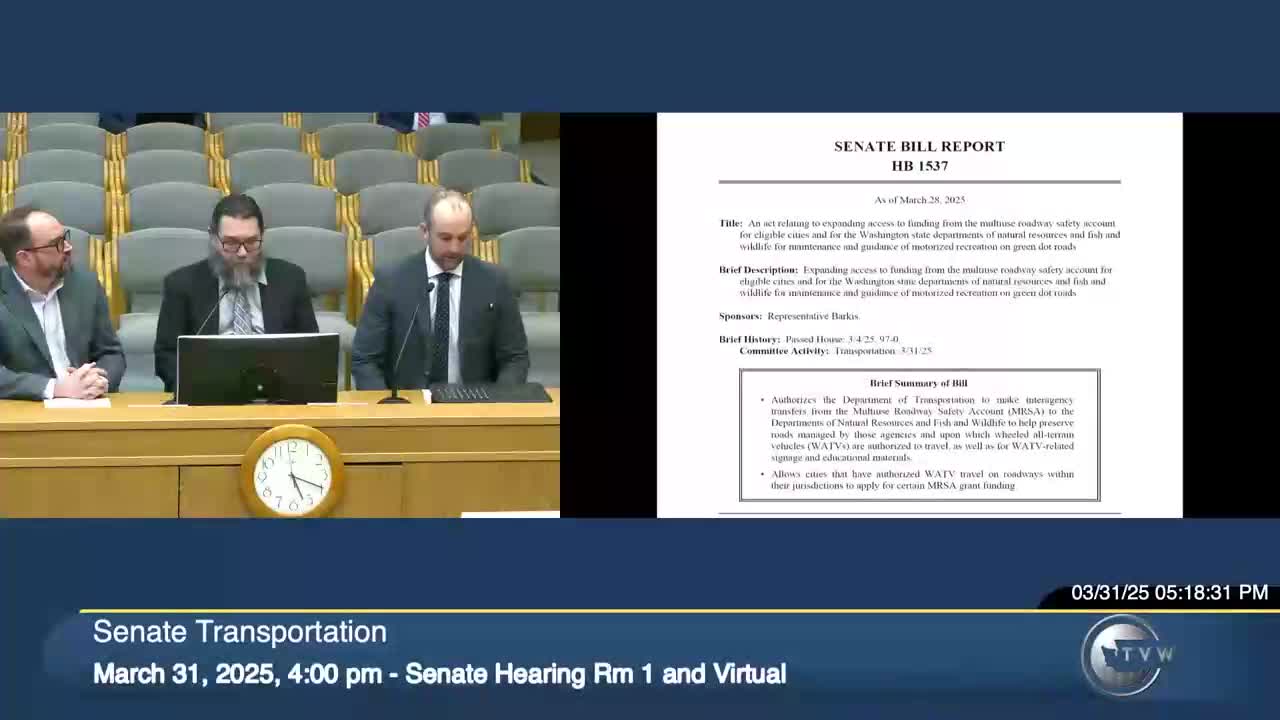
The Senate Transportation Committee heard House Bill 1537 on March 31, a bill to expand eligible recipients of the multiuse roadway safety account (MRSA) to include the Department of Natural Resources (DNR), the Department of Fish and Wildlife (DFW) and certain cities. Committee staff said MRSA is funded by an annual wheeled‑ATV registration fee and currently funds WSDOT grants for county roadway safety analyses, signage, and enforcement related to wheeled ATVs.
Brody Coval, Recreation Policy Manager at DNR, and Joel Sisolak, lands planning and recreation section manager at DFW, testified in support. They said the so‑called green‑dot system — a set of roads in Chelan, Yakima and Kittitas counties marked with green reflectors that provide access for camping, hunting and wheeled ATV travel — comprises more than 800 miles of routes that currently lack stable maintenance funding. The bill would authorize WSDOT to transfer MRSA funds during the second year of each biennium to DNR or DFW for mitigation of impacts, signage and educational mapping, but only after the relevant county submits a letter of support. WSDOT must retain a minimum of $80,000 in MRSA for grants to eligible local governments. The bill also expands eligible local governments to include cities or towns that have approved operation of wheeled ATVs on their roadways.
Ted Jackson of the Washington ATV Association and local recreation representatives urged passage, saying modest MRSA transfers could materially improve maintenance, user safety and emergency access. WSDOT staff estimated minimal administrative costs to manage the interagency transfers. Committee members did not pose substantive questions during the public hearing and no formal action occurred.