Get Full Government Meeting Transcripts, Videos, & Alerts Forever!
Get email alerts on the Producer Responsibility Packaging topic
No spam. Unsubscribe anytime.
Committee advances producer-responsibility packaging bill with clarifying amendments
Summary
The committee voted 11-10 to report out substitute Senate Bill 5,284 after adopting a striking amendment that clarifies metrics, auditing standards and program responsibilities for producer responsibility organizations (PROs). Members debated costs, needs assessments and equity concerns.
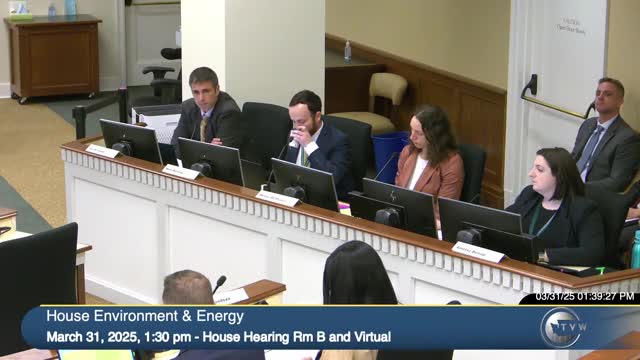
On March 20, 2025 the House Environment & Energy Committee voted to report out substitute Senate Bill 5,284, 11-10, after adopting striking amendment H2026.2 and debating program scope, costs and data requirements.
The striker H2026.2 made logistical and definitional changes to the underlying producer-responsibility framework. Key changes include: if the federal metric used to identify socially vulnerable populations becomes unavailable, the Department of Health environmental health disparities map will serve as the fallback until Ecology adopts a rule specifying an alternative; Ecology may, by rule, update the auditing standard referenced in the statute (the striker allows Ecology to reference versions newer than the 2015 standard); the striker clarifies that a PRO will make a separate one-time payment in lieu of the annual registration fee beginning in 2027; it shifts responsibility for posting a list of noncompliant producers from the PRO to the Department of Ecology; and it expands the scope of an independent audit of the first seven years of program implementation to include reuse rates, post-consumer recycled content and source-reduction rates in addition to recycling and composting rates.
Sponsor remarks emphasized existing recycling shortfalls and equity goals. Representative Barry said state recycling is struggling and that "only 39% of residential recyclable materials are actually being recycled," and argued the bill will "hold companies that are creating these materials responsible for managing their waste" and expand recycling services and equity.
Several members voiced cost and implementation concerns. Representative Dye and others warned the fees charged to producers could raise household grocery costs by an estimated range cited during debate; Dye and Representative Fey urged a cautious approach and a robust needs assessment before deeper delegation of program design to Ecology and PROs. Representative Fey said she supports holding producers responsible "but only after we, the legislature, have all the information to design a program that will achieve results for reasonable cost to our constituents."
The committee adopted the striking amendment and then voted to report the substitute bill out of committee with a due-pass as amended recommendation; staff announced the vote totals as 11 ayes and 10 nays. The bill includes a preliminary needs assessment due by the end of 2026 and a fuller needs assessment by the end of 2027, with periodic updates once the program begins implementation.
Committee discussion also noted auditing, enforcement and transparency provisions and gave Ecology rulemaking authority to clarify certain program standards and future updates.