Get Full Government Meeting Transcripts, Videos, & Alerts Forever!
Get email alerts on the Environmental Crimes topic
No spam. Unsubscribe anytime.
Committee advances environmental-crimes bill after extensive amendment debate
Summary
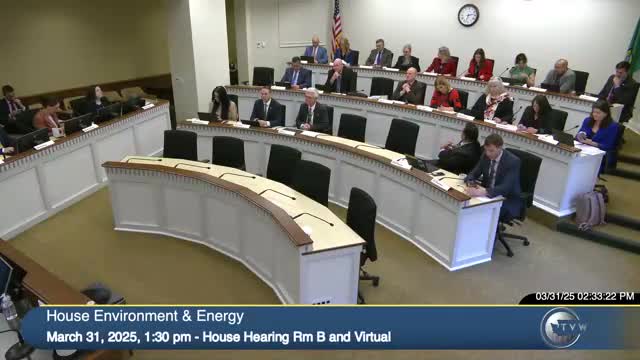
The House Environment & Energy Committee voted to report out engrossed substitute Senate Bill 5,360, which creates new criminal penalties for certain violations of state environmental laws, after adopting a striking amendment and rejecting numerous member amendments aimed at narrowing or clarifying the measure.
On March 20, 2025, the Washington State House Environment & Energy Committee voted to report out engrossed substitute Senate Bill 5,360 by a voice and roll-call vote, 11-10, after adopting striking amendment H2028.2 and debating more than a dozen member amendments.
The striking amendment H2028.2 narrows some potential criminal exposure and adds several provisions: it excepts permit-compliant conduct (including required reporting or corrective actions) from criminal liability under the Water Pollution Control Act, the state Clean Air Act and the Hazardous Waste Management Act; it creates an exception to Clean Air Act criminal penalties for odors or fugitive dust from agricultural activities consistent with good agricultural practices; it excepts outdoor burning done under valid state or local permits; it clarifies that negligent violations must be criminally negligent to be felonies; it requires the Department of Ecology to prepare and publish information about criminal penalty provisions and to provide that information when issuing permits; it removes the bill's prior definition of “entity”; and it adds a severability and an intent section.
Committee members described sharply different views of the bill. Representative Mena, the bill sponsor, said the measure "enhances the tools we already have in the state of Washington" and will "increase accountability for violators," adding that the bill addresses conduct that already can be illegal under state or federal law. Representative Barnard and others pressed for additional procedural protections for permit holders; Barnard urged training and said employers and employees who work under permits "need some training" so they understand what is expected. Representative Abel proposed language intended to preserve the presumption of innocence and to limit prejudicial pretrial publicity; that amendment failed. Representative Dye repeatedly objected that the bill is "imbalanced," arguing that state agencies’ delays and failures to meet permitting and assessment duties also produce environmental harm and that the bill should include more accountability for those agency failures; Dye’s attempts to add such provisions were also not adopted.
The committee considered at least a dozen stand-alone member amendments (STIR 114, 116, 117, 108, 109, 110, 111, 112, 115, 118 and others). Most were moved and debated on the floor of the committee and were not adopted. Examples: - STIR 114 (Rep. Barnard) would have required free state-provided environmental-crime training for permittees before felony charges could be brought; failed. - STIR 116 (Rep. Abel) would have codified that nothing in the criminal provisions should be construed to undermine the presumption of innocence or allow pretrial publicity by Ecology or the Attorney General; failed. - STIR 117 (Rep. Dye) would have required Ecology to certify compliance with federal requirements before charges under the Water Pollution Control Act or state Clean Air Act could be brought; failed. - STIR 108 (Rep. Barnard) would have made certain Ecology failures to meet permit review timelines a criminal violation; failed. - STIR 115 (Rep. Barno) sought a caseload/fiscal forecast from the Attorney General and Ecology and a null-and-void clause if appropriation was not provided; failed. (Each of the STIR amendments listed above was moved and then defeated in committee.)
Several members expressed concern about the bill’s scope and fiscal effects. Representative Barno warned repeatedly that the measure, as drafted, could expose small workers and contractors who operate under permits to criminal prosecution and noted the committee did not have a comprehensive fiscal estimate for prosecution, incarceration and administrative work tied to the bill. Barno also noted the striking amendment removed the statutory "entity" definition, which she said left uncertainty about who might face felony charges.
After adoption of the striking amendment, Vice Chair Hunt moved the final motion that the engrossed substitute be reported out of committee with a due-pass recommendation; the motion carried on a roll call of 11 ayes and 10 nays. The committee clerk announced the result and the measure will proceed in the legislative process.
The committee record shows sustained debate about balancing stronger enforcement tools with safeguards for permit-holders and about whether state agencies should face parallel accountability for delays in permitting, assessments and other duties.
The committee hearing included extended conversations about procedural protections, training, whether "knowing" or "criminally negligent" standards apply, and how Ecology and the Attorney General's Office would implement and resource any new investigative or prosecutorial duties. Multiple members urged narrower, more specific statutory language; sponsors and proponents argued the bill is intended to target serious, knowing harm to people and environment.
The committee did not adopt amendments that would have added criminal accountability for agency failures or local land-use decisions, and it did not adopt several amendments designed to restrict prosecutorial coordination or to require federal or local prosecutorial signoff before the Attorney General could proceed.