Get Full Government Meeting Transcripts, Videos, & Alerts Forever!
Get email alerts on the Education — Parental Rights And Student Records topic
No spam. Unsubscribe anytime.
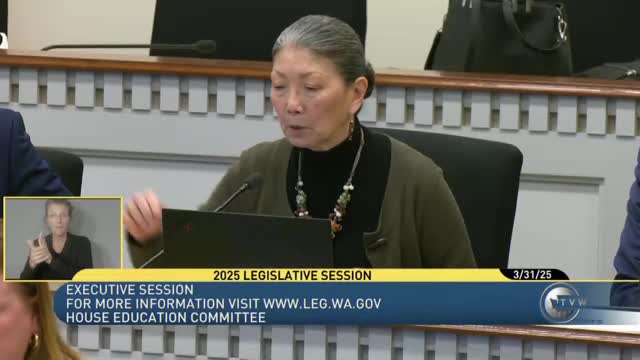
Committee reports parents‑rights bill after extended debate over student records, notifications and health services
Summary
The House Education Committee reported Engrossed Substitute Senate Bill 5,181 out of committee with a due‑pass as amended recommendation, 11‑8.
The House Education Committee reported Engrossed Substitute Senate Bill 5,181 out of committee with a due‑pass as amended recommendation, 11‑8.
Committee staff briefed the bill at the start of the session. "At a very high level, engrossed, substitute Senate Bill 5,181 makes changes to the delineated rights of parents and legal guardians of public school children, including specifying additional rights and removing rights related to notification requirements for medical services and treatments," committee staff member Ethan told the committee. He also noted the bill specifies that the delineated rights do not create a private right of action.
Members considered multiple amendments on records access, health and mental‑health records, notification for medical services, immediate notification for alleged criminal actions against children on school property, charter‑school enrollment requests, and a technical correction to a federal citation. Several amendment votes failed; others were adopted. Key votes and provisions adopted or considered include:
- An amendment (MOET 4 59) requiring immediate notification of parents or legal guardians if a criminal action is alleged to have been committed against their child on school property or during a school sponsored activity, and related amendments that add enforcement language. That amendment was adopted after debate.
- An amendment permitting parents and legal guardians the right to request enrollment in a charter school (H2086.1); that amendment was adopted.
- A technical correction to the citation to Title VI of the Federal Civil Rights Act of 1964 (MOET 4 55) was adopted.
House members debated how the bill would interact with existing federal and state law, including FERPA and HIPAA, and with the state's existing parental‑rights initiative. Several members said federal statutes and case law limit the committee's ability to redefine which records are classified as medical versus educational. Representative Marshall, who proposed an amendment to treat medical and mental‑health records for children 12 and under as education records for the purposes of disclosure, said: "If it is happening, parents should have a right to it, and they should have access to it." The amendment failed on a voice/standing vote after legal and procedural objections.
Representative Keaton argued for restoring prior notification rights for children 12 and under and said, "These kids need their parents. All kids need their parents. Vote yes." Opponents, including Representative Ortiz Self and others, said schools generally do not provide medical services, that many services on campus are provided by contracted health providers who operate under health‑care law, and that a hard 10‑business‑day deadline for record production would conflict with federal practice allowing up to 45 days for reasonable response.
After debate and a roll call, the clerk announced a final committee tally of 11 ayes and 8 nays and reported the bill out of committee with a due‑pass as amended recommendation.
Votes at a glance: the final standing committee report recorded 11 ayes and 8 nays on the due‑pass as amended recommendation.
The bill contains numerous amendments and policy choices that members said will require further rule clarifications and possible cross‑committee work on health‑care topics. If enacted, the bill's interactions with federal statutes and existing health‑care privacy law were identified repeatedly during debate as points that could require legal review or administrative guidance.