Get Full Government Meeting Transcripts, Videos, & Alerts Forever!
Get email alerts on the Wildfire Resiliency topic
No spam. Unsubscribe anytime.
Conservation districts urge sustained funding for forest health as federal support stalls
Summary
The Washington State Conservation Commission told the Senate Agriculture and Natural Resources Committee that locally based conservation districts are central to forest health and wildfire resiliency work and warned that state and federal funding uncertainties put that work at risk.
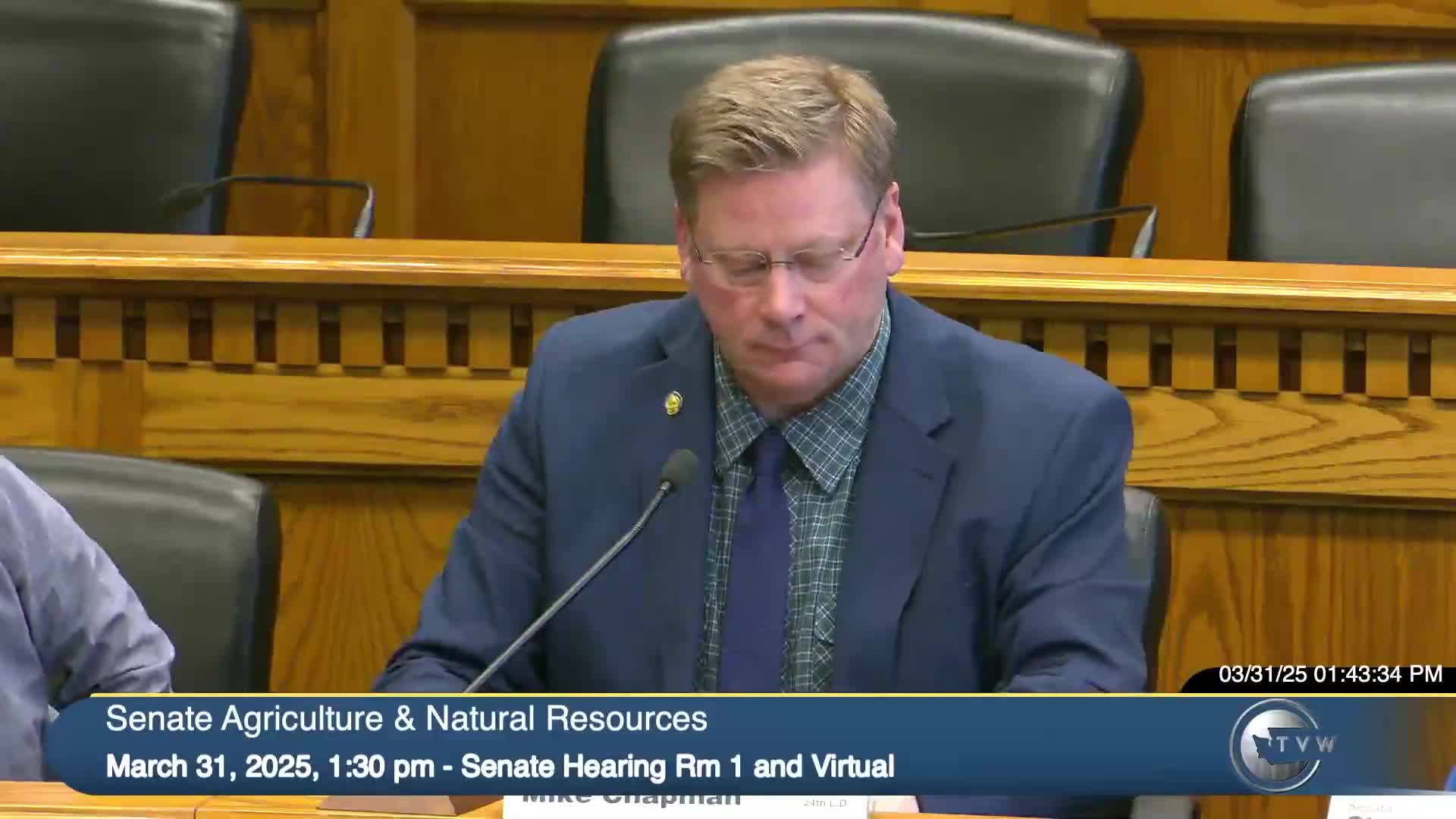
Danny Madrone, legislative director of the Washington State Conservation Commission, told the Washington State Senate Agriculture and Natural Resource Committee that conservation districts provide the local capacity needed for forest health treatments and neighborhood-scale wildfire planning. He said the commission’s Forest Health and Wildfire Resiliency Program funded by the Legislature in the last biennium moved quickly: $15,000,000 was allocated and spent within six months to support roughly 42 full‑time equivalent positions working in communities across the state.
The commission argues that conservation districts are uniquely positioned to reach private landowners and neighborhoods because they are nonregulatory local governments that can build trust and deliver voluntary conservation, Madrone said. “Forest health and wildfire resiliency are core parts of our strategic priorities,” he said, describing district work that ranges from fuels reduction and prescribed‑burn training to neighborhood risk assessments and home hardening cost share.
Why it matters: districts serve as local implementers for statewide wildfire resilience strategies. The commission told the committee that without stable, dedicated funding districts struggle to keep staff and sustain multi‑year projects.
Details and examples: Madrone highlighted projects across the state: San Juan Island and Underwood Conservation Districts partnered with the Department of Natural Resources and local fire districts on a wildfire‑ready neighborhoods program; Cascadia Conservation District supported prescribed‑burn trainings; Pine Creek Conservation District used goats for fuel reduction around Malden after the 2020 Bab Road Fire; Skagit and Whatcom districts demonstrated biochar kilns and considered a kiln loan program for landowners; at least 14 districts have helped develop community wildfire protection plans.
Budget and funding risks: the commission said the newly created Forest Health and Wildfire Resiliency Program received $15,000,000 in the previous biennium and that funding supported about 42 FTEs. Districts estimate that maintaining current capacity in the next biennium would require $14,000,000. For the current budget cycle the commission requested $5,000,000 ongoing plus an additional $5,000,000; Madrone said districts have told the commission those amounts are insufficient. He also warned that the Department of Natural Resources’ wildfire accounts are facing reduced funding.
Federal funding uncertainty: Madrone raised concerns about federal program interruptions. He said federal layoffs and administrative pauses affected the U.S. Department of Agriculture’s Natural Resources Conservation Service (NRCS), slowing contract processing and reimbursing work. He said Inflation Reduction Act funding that underwrote some NRCS programs had been frozen, leaving $90,000,000 in wildfire funding for Washington in limbo and pausing new contracts under programs such as EQIP. Madrone said existing contracts are being honored but new awards are paused, and some NRCS agreements tied to climate, climate justice, or DEI language are under review or on hold.
Committee response and next steps: committee members did not take formal action during the work session. Madrone asked for continued support in the operating budget and warned that reduced funding at state and federal levels could weaken local preparedness heading into wildfire season.
Ending: the commission emphasized the local role of conservation districts and urged stable, predictable funding so districts can continue on‑the‑ground work that district staff and community partners say has accelerated in recent years.