Get Full Government Meeting Transcripts, Videos, & Alerts Forever!
Get email alerts on the Floodplain Management topic
No spam. Unsubscribe anytime.
Okanogan County planning commission forwards redlined floodplain-management update to commissioners
Summary
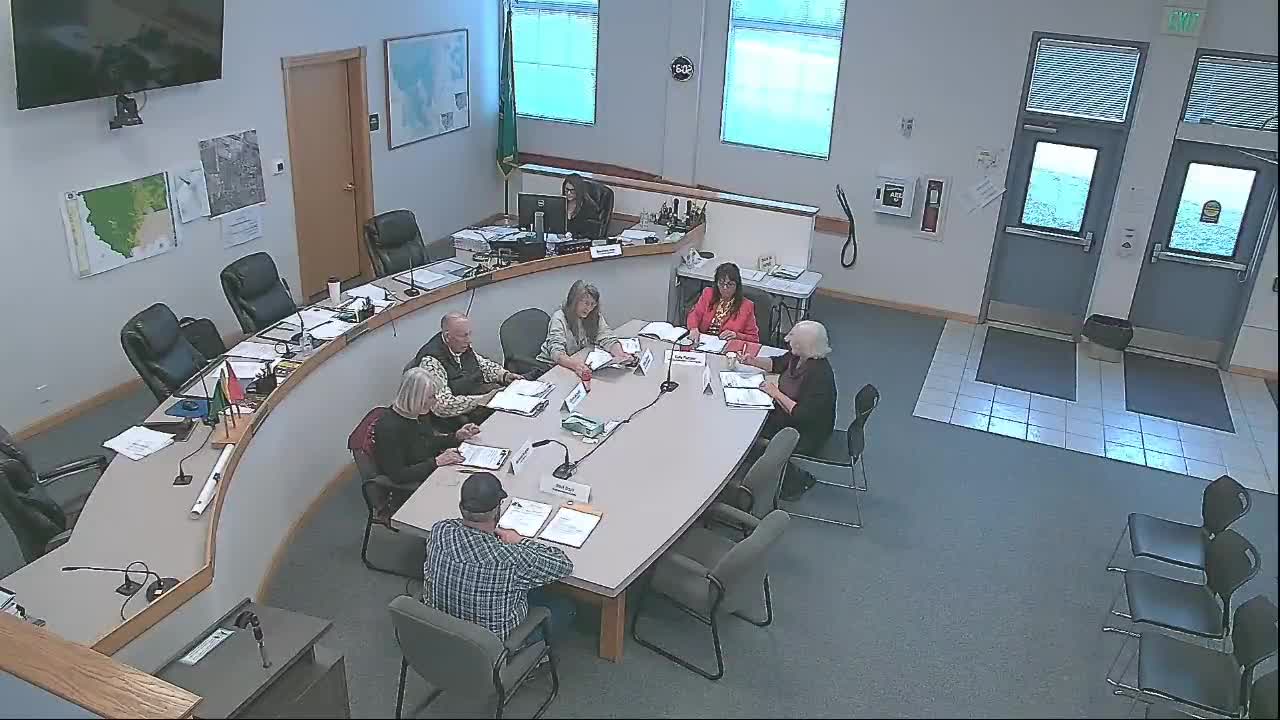
The Okanogan County Planning Commission voted to forward a redlined update of the county's floodplain-management code to the Board of County Commissioners after a work session that included public comment and staff explanation.
The Okanogan County Planning Commission voted to forward a redlined update of the county's floodplain-management code to the Board of County Commissioners after a work session that included public comment and staff explanation.
The change package consolidates state-mandated provisions and references to Federal Emergency Management Agency (FEMA) flood maps, adds record-keeping language and technical standards for anchoring manufactured homes and equipment, and amends enforcement language to emphasize compliance measures. Planning staff and commission members described the update as largely codifying statutory requirements the county already follows.
Why it matters: Planning staff said the update is part of work required by state agencies and FEMA and is intended to remove Okanogan County from a community-assistance status that had required additional review and corrective actions. The update will also trigger public-notice steps: staff said the package will go to the commissioners, then to a public-comment period and a SEPA (State Environmental Policy Act) checklist as required for code and map changes.
Public comment and local examples Resident Dave provided the primary public comment during the meeting, recounting multiple local flood events and unauthorized construction in flood-prone areas. He told the commission, "Thank you, and thank you, planning commission members, for listening to what I have to say," and described houses and infrastructure that had been undermined or placed in active river channels after storms.
Staff explanation and key technical points Planning staff and the commission discussed several technical elements that changed in the redline draft: - FEMA maps and notification: the draft explicitly requires notifying FEMA when annexations occur in special flood-hazard areas and when technical changes to base flood elevations are available. Staff told the commission that the county already reports such changes and that FEMA will reflect jurisdictional changes on its maps when they are processed. - Record keeping: the draft replaces some language requiring the county to "record" technical elevation information with language to "obtain and maintain" actual elevation records (lowest floor elevation relative to mean sea level) for new and substantially improved structures. Staff and commissioners clarified during the meeting that the change is intended to require permanent documentation for public inspection rather than to impose immediate physical work on existing buildings. - Anchoring and equipment: the redline adds explicit requirements for anchoring manufactured homes and for elevating or floodproofing machinery and equipment that service structures (generators, lift motors, marina machinery). A staff explanation noted these meet existing state standards for utilities and mechanical equipment in flood-prone areas. - Enforcement and compliance: staff described a policy direction away from criminal enforcement for many land-use violations. The planning office said it is drafting a compliance chapter to provide civil-infractions, written mitigation agreements, timelines and fines as alternatives to prosecution. As staff put it, the goal is to "keep it out of the prosecutors, to keep it out of jail, to keep it out of the courts" and to use written agreements to address violations.
Staff and commission context Planning staff said the county code had not been comprehensively updated since 2006 and that many redline insertions reflect statutory changes at the state level and technical updates from FEMA. Rocky, planning department staff, summarized permitting practice: "Anybody that's building in the flood plain or in a critical area, probably 98% of them hire a consultant to carry them through that process because it isn't a process that the layperson is ever gonna understand." Rocky and other staff said the department provides permit packets and one-on-one guidance for complex permits.
Action taken Commissioner Sally moved to accept the redlined floodplain-management document and forward it to the Board of County Commissioners; John seconded the motion. The commission recorded a vote of three in favor, one opposed and one abstention; the motion carried and the draft will be transmitted to the commissioners with meeting minutes and staff notes. Commissioners will schedule workshops and a public hearing as part of the ordinance-adoption process.
Concerns and next steps One commission member opposed the transmittal because they said they had not received the draft materials in advance; other members asked staff to send a memorandum summarizing written comments that will accompany the draft when it goes to the commissioners. Staff said the package will include the redline, a SEPA checklist, proposed code language and a list of suggested clarifications (including an acronym list requested by several members). After the commissioners hold hearings and consider revisions, the final ordinance would return to the county for adoption under the normal public-notice process.