Get Full Government Meeting Transcripts, Videos, & Alerts Forever!
Get email alerts on the Communicable Diseases topic
No spam. Unsubscribe anytime.
Clallam County annual report: STI and pertussis increases, ongoing rabies guidance and surveillance priorities
Summary
Public-health staff presented the department annual report covering rising syphilis and HIV cases, pertussis clusters tied to school-age transmission, ongoing rabies (bat) messaging and surveillance resource constraints affecting rapid testing and response.
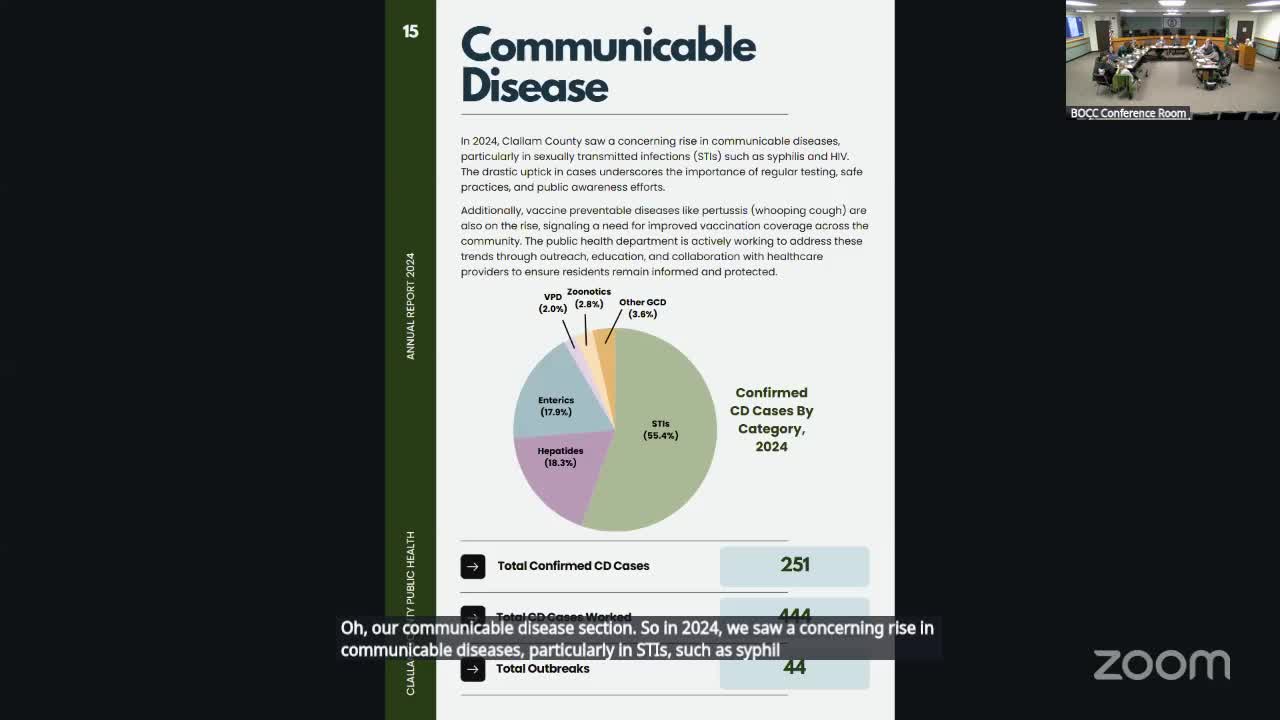
County epidemiology and communicable-disease staff summarized the department’s 2024 annual report and surveillance priorities to the Board of Health on March 8.
Manny Majdi, the county epidemiologist, told the board that Clallam County recorded increases in syphilis and HIV in 2024. He said the county saw four total HIV cases in 2024 — up from zero in 2022 — and a “pretty significant” increase in syphilis mirroring statewide trends. Majdi said syphilis increases are primarily associated with drug-related transmission in the region, and noted that greater screening and clinic engagement may also explain increases in some other sexually transmitted infections.
The report included a dedicated review of pertussis. Staff described a statewide and local rise in pertussis cases in 2024, including school clusters. Majdi said schools and school nurses have remained an effective reporting and outreach pipeline established during the pandemic; the county provides letters and guidance to schools when cases are identified and coordinates immunization outreach.
The annual report also covered rabies risk from bats. Majdi and HHS staff said bats remain the primary rabies vector in the state; in 2024 one bat in the county tested positive and public outreach emphasized avoiding direct contact with bats, reporting exposures quickly and seeking medical advice because post-exposure prophylaxis is expensive and time-sensitive. Staff noted common scenarios of concern: bats found in sleeping areas, bats that exhibit daytime activity, or any unexplained contact with a bat — scenarios that can trigger rapid public-health action.
Staff discussed surveillance limitations. Rapid respiratory multiplex tests previously supported quicker outbreak response; staff said recent cuts in state funding have reduced access to those tests, delaying some outbreak confirmation and response. Staff also described lead-testing access, WIC service and maternal-child staffing challenges: WIC appointments were backlogged with a three-month wait for food benefits in some cases and program staffing limits constrained outreach and clinical work.
Ending: The board accepted the annual report and asked staff to continue liaison work with schools, long-term care providers, and county communicable-disease partners; members requested the report and presentation be circulated to board members and stakeholders.