Get Full Government Meeting Transcripts, Videos, & Alerts Forever!
Get email alerts on the Respiratory Diseases topic
No spam. Unsubscribe anytime.
Clallam County health officer warns severe flu season, urges vaccination amid measles cases and avian-flu watch
Summary
Dr. Hasseberry reported higher-than-usual influenza hospitalizations including a child, described a national measles rise and ongoing avian-flu activity in animals, and said federal cuts have reduced pandemic-response coordination.
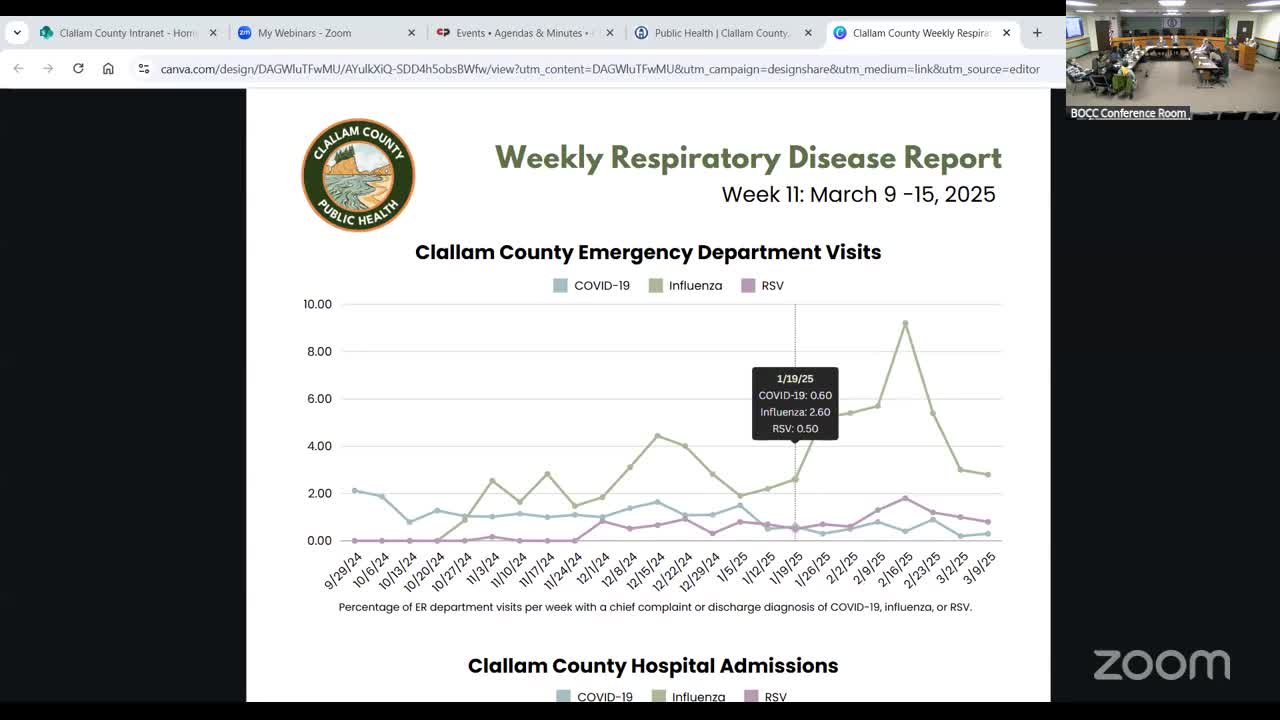
Dr. Hasseberry, the public health officer serving Clallam and Jefferson counties, told the Board of Health on March 8 that this flu season has produced more severe outcomes than typical and urged vaccination for everyone older than 6 months.
Hasseberry said the county saw a small recent spike in influenza hospitalizations and that “those are real people that got hospitalized,” adding the spike included one child and was not tied to any long-term care outbreak. She said most children hospitalized for influenza nationwide are unvaccinated and that vaccination remains the best protection: “When we see children hospitalized for influenza, near exclusively they're not vaccinated.”
The health officer reviewed national trends and possible causes. While circulating strains match last year’s, Hasseberry said scientists suspect a mutation in one strain may be contributing to more severe disease this season and that research will continue. She also reported COVID-19 and RSV levels were “relatively low, and are actually downtrending.”
On measles, Hasseberry said Washington has not seen secondary cases stemming from a recent Seattle infant case, but the U.S. has recorded more than 300 measles cases so far in 2025. She told the board that 75% of those cases are school-age and that 95% were unvaccinated or vaccination status could not be confirmed. “The measles vaccine is not associated with autism,” Hasseberry said, criticizing renewed federal study of the question and urging parents to discuss vaccination with a trusted clinician.
The county health officer also briefed the board on avian influenza. She said the state and federal picture shows ongoing wild-bird transmission and sporadic poultry and cattle outbreaks, with about 70 human infections nationally and one death at the time of the briefing. Hasseberry said there has been no confirmed sustained person-to-person transmission. She told the board federal coordination has been weakened after the Office of Pandemic Preparedness lost staff and funding, saying the office that had coordinated avian-flu response is now “down to 1 person,” which hampers national-level response coordination.
Board members asked whether research would examine interactions between prior COVID infection and worse influenza outcomes; Hasseberry said such questions are being considered but cautioned that federal research cuts may limit large-scale studies.
The health officer closed by reiterating vaccination guidance: anyone older than 6 months should get the seasonal influenza vaccine, and families uncertain about measles vaccination should consult their primary care provider or pediatrician.
Ending: The board accepted the update and moved on to other agenda items; the county continues surveillance and will share more data as it becomes available.