Get Full Government Meeting Transcripts, Videos, & Alerts Forever!
Get email alerts on the Public Safety Communications topic
No spam. Unsubscribe anytime.
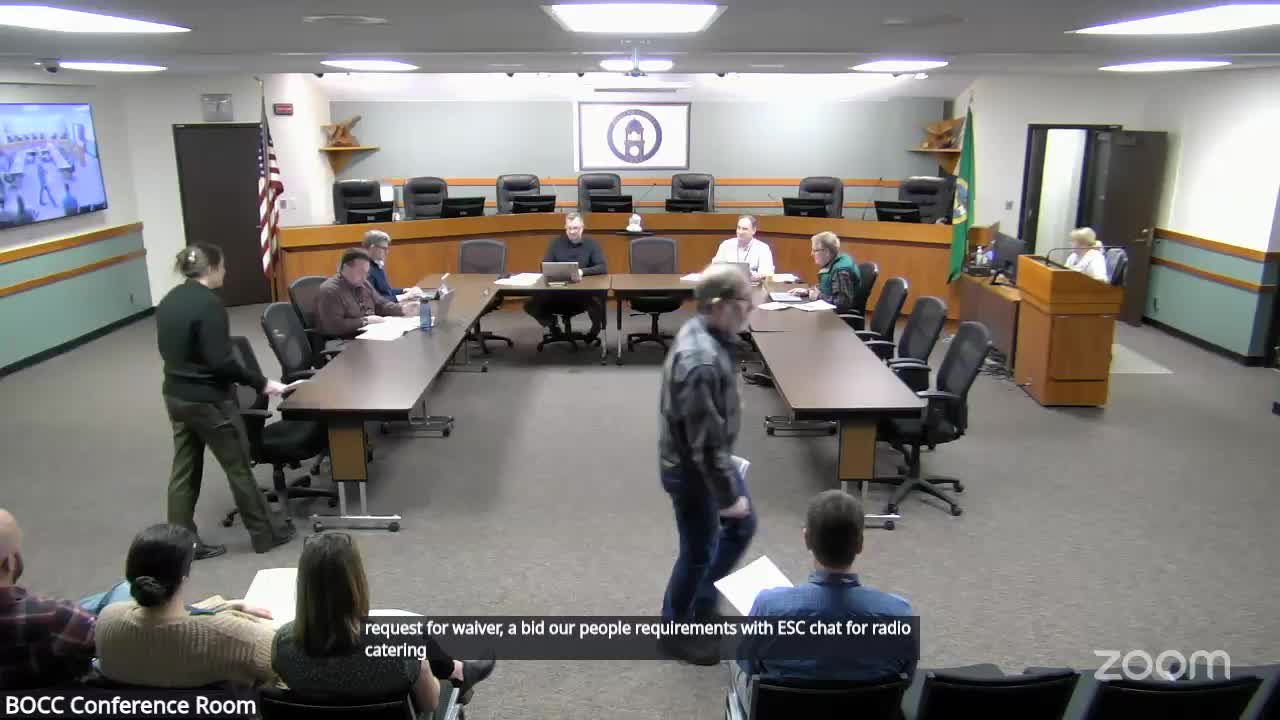
Commissioners review waiver request to add ESChat gateway modules for county radio network
Summary
Staff asked the board to waive competitive-bidding rules so the county can buy gateway modules that make ESChat cellular-based communications interoperable with the county’s radio dispatch system. Commissioners asked about policy and funding; the item was scheduled for action at the next meeting.
County radio and public-safety staff asked the Clallam County Board of Commissioners to approve a waiver of bid requirements so the county can purchase gateway modules that make ESChat cellular communications interoperable with the county’s existing radio dispatch network.
The request, presented during the administration section of the meeting, said many partner agencies now use ESChat software on cellular networks to supplement microwave and VHF radio links, especially in areas where line-of-sight radio coverage is limited — for example the roadway to Hurricane Ridge. Staff said the gateway hardware is required so voice traffic from ESChat users can interoperate with traditional radio channels.
The staff presentation said the county’s radio team would install the hardware and the vendor’s IT or the partner agency IT would configure and maintain software connections. The presenter (identified in the transcript as “Dean”) said the modules are already in wide use among neighboring agencies, and using a single vendor is the only practical way to preserve interoperability without requiring other agencies to change contracts.
Commissioners asked about two kinds of risk: policy-level concerns about multiple parallel communications paths during an emergency and the funding source for the hardware. One commissioner asked whether information sent on the ESChat stream is the same as the radio stream; staff answered, “It’s exactly the same information. You can hear this the person speaking the same,” clarifying that ESChat is not a transcription service but a real-time voice-passthrough when linked via a gateway module.
On funding, staff said the radio network is held in a stand-alone capital fund supported by user fees; the fund balance is used for replacement and maintenance and is not general fund. Commissioners discussed responsibility for site leases, staffing and the expectation that user fees and partner contributions support the purchase and upkeep. No formal motion or vote was recorded at the meeting; staff said the item would return for action at the board’s next scheduled meeting (a week later).
The board asked staff to confirm policy implications for emergency communications and to document who will be responsible for on‑call support and configuration after installation. Staff also committed to include the purchase in the capital expenditures reporting and confirm vendor exclusivity considerations with partner agencies before the vendors are engaged.