Get Full Government Meeting Transcripts, Videos, & Alerts Forever!
Get email alerts on the Opioid Settlement topic
No spam. Unsubscribe anytime.
Clallam County leaders map spending of opioid settlement funds after county reports drop in overdose deaths
Summary
County public health, tribal partners and behavioral health providers held a joint discussion on how to program opioid settlement money, reviewed local overdose data showing a year-over-year decline, and flagged gaps in children’s mental-health services, law-enforcement co-responder staffing and funding sustainability.
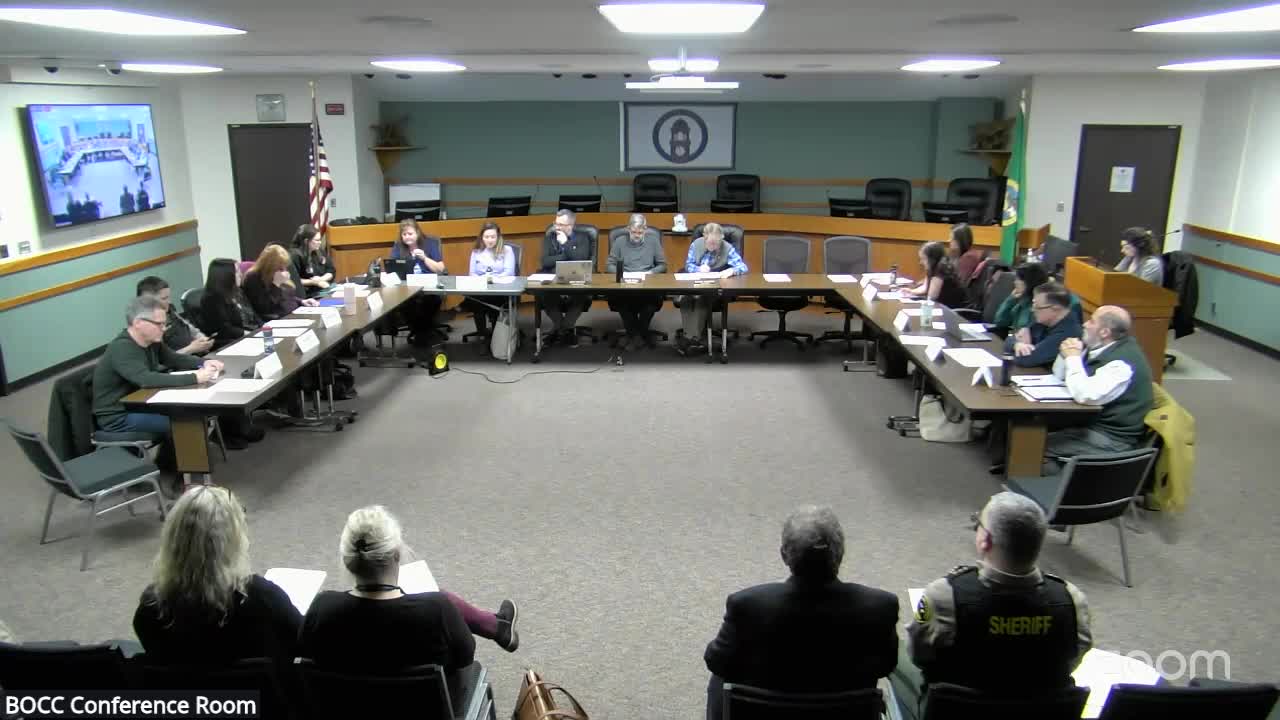
Clallam County public health officials, tribal representatives and behavioral-health partners met in a joint session to discuss how to program incoming opioid settlement funds and to review local overdose data and service gaps.
County staff outlined the allowable uses set by the One Washington memorandum of agreement (MOA) that governs settlement spending, described the county’s current and anticipated settlement payments and said most money received so far has been spent on in-county public-health and harm-reduction services. Jenny Outfield, a Clallam County health and human services staffer, said the county has obligated a fixed amount for public-health programming and that those funds currently support the county’s harm-reduction health center, staffing for naloxone distribution and outreach to connect people into treatment. “Those dollars are being used to support our harm reduction health center,” Outfield said.
Public-health epidemiologists presented overdose surveillance data compiled from Clallam County coroner records, harm-reduction contacts and EMS reports. County epidemiologist Manny Majdi said preliminary local numbers show a substantial year-over-year fall in overdose fatalities — roughly a one-third decline from 2023 to 2024 — and staff credited a combination of interventions for the change, not a single program. Majdi highlighted expanded naloxone distribution, growth in harm-reduction health center participation, mobile clinic outreach run by the Jamestown S’Klallam-operated Jamestown Healing Clinic, community paramedic buprenorphine programs and jail-based medication for opioid use disorder (MOUD) as contributors to the trend.
Tribal partners described how they are using settlement dollars. A Jamestown S’Klallam Tribe representative said most tribal funds have gone to the Jamestown Healing Clinic to expand capacity for medication-assisted treatment, primary care and behavioral health; the tribe also funds youth-prevention and cultural programs intended to engage young people and strengthen community ties.
County staff reviewed the structure of the settlements. Several payments come from distributor and manufacturer settlements (names referenced during the meeting included Janssen/Johnson & Johnson, Teva and others), and some payments are spread over 17 years; an administrative 10% withheld by the regional behavioral health administrative services organization (ASO) may be returned to counties for use if not spent by the ASO. Staff reported an estimated total of roughly $4,832,948 available for new programming in an allocation scenario that includes returned administrative funds, but they emphasized totals will change as more settlements are finalized.
Discussion among commissioners, public-safety and behavioral-health providers focused on where funds can have the most impact and how to protect existing services from fiscal uncertainty. Attendees repeatedly flagged three priorities: (1) sustain core harm-reduction and treatment services already in place (including the Harm Reduction Health Center and jail MOUD), (2) invest in prevention and youth services to interrupt intergenerational cycles of trauma and substance use, and (3) create capacity for law-enforcement co-responder or diversion staffing so officers can do warm handoffs and follow-up in the community rather than making immediate arrests.
Several speakers warned about funding risks. Participants noted that federal and state Medicaid funding changes and other statewide policy shifts could reduce capacity in treatment and mental-health services; meeting remarks recommended reserving settlement funds, where permissible, to fill shortfalls for uninsured or low-income residents if Medicaid funding shrinks. Attendees also called for transparent decision rules and community input on future spending.
On next steps, staff said they will keep developing options for a public RFP or an internally managed spending plan, coordinate with the regional ASO and tribal governments, and bring a recommended framework back for more detailed review by the Board of Health and behavioral-health advisory groups.
While the meeting produced no formal vote, participants emphasized that continued data collection, tribal coordination and attention to service sustainability will guide how settlement dollars are programmed going forward.