Get Full Government Meeting Transcripts, Videos, & Alerts Forever!
Get email alerts on the Energy Waste Costs topic
No spam. Unsubscribe anytime.
Senate committee hears bill to require utilities to recover energy-waste storage costs
Summary
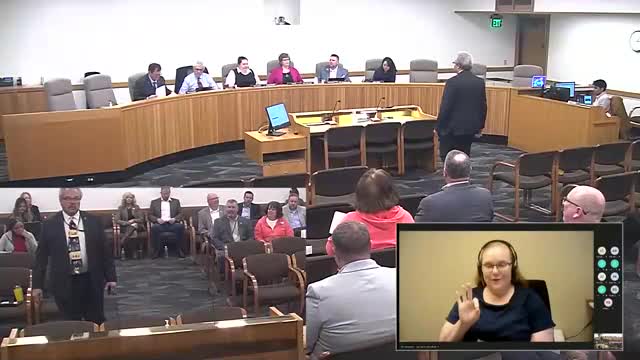
Senate Energy and Environment Committee members on March 31 heard testimony on Senate Bill 577, a measure that would require electric utilities to recover in rates the costs of storing waste produced by energy facilities.
Senate Energy and Environment Committee members on March 31 heard testimony on Senate Bill 577, a measure that would require electric utilities to recover in rates the costs of storing waste produced by energy facilities.
The bill’s digest was read into the record by committee staff member Beth: "Senate Bill 577 requires an electric utility to recover the costs and rates of storing the waste produced by an energy facility and generating electricity." Senator Lou Frederick (D–District 22), sponsor of the bill, told the committee he brought the measure because of long experience reporting on high-cost energy projects and nuclear waste cleanup.
Committee members and witnesses focused on three core issues: who ultimately pays for long‑term waste storage, whether the state’s Public Utility Commission would allow those costs to be passed to ratepayers, and what time horizon the state should assume for “temporary” storage.
Frederick said the bill seeks transparency about those costs. "If it's gonna cost money, say that right off the top," he told the panel, arguing that past projects underestimated costs and that ratepayers later bore the burden. He described historical examples — Hanford, Trojan, Rocky Flats and Yucca Mountain — to explain why storage planning and cost accounting are central to evaluating new generation proposals.
Committee discussion referenced existing federal guidance. Frederick told senators the Nuclear Regulatory Commission already calculates an expected amount utilities should set aside for waste storage, and that current U.S. practice provides temporary storage but not a permanent federal repository. He said, "right now there's not, only temporary storage is available. There is no permanent storage," and added that engineers advise safety planning on the scale of "thousands of years."
Members pressed staff and the sponsor on the bill's rate language. A committee member asked whether the sentence in the bill that says the Public Utility Commission "shall require the recovery of costs in the rates of the electric utility" means those costs will be borne by ratepayers. Frederick responded that the language was deliberate and intended to make costs transparent to ratepayers through the PUC rate‑setting process.
The committee also sought clarity on the bill's scope. Vice Chair Brock Smith asked whether the bill would encompass lifecycle waste from nonnuclear generators — for example, wind turbine blades and solar panels — as well as nuclear waste. Frederick replied that the bill was intended to cover the full life cycle of electric generation, citing examples of long‑term disposal issues for wind and incinerator ash.
Several senators and witnesses raised technical and policy caveats: the Nuclear Regulatory Commission has an established estimate for nuclear plants, but costs can vary widely for new technologies such as small modular reactors. Proponents of small modular reactors were mentioned during the discussion, and Frederick said the bill is intended to ensure cost realism rather than marketing hype.
No committee vote was taken. The chair closed the public hearing on SB 577 and moved on to other agenda items. At the start of the session the committee also noted that Senate Bills 1047 and 1062 were carried over to Monday, April 7.
Ending: The committee kept the record open for written testimony and did not schedule a final vote during the March 31 hearing.