Get Full Government Meeting Transcripts, Videos, & Alerts Forever!
Get email alerts on the Oversight Models topic
No spam. Unsubscribe anytime.
Expert urges Alaska to create independent external oversight for prisons and jails
Summary
Alicia Welch of the Prison and Jail Innovation Lab told the House Judiciary Committee that independent, external oversight—such as an ombuds office with 'golden-key' access—improves transparency and can help prevent deaths in custody by identifying problems early.
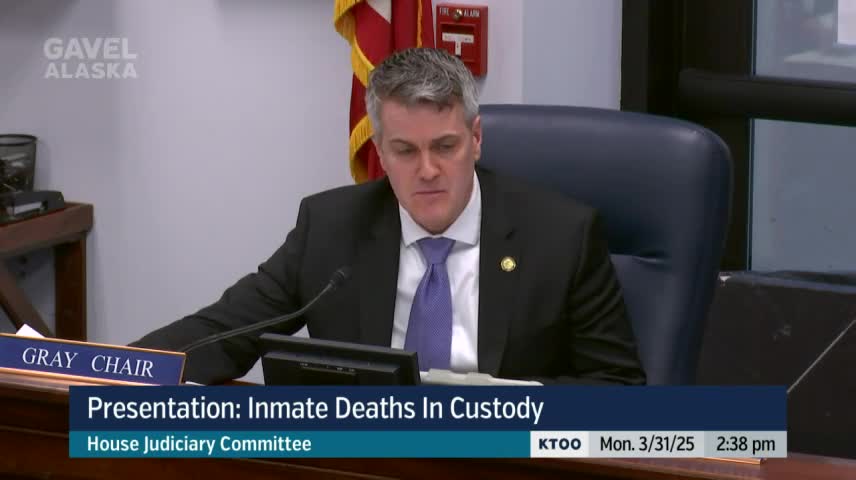
A national corrections oversight expert urged the Alaska House Judiciary Committee on March 31 to establish independent external oversight of the state’s correctional system, saying routine, unfettered inspections and public reporting reduce risk and improve accountability.
"Independent external oversight is absolutely critical for the safe and humane operation of prisons," said Alicia Welch, associate director of the Prison and Jail Innovation Lab at the Lyndon B. Johnson School of Public Affairs, University of Texas at Austin. Welch described the National Resource Center for Correctional Oversight (NRCCO), a project of her lab, and advised lawmakers on models and features of effective oversight.
Key features Welch named included institutional independence (an office outside the corrections agency with separate administrative and financial support), mandated routine inspections, and "golden-key" access allowing confidential interviews with incarcerated people and staff and unscheduled visits to any part of a facility. She said oversight offices should publish reports with findings and recommended corrective actions and that agencies should publicly respond with implementation timelines.
Welch described oversight functions ranging from proactive monitoring and routine inspections to reactive investigations, legal remedies and legislative review. She said no single entity can do every oversight function; instead, a multilayered system (internal reviews, accreditation, external oversight and legislative hearings) produces stronger accountability.
The NRCCO researcher noted that several U.S. states have recently created oversight bodies (examples cited in the presentation included Connecticut, Maryland and Hawaii) and that states use different models — ombuds offices, inspector general-type entities or commissions. Welch recommended Alaska study models in states with unified correctional systems (she highlighted Hawaii as a potentially informative example).
On data about deaths in custody, Welch said national reporting is incomplete because federal reporting systems have implementation gaps; external oversight offices in jurisdictions that have them typically publish reports on deaths in custody that internal structures do not. She said some states have started legislative changes to ensure deaths tied to in-custody events are captured even if a person dies after release from custody for medical reasons.
Committee members asked whether jurisdictions with oversight see fewer deaths in custody; Welch said comprehensive cross-state data matching oversight status to death rates are not yet available but noted oversight improves transparency and public access to information that can inform policy choices.
Welch offered to provide the committee with NRCCO resources and to connect lawmakers with oversight officials in other states.