Get Full Government Meeting Transcripts, Videos, & Alerts Forever!
Get email alerts on the Law Enforcement Investigations topic
No spam. Unsubscribe anytime.
Alaska State Troopers: unanticipated in-custody deaths are treated as suspicious; investigators summarize procedures
Summary
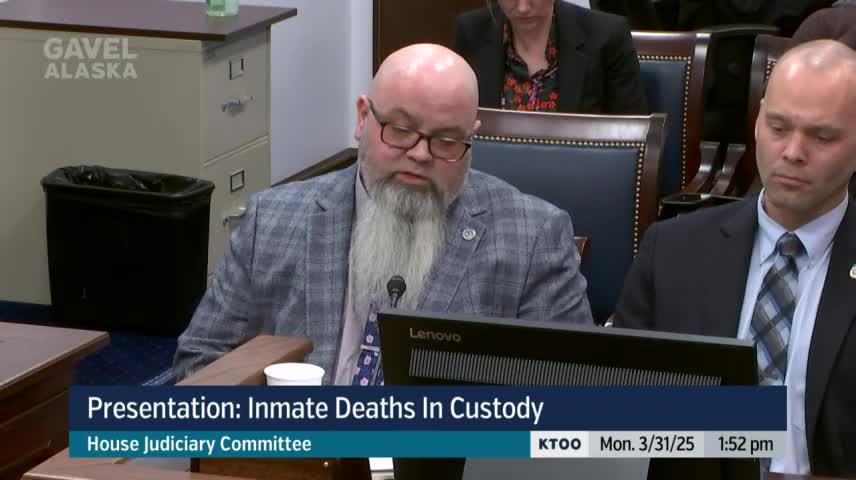
Lieutenant Ron Hayes told the House Judiciary Committee that the Alaska State Troopers treat unanticipated in-custody deaths as suspicious, secure scenes, work with the state medical examiner and face challenges such as delayed reporting and limited witness cooperation.
Lieutenant Ron Hayes, deputy commander of the Alaska Bureau of Investigation, told the House Judiciary Committee on March 31 that troopers respond to and investigate all unanticipated deaths in correctional custody and coordinate autopsies with the Alaska State Medical Examiner.
"AST treats all unanticipated death as suspicious until proven otherwise," Hayes said, describing an investigative process that begins with scene security and evidence collection. DOC staff, he said, typically notify troopers through regional dispatch after a superintendent or shift supervisor contacts regional dispatch and provides identifying details and immediate observations.
Hayes outlined investigative steps: secure and map the scene; collect physical evidence and photographs; review surveillance footage; interview staff, inmates and medical personnel; and coordinate autopsy and cause-of-death determination with the state medical examiner. He said troopers aim to produce a comprehensive report that can be forwarded to prosecutors when appropriate.
Hayes told the committee some common challenges include delayed reporting (which can hinder evidence collection), limited witness cooperation from other inmates, evidence contamination in high-traffic areas, and medical complexities from preexisting conditions.
On whether troopers investigate assaults that later result in death, Hayes said such incidents are pursued: "If they die while in custody or even out of custody at the hospital, then those charges could be upgraded to homicide. But at the very least, we're still investigating an assault that happened within DOC." He also told the committee troopers generally find DOC staff cooperative in securing scenes and separating witnesses for interviews.
The troopers' presentation was followed by committee questions about notification timeliness, whether DOC staff receive appropriate training to secure crime scenes, and the relationship between trooper investigations and DOC administrative reviews. Hayes said the troopers work closely with DOC and do not typically perform internal-affairs functions for DOC.