Get Full Government Meeting Transcripts, Videos, & Alerts Forever!
Get email alerts on the Early Childhood At Home Care topic
No spam. Unsubscribe anytime.
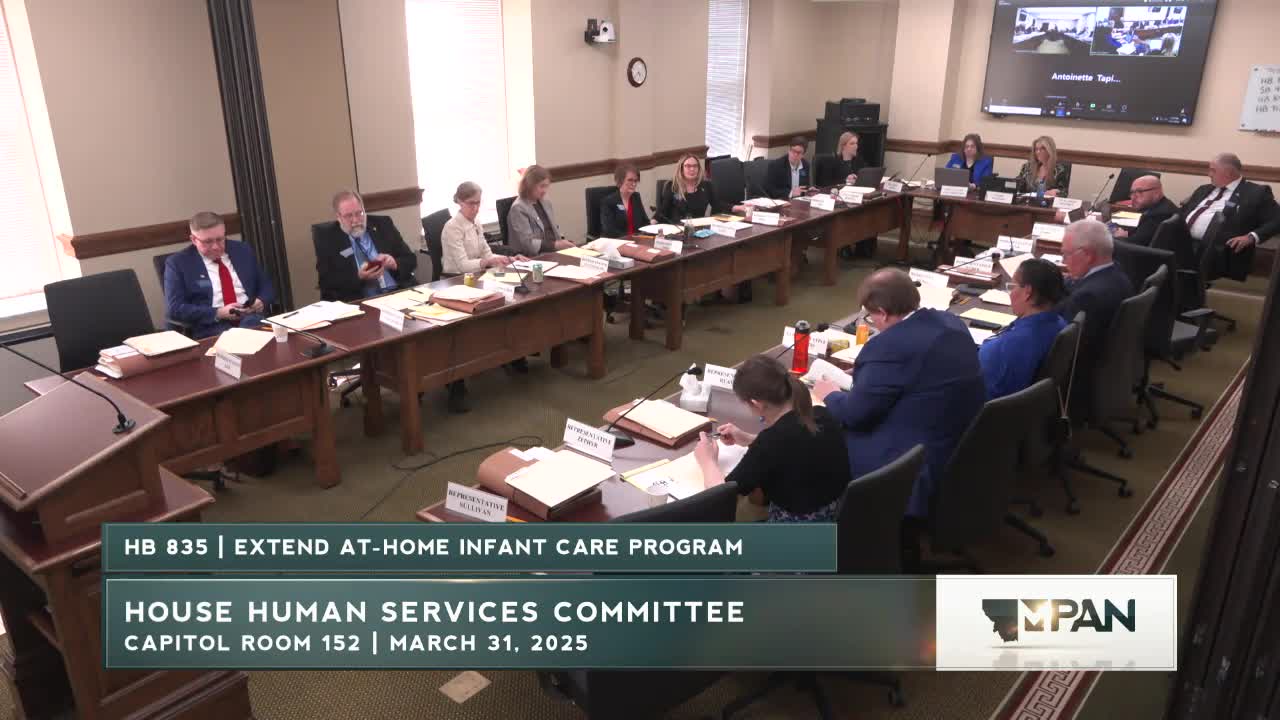
Hearing held on at‑home infant care subsidy; sponsor seeks $2M to serve ~200 families
Summary
Representative Neil Durham and proponents presented House Bill 835, proposing a roughly $2 million appropriation to fund an at-home infant care subsidy for qualifying families (estimated to serve about 200 families at roughly $800 per month). DPHHS said rulemaking and implementation details require follow-up.
House Human Services Committee members heard House Bill 835, which would create an at‑home infant care subsidy intended to give parents another option to provide infant care at home during the early years.
Sponsor Rep. Neil Durham described the bill as an investment in early childhood and family stability and said the proposal is estimated to serve about 200 families with an appropriation of $2,000,000 for the biennium; the sponsor and proponents cited an approximate benefit level near $800 per month per family in their initial estimates. Rebecca Durham, a proponent and parent, described personal experience staying at home with young children and said state support would help families who choose to parent at home.
Why it matters: Pediatricians and early-childhood advocates testified the prenatal-to-age-3 period is critical for brain development and that targeted financial support for families with very young children can improve long-term health and economic outcomes. Dr. Lauren Wilson, advocacy chair for the Montana Chapter of the American Academy of Pediatrics, said targeted financial support for young children is a health intervention that can reduce toxic stress.
Administration and eligibility: DPHHS early childhood staff said the department would need to create rules and that many details would be clarified through rulemaking; a DPHHS official said the agency would need to consult legal staff to determine whether a July 1 start date gives sufficient time for rule development. Committee members questioned eligibility language and exceptions that could exclude families receiving Medicaid or TANF; DPHHS agreed to follow up.
Operational history and pilot data: Sponsors and proponents referenced an earlier pilot program and a Vanderbilt/Center on the Developing Child research basis for investing in the 0–3 period. Witnesses said the pilot found average usage near 10 months and that most participants were two‑parent families in rural areas.
No vote was taken at the conclusion of the hearing. The department will work with the sponsor on implementation details and rule timelines before the bill advances.
Ending note: Proponents framed the proposal as a family-choice policy that adds an option alongside child care subsidies and licensed care, and they urged the committee to consider the long-term developmental and economic benefits of targeted early-childhood support.