Get Full Government Meeting Transcripts, Videos, & Alerts Forever!
Get email alerts on the Corrections Policy topic
No spam. Unsubscribe anytime.
Alaska DOC describes death-review policy, family-notification process and medical screening tools
Summary
Department of Corrections officials told the House Judiciary Committee they follow policy 104.04 for preserving scenes and conducting administrative reviews, use a new electronic health record and evidence-based screening tools, and count deaths occurring while in custody but not those that occur after formal release from custody.
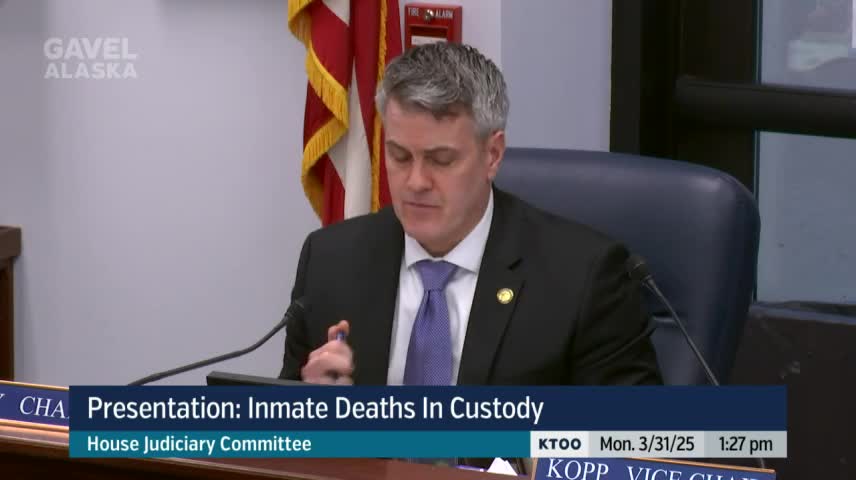
Department of Corrections officials briefed the House Judiciary Committee on March 31 about the agency’s practices for investigating deaths in custody, family notification, and medical review.
"The Alaska Department of Corrections does not investigate and make deaths. We notify the appropriate legal authorities and cooperate with them to do their investigation as they see fit," said Dr. Timothy Ballard, DOC chief medical officer, describing the agency’s relationship with the Alaska State Troopers and the state medical examiner.
DOC officials told the committee the agency follows a written policy — DOC Policy 104.04, "Death of a Prisoner" — that requires staff to secure scenes, preserve 24 hours of video, log access, document witnesses and work with the Alaska State Troopers on evidence collection. Director of Institutions Zane Niswonger said administrative reviews called "death reviews" have shifted toward a continuous-quality-improvement approach that looks beyond single bad outcomes to emergency responses, suicide attempts and assaults in order to identify systemic fixes.
On family notification and property: DOC staff collect and validate next-of-kin information at booking and the facility superintendent is responsible for notifying the statewide DOC chaplain, who then notifies next of kin. The agency told the committee that property and any funds are released to next of kin 30 days after the event and that the chaplain explains the process during notification.
On classification: Ballard said DOC "counts all deaths that occur within custody regardless of location. This does include those that are hospitalized." He also said that if an individual is released from custody while hospitalized "a death occurring after release from custody is not reported by the Department of Corrections" because the agency no longer has legal or medical authority to gather records once custody ends.
Ballard cited federal privacy law in explaining limits to post-release investigation: "I no longer have legal ability to investigate the cause and nature of the death because... HIPAA law." Committee members raised concerns that injuries sustained in custody and followed by death after release might be omitted from DOC reporting.
Medical and screening practices: DOC said it replaced its electronic health record and embedded standards from the National Commission on Correctional Health Care (NCCHC) and integrated evidence-based screening tools, including the Columbia Suicide Severity Rating Scale, CIWA (Clinical Institute Withdrawal Assessment for Alcohol), COWS (Clinical Opiate Withdrawal Scale) and ASAM-related triage tools. Adam Rutherford, deputy director of Health and Rehabilitation Services, told the committee roughly 18,000 people had been placed on detox protocols since 2022.
Capacity and staffing: DOC reported facilities were at "just under 84% of general capacity," but internal study data showed operational capacity closer to 92% when beds offline for maintenance, specialty populations or classification are accounted for. DOC officials said staffing has improved from earlier shortages; the department is actively recruiting and reported single-digit vacancy rates for correctional officers at the time of the hearing, though they acknowledged overtime has been used historically to meet minimum staffing requirements.
Administrative-review process: DOC described multidisciplinary teams from other facilities that review incidents (security, medical, nursing, mental-health clinicians), who examine training records, video, medical records and phone logs and generate a summary report with recommendations. The department said administrative reviews have produced policy, staffing and physical-plant changes.
Accreditation: DOC said it was not yet NCCHC accredited but had completed a pre-accreditation review to identify gaps that would need addressing to achieve accreditation.
The committee followed with questions about how DOC decides housing placements for people with severe mental illness, how the department coordinates with Alaska Psychiatric Institute for competency and restoration cases, and the limits that federal law places on post-release medical review. No formal committee votes occurred during the session.