Get Full Government Meeting Transcripts, Videos, & Alerts Forever!
Get email alerts on the Homelessness Rapid Rehousing topic
No spam. Unsubscribe anytime.
Committee hears testimony supporting $1M/year state supplement to federal Emergency Solutions Grant for rapid rehousing
Summary
Supporters told the House Human Services Committee that House Bill 843 would add $1 million per fiscal year to supplement HUD Emergency Solutions Grant (ESG) funds for rapid rehousing and homelessness prevention, and witnesses described use cases, local shortfalls and how the funds would be distributed through existing HRDC structures.
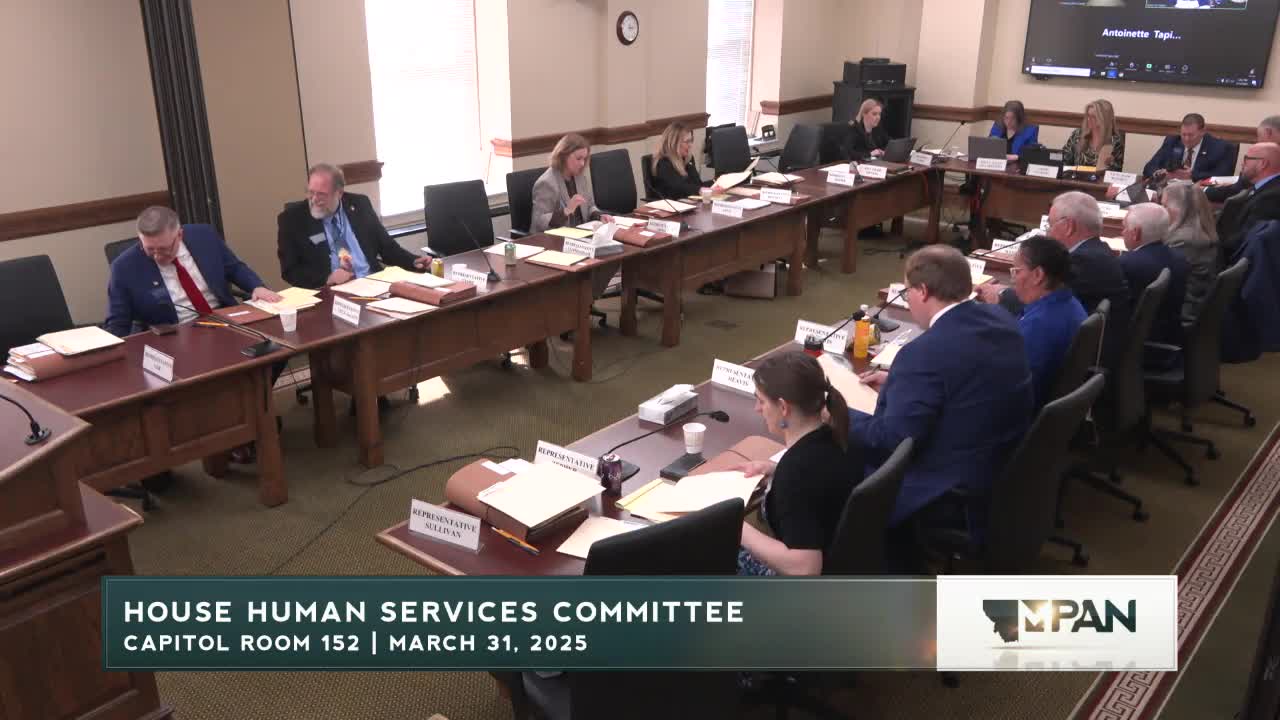
House Human Services Committee members heard more than a dozen proponents Wednesday supporting House Bill 843, which would appropriate $1,000,000 for each fiscal year of the biennium to supplement federal Emergency Solutions Grant funding for homelessness prevention and rapid rehousing.
Proponents told the committee the state dollars would stretch federal ESG resources and be distributed through existing regional Human Resource Development Council (HRDC) districts and ESG delivery systems. "The legislation represents a critical step toward addressing homelessness in Montana by allocating a million dollars for each fiscal year of the biennium to supplement federal resources for rapid rehousing initiatives," said Kathy Marks of Rocky Mountain Development Council.
Why it matters: Witnesses said federal ESG funding and HUD fair market rents have not kept pace with local markets, limiting program use in communities where rents exceed HUD limits. Testimony emphasized that short-term rental assistance and move-in supports prevent households from entering literal homelessness and can be cheaper than shelter, emergency health care and justice system costs.
Committee members and informational witnesses provided context on current federal ESG allocations in Montana and program administration. Sarah Loewen, bureau chief at the Department of Public Health and Human Services (DPHHS), said Montana's ESG awards were $744,418 for program year 2024 and $741,906 for program year 2025 and that state funds would "just supplement" those federal dollars. Proponents described how state funds could allow ESG recipients to pay up to 150% of HUD fair market rent in high-cost areas, cover security deposits and arrears, and provide landlord incentives and move-in assistance where needed.
Supporting testimony came from a range of service providers and advocacy groups including HRDC District 9, Montana Community Action Network, Catalyst Montana, Ability Montana Center for Independent Living, the Montana Coalition to Solve Homelessness, and local HRDCs and shelters. Hannah Altman of HRDC District 9 said additional funds would let programs "reach more people, particularly those who fall through the cracks of other programs" and would be deployed quickly because they align with existing ESG infrastructure. Cassie Wick of Ability Montana described SSI and SSDI income limits and underscored the need for flexible housing assistance for people with disabilities: "If you receive Supplemental Security Income, SSI, you get $967 a month." Margie Secom of Action, Inc. described a local example in Butte where federal ESG funds helped a person who had been unhoused for 10 years and reduced annual crisis costs.
Several witnesses urged allowing flexibility in allowable rents, landlord engagement, and rapid use of funds by fiscal-year end. Committee questions probed how many additional people could be served; HRDC testimony cited serving more than 100 households in the last year across multiple grants and said higher allowable rents would increase placements. DPHHS confirmed the state appropriation would be distributed through established ESG recipients (the HRDC districts) rather than creating a new delivery system.
No formal action was taken during the hearing. The bill remains at the hearing stage with proponents urging the committee to advance the appropriation to increase statewide rapid-rehousing capacity.
Ending note: Proponents argued the appropriation would be cost-effective and immediately deployable through existing ESG partners; DPHHS told the committee the agency would administer payments under current federal program structures if the Legislature funds the bill.