Get Full Government Meeting Transcripts, Videos, & Alerts Forever!
Get email alerts on the Hospital Finance topic
No spam. Unsubscribe anytime.
Committee hears debate over hospital supplemental-payment changes that carve out funds for small, unaffiliated critical-access hospitals and quality incentives
Summary
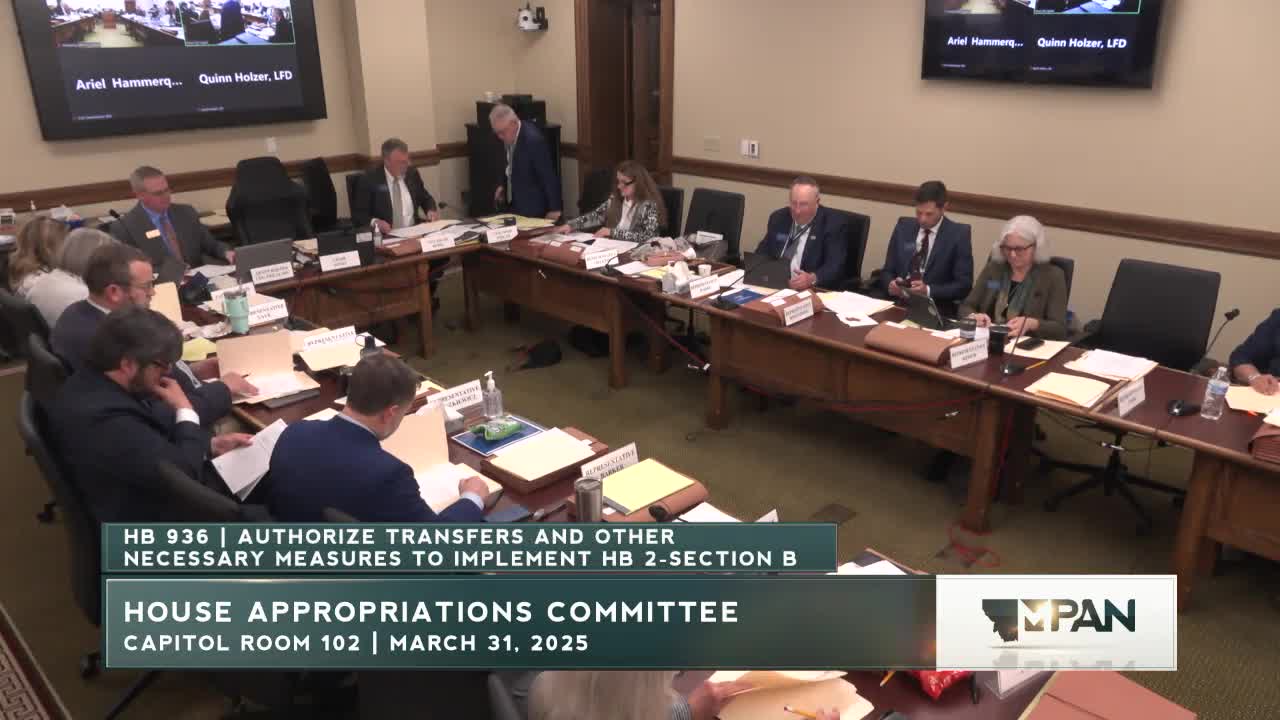
Representative Gillette told the House Appropriations Committee that House Bill 9 36 would divert two small portions of the state’s inpatient supplemental payment to bolster independent critical‑access hospitals and to create a quality‑incentive pool, proposals that hospital officials said would weaken statewide capacity.
Representative Gillette, sponsor of House Bill 9 36’s policy companion, told the committee the bill includes two new carve-outs in the state’s inpatient supplemental payment distribution that aim to help the smallest, most at‑risk hospitals and to reward quality. She said the packet of changes comes from the Appropriations Committee and is intended to relieve pressure on systems that provide rural access to care.
The two contested provisions described in committee testimony were: an additional 2 percentage-point carve‑out of the inpatient supplemental payment (frequently called the “bed tax”) to be redistributed to independent, non‑affiliated critical‑access hospitals, and a separate 2 percentage‑point carve‑out to be redistributed to all hospitals as quality incentive payments. Representative Gillette said the measures represent modest redistributions — roughly $4 million each from a roughly $200 million pool — aimed at bolstering fragile facilities and incentivizing better outcomes.
Duane Preshinger of the Montana Hospital Association rose in opposition and urged the committee to reject the two amendments. He said the additional carve‑outs take money from hospitals of all sizes and direct it to a narrowly defined group of independent hospitals, penalizing small facilities that deliberately chose affiliations or partnerships to preserve services. “Small hospitals in small towns are being penalized for their partnerships and strategic thinking to improve performance, efficiency, and preserve services,” Preshinger said. He also told the committee that the supplemental payments are tied to patient care and complexity and that a sudden redistribution will weaken statewide capacity.
Aden Myhre of Billings Clinic Logan Health System also opposed the carve‑outs, saying affiliations are often the means by which rural hospitals sustain access, and that pulling money from larger systems risks undercutting services the smaller hospitals rely on. Myhre and Preshinger both urged the committee to reject the two amendments or to pursue a more deliberative, stakeholder-driven quality‑payment design.
Representative Gillette and staff described example math showing the redistributions are small relative to the budgets of larger hospitals. She used an anonymized example in which a large hospital with roughly $200 million in annual revenue would see about a $260,000 reduction when both 2% carve‑outs are applied, and — depending on quality scores — receive a smaller quality incentive payment back. Gillette said the net impact in her example is “minuscule” for large hospitals but meaningful for single‑hospital, independent critical‑access facilities.
Kim Aiken, chief financial officer for the Department of Public Health and Human Services, appeared as an informational witness to answer technical questions about the supplemental payment program, matching federal funds, and the interplay between policy language and appropriations.
Committee members pressed both sides on implementation details: how an “independent” critical‑access hospital would be defined, whether federal rules would be affected, and how quality metrics would be selected and measured. Hospital witnesses said they already participate in federal and state value‑oriented programs and warned that a new quality pool created without hospital and department input could duplicate existing efforts and remove dollars from patient care. The sponsor said the department had been consulted on the math and that the carve‑outs were intended as a narrow targeting mechanism for facilities “on the brink.”
No formal committee vote on the two amendments is recorded in this transcript; Representative Gillette told the panel that the alterations had been passed in full appropriations earlier in the process. Hospital group witnesses asked the committee to pause and develop a collaborative design for any future quality payments.
Ending: The hearing closed after several committee members asked staff to provide additional hospital‑level data. Representative Gillette indicated she planned amendments and follow‑up materials; hospital representatives offered to provide more financial detail for the committee’s review.