Get Full Government Meeting Transcripts, Videos, & Alerts Forever!
Get email alerts on the Alaska Canada Relations topic
No spam. Unsubscribe anytime.
Committee hears HJR11 recognizing Alaska–Canada relationship; Yukon premier and regional partners offer support and warn of tariff risks
Summary
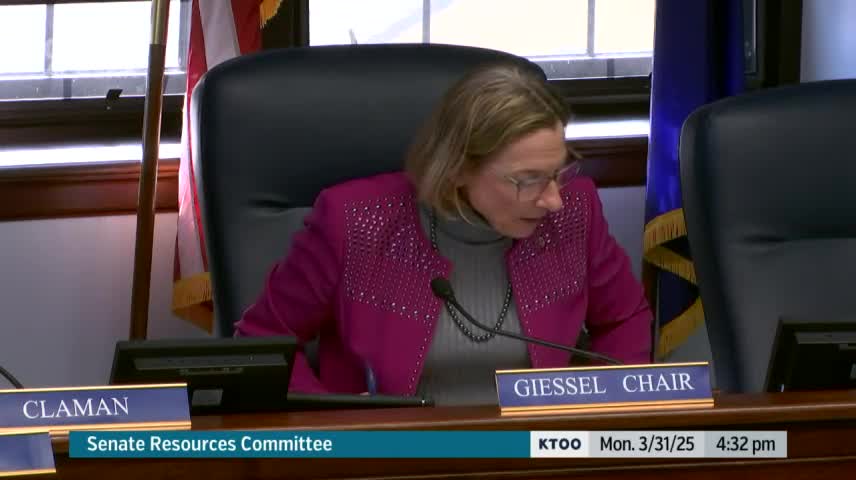
The Alaska Senate Resources Committee on March 31, 2025 heard invited testimony on HJR11, a joint resolution recognizing Alaska’s economic, security and cultural ties to Canada.
The Alaska Senate Resources Committee on March 31, 2025 held a hearing on House Joint Resolution 11, a measure recognizing and affirming the historic, economic and cultural relationship between Alaska and Canada. Representative Chuck Kopp (sponsor) said the resolution is intended to “present a unified voice of restoration and reconciliation among old allies and friends” amid recent trade tensions.
Why it matters: Members and witnesses described deep cross‑border ties that support Alaska’s economy, security and way of life. Representative Kopp told the committee that Alaska ships roughly $596 million in exports to Canada and imports about $753 million annually; he also said about 23,000 Alaskans have jobs connected to Canadian trade.
Invited testimony and key points - Premier Ranj Pillai, Government of Yukon: Calling from Whitehorse, Premier Pillai said Yukon and Alaska share northern challenges and infrastructure, and he warned that tariffs planned by both national governments could disrupt the region’s integrated economy. Pillai described recent federal conversations and noted Canada’s domestic discussions about how to respond. He said, in part, “Canada will never be the 50 first state,” while adding that Canada remains a close ally and that both jurisdictions must protect jobs and supply chains.
- Matt Morrison, executive director, Pacific Northwest Economic Region (PNWER): Morrison urged support for the resolution and highlighted the importance of transportation corridors—land, sea and air—that link Alaska to Canadian ports and markets. He noted regional work to secure grants for the Shakwak (Shakwak/Shakwak Highway) corridor and other infrastructure that keep Alaskan freight and fuel flowing.
- John Rada, president, Arctic Winter Games International Committee, and Sarah Frampton, executive director Team Alaska: Both witnesses described the Arctic Winter Games and other youth exchanges as longstanding avenues of cultural and athletic cooperation. Frampton said Team Alaska plans to send roughly 355 athletes, coaches and staff to the 2026 Games in Whitehorse and urged passage to underscore the partnership’s value for young people across the North.
Public testimony One caller from Wasilla urged the committee to oppose the resolution and supported the imposition of tariffs in retaliation for Canadian trade measures; the caller said, “Let this resolution die in committee.” The chair closed public testimony after allowing the two‑minute statement.
Discussion and next steps Committee members and invited witnesses agreed the resolution is largely symbolic but said it signals support for continued cross‑border cooperation across emergency response, transportation, defense (NORAD and Arctic search‑and‑rescue cooperation were discussed) and people‑to‑people ties such as sports and cultural exchanges. The committee set the resolution aside for further consideration and indicated an intent to return to it with an explanation of changes at a near‑term meeting.
Ending Representative Kopp and witnesses encouraged the committee to pass a bipartisan statement reaffirming the Alaska–Canada relationship. No vote occurred at this hearing; the committee left HJR11 pending while signaling willingness to act quickly if members finalize changes.