Get Full Government Meeting Transcripts, Videos, & Alerts Forever!
Get email alerts on the Infant Safety Devices topic
No spam. Unsubscribe anytime.
Senate Judiciary hears SB 9 to authorize infant safety devices; bill set aside for further review
Summary
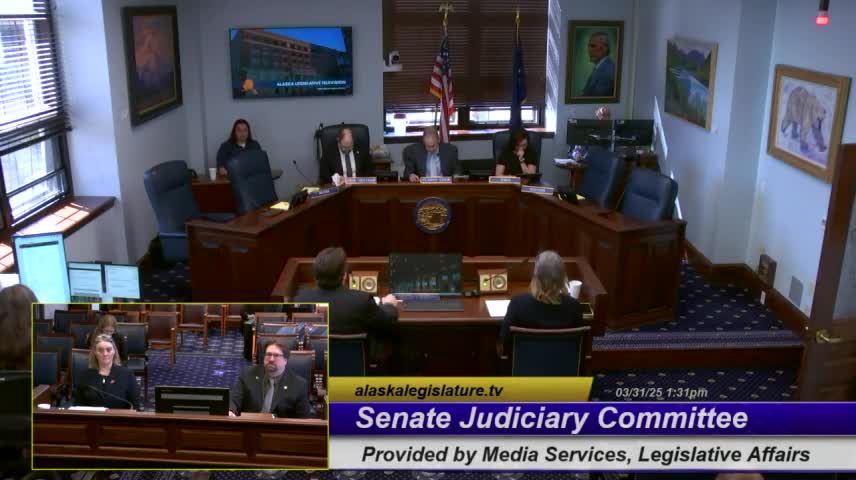
The Alaska Senate Judiciary Committee on March 31, 2025, held the first hearing on Senate Bill 9, sponsored by Senator Robert Myers, a bill that would authorize infant safety devices as an additional location where parents may safely surrender a newborn. The committee did not take a vote and set the bill aside for further review.
The Alaska Senate Judiciary Committee on March 31, 2025, held the first hearing on Senate Bill 9, sponsored by Senator Robert Myers, a bill that would authorize infant safety devices as an additional location where parents may safely surrender a newborn. The committee did not take a vote and set the bill aside for further review.
SB 9 would add qualified infant safety devices to Alaska's safe surrender framework, authorizing their installation at hospitals, fire stations, police stations, facilities owned or managed by tribal health organizations and other sites the Commissioner of the Department of Family and Community Services designates. The bill sets technical requirements for devices: climate control, an automatic security lock, conspicuous signage, continuous interior video monitoring and an automatic connection to 911 that requests an emergency dispatch when the device is opened. The bill does not mandate installation and does not provide state funding; sponsors said private funding has been offered to cover installation costs. The bill sets an effective date of July 1, 2026.
Why it matters: Committee sponsors and witnesses said the change is intended to reduce illegal abandonment and save infant lives by offering an anonymous, monitored option where a newborn can be left and immediately receive emergency care. Committee members and witnesses disagreed over how anonymity, identification of parents, response times in Alaska's large and rural geography, and compliance with federal Indian Child Welfare Act (ICWA) obligations would work in practice.
Sponsor presentation and bill details
Senator Robert Myers, the bill sponsor, described SB 9 as "a tool in the toolbox to save lives," noting that Alaska passed its safe surrender law in 2008 and that 9 infants have been surrendered under that law since then. Myers said three infants found abandoned outdoors in Alaska since 2013 are known to his office, two in Anchorage who were found deceased and one in Fairbanks who was found alive in 2022. Myers told the committee the bill mirrors language unanimously passed by the Maryland legislature in 2024 and that it was drafted after a national survey of other states' statutes. Teresa Wolstead, legislative aide to Senator Myers, walked the committee through the bill sections and the device requirements.
Child-welfare, safety and identification concerns
Kim Guay, director of the Office of Children's Services (OCS), told the committee that in past safe surrender cases the department "typically find[s] out through community providers" who the parents are and that parents will sometimes come forward after a surrender. Guay said OCS follows its policy (cited in testimony as policy 2.1.05) to identify tribal affiliation when an Indian child is involved and that the department would notify the tribe when it determines a surrendered infant is an Indian child. Guay also said she did not have hard data on how often parents remain unidentified in surrenders, but estimated from practice that OCS is unable to identify a father in perhaps 5 to 10 percent of cases; she said she could not recall a case in which the mother could not be identified.
Committee members pressed OCS and the sponsor on several points they said would affect safety and implementation in Alaska: how anonymous surrender by box would interact with investigations when no missing-child report exists; whether interior video monitoring would undermine the anonymity that some parents seek; how device design would prevent thermal or suffocation risks; who would set and enforce equipment and response-time standards in rural communities; and whether ICWA procedures would be satisfied. Senator Stevens noted earlier state hearings on similar legislation had explicitly avoided video surveillance to protect anonymity; Senator Myers and others responded the bill requires interior video only to check on the child, not to record the person dropping off the infant.
Invited and public testimony
State Senator Mike McKay of Maryland described Maryland's experience and said the Maryland law expanded the surrender period and created monitored devices that notify emergency services immediately; he reported bipartisan support in Maryland in 2024. Frances Robinson, a dispatcher with the Anchorage Fire Department who testified as an invited witness, recounted answering a 2013 911 call for an infant later found deceased and said SB 9 would have given an anonymous option that could have saved that child. Robinson told the committee that the devices she had seen are "secure medical bassinets that are monitored and have a temperature controlled environment." Public testimony from Pamela Samash of Nenana urged support for the bill and emphasized Alaska's extreme weather as an additional rationale for allowing monitored dropoff devices.
Questions about data and criminal penalties
Committee members asked the sponsor and OCS for more data about past surrenders, including whether both parents were identified in the nine safely surrendered infants the sponsor cited. Senator Myers told the committee his office obtained the nine-case figure from the department and agreed to follow up with OCS to obtain case-level details. The committee also asked about existing criminal penalties for abandonment; testimony referenced AS 11.81.500 as related to the safe surrender statutory framework, and the sponsor and staff said they would provide the committee with the specific criminal statute for abandonment before the next hearing.
Next steps
The committee closed public testimony, set SB 9 aside for additional review and requested follow-up information from OCS and the sponsor's office on the nine safe-surrender instances, identification rates, safety and design standards for devices, response-time assumptions in remote communities, and the applicable criminal statute for abandonment. The committee did not vote on SB 9 at the March 31 hearing. The committee adjourned and announced a continuation of business on April 2, 2025.
Ending note: The hearing record shows the bill would not require facilities to install devices and would not appropriate state funds; sponsors said private donations have been offered to cover installations. The committee requested precise data and statutory citations before further action.