Get Full Government Meeting Transcripts, Videos, & Alerts Forever!
Get email alerts on the Fisheries Policy topic
No spam. Unsubscribe anytime.
Senate committee reviews fisheries task force report; first hearings held on SB130 tax credit expansion and SB135 municipal refund
Summary
The Alaska Senate Resources Committee on March 31, 2025 received the final report of the Alaska Seafood Industry Task Force and held first hearings on two bills the task force recommended: SB130, expanding the Fisheries Product Development Tax Credit, and SB135, increasing municipal shares of fisheries taxes.
The Alaska Senate Resources Committee on March 31, 2025 received the final report of the Alaska Seafood Industry Task Force and held first hearings on two bills the task force recommended: SB130, which would expand the Fisheries Product Development Tax Credit to additional species and equipment, and SB135, which would increase the share of fisheries business and landing tax revenue distributed to qualified municipalities.
The task force report, prepared after a series of meetings and stakeholder hearings, was presented by Tim Lampkin, staff to Senator Gary Stevens, who sponsored the task force. Senator Stevens told the committee the industry remains Alaska’s largest manufacturing sector, “it employs some 48,000 workers” and “generates about $6,000,000,000 overall,” and that task force recommendations include a mix of near-term policy changes and longer-term budget items.
Why it matters: Committee members and invited witnesses described a wide downturn in market conditions in 2023 that hurt prices and demand across almost all fisheries and put coastal communities and processors at economic risk. The bills aim to encourage private investment in value-added processing and to direct a larger share of fisheries revenues to local governments that operate ports and harbors.
Task force and policy context Tim Lampkin told the committee the eight-member legislative task force met 12 times and condensed a roughly 20-page report into an action-item spreadsheet; near-term policy items on page 1 included tax and investment incentives and workforce development, while page 2 listed mid- to long-term items that would require budget appropriations. Lampkin said some recommendations are already the subject of legislation or committee work, including insurance/risk-management proposals in Labor and Commerce and proposals tied to energy or Department of Labor workforce initiatives.
SB130: Fisheries product development tax credit (first hearing) SB130 would broaden the existing Fisheries Product Development Tax Credit so that more equipment types and more species are eligible. Julie Decker, president of the Pacific Seafood Processors Association (PSPA), told the committee PSPA “strongly supports this bill” and said the measure would “provide an incentive for the Alaska seafood processors to invest in new equipment that produces higher quality, value added products within Alaska.” Decker emphasized the bill does not change the current statutory cap on the credit: “The bill does not change the current maximum value of the tax credit, which is capped at 50% of a processing company's Alaska fisheries business tax.”
Department of Revenue staff described the bill’s fiscal note as indeterminate because projected utilization is uncertain. Deputy Director Brandon Spanos said the tax division prepared low/average/high scenarios by scaling existing forecasts to account for expanded species and equipment and by modeling a three‑year carryforward; the department’s scenarios ranged from a modest negative impact in some years to multi‑million‑dollar impacts in later years. Spanos summarized the note as indeterminate and said the department provided example scenarios rather than a single forecast. Lead auditor Chris Becker clarified what tax the credit offsets: “This credit can only be claimed against the fishery business tax.” Becker said total fishery business tax collections before credits were about $35 million in FY2024 and about $51 million in FY2023.
Committee members asked about whether smaller processors routinely reach the existing credit cap and about the rationale for opening the credit to all species rather than a narrower set. Lampkin and Decker said expanding eligibility avoids the need to amend statute each time a new processing sector or species becomes commercially significant and recognizes that many processors operate across multiple fisheries.
SB135: Refund of fisheries business tax to municipalities (first hearing) SB135 would change how fisheries business and landing taxes are shared between the state and qualifying municipalities. Tim Lampkin summarized the statutory history: sharing began at 10% in earlier territorial statutes, rose over time and settled at a 50/50 split after 1981. The bill as filed would generally shift a larger share to municipalities (commonly described in testimony as a 60/40 direction), though the exact allocation would vary by municipality type and statutory structure.
Spanos described the bill’s fiscal note and explained the department had read the draft language conservatively; because historical statute and the bill’s language interact differently for various community types, the department’s illustrative fiscal note used a 75/25 sharing assumption in its initial scenarios. Under that assumption the note shows multi‑million‑dollar reductions in state unrestricted receipts (for example, a roughly $12.3 million negative impact in the first modeled year and a larger impact in later years). Spanos said the bill’s exact state fiscal impact depends on final language and how the shares are specified for different community classifications.
Nils Andreasen, executive director of the Alaska Municipal League (AML), testified in support of the bill’s intent to increase municipal shares but urged flexibility. AML noted that not all recipients operate harbors, that sharing should be additive rather than replace other forms of state investment, and that new annual reporting requirements could impose an administrative burden on communities that receive very small amounts (AML gave examples of communities receiving only a few hundred dollars). Andreasen said AML’s most recent port-and-harbor survey (2019) identified statewide needs in the hundreds of millions; he said AML will update that survey to help size future proposals.
Discussion highlights and outstanding issues - Scope and equity: committee members and witnesses debated whether to limit SB130 by species or equipment or to leave it broadly inclusive so processors operating across fisheries are not penalized. - Fiscal uncertainty: Department of Revenue staff characterized both bills’ fiscal impacts as indeterminate and offered scenario-based numbers; members asked for clearer scoring and for options to refine statutory language to control fiscal exposure. - Reporting and targeting: AML and other witnesses asked for flexible language so funds meet local needs and do not impose disproportionate reporting burdens on small recipients. Several members noted that targeted capital grants remain the tool to prioritize the highest‑need harbor projects. - Related policy items: Lampkin summarized additional task force recommendations (insurance/risk management, emergency loan authority tied to AS 44.88, coordination with the University of Alaska and Department of Labor on data and workforce development, and review of CFEC/permit issues), and noted some items are already before other committees or require appropriations.
What the committee did The committee took testimony and set both SB130 and SB135 aside for further review. Senator Gary Stevens, sponsor of the task force and an author of the bills, urged committee members to work with staff and stakeholders to refine the language and noted the bills reflect a set of near‑term, actionable items from the task force report.
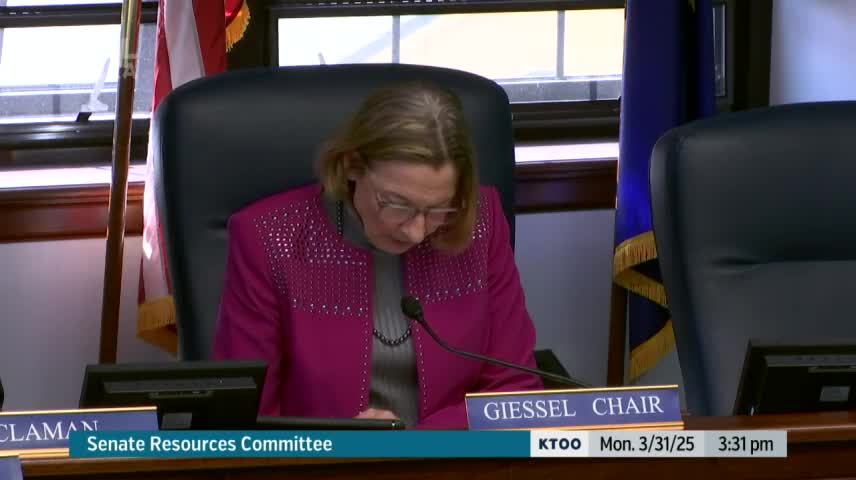
Ending Committee chair Senator Giesel reminded members of the amendment deadline announced earlier in the hearing for an unrelated bill and said members should expect further work sessions and follow‑up hearings on the fisheries measures. The committee did not vote on either bill at this hearing and left both pending for further drafting and fiscal clarification.