Get Full Government Meeting Transcripts, Videos, & Alerts Forever!
Get email alerts on the Healthcare Pharmacy Benefits Management topic
No spam. Unsubscribe anytime.
Committee hears bill to license pharmacy benefit managers and TPAs for transparency and consumer protection
Summary
House Bill 149 would change pharmacy benefit managers and third-party administrators from registered entities to licensed entities under the Division of Insurance, closing exemptions and allowing market-conduct examinations; committee set the bill aside for future consideration.
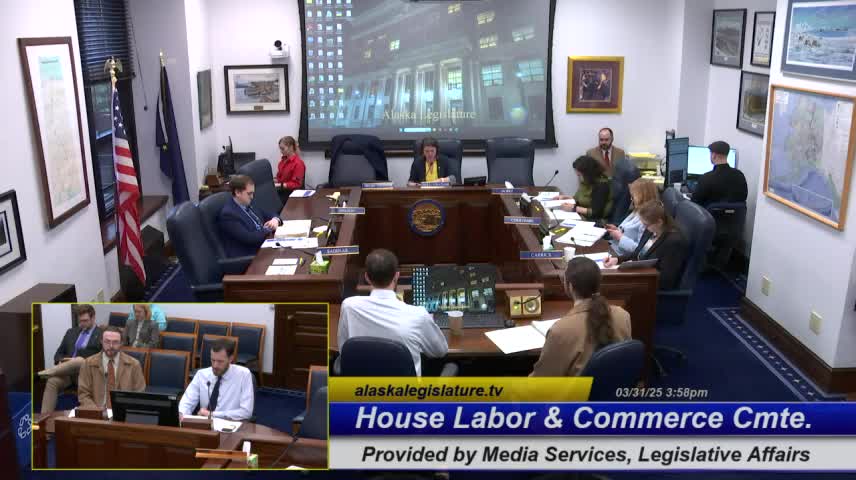
Anchorage — The House Labor and Commerce Committee heard an introductory presentation on House Bill 149, a bill directing the Alaska Division of Insurance to license pharmacy benefit managers (PBMs) and third-party administrators (TPAs) and to gain expanded regulatory authority over those entities.
Sponsor and staff said the bill is intended to implement and clarify earlier PBM-related legislation by requiring licensure rather than registration for PBMs and TPAs, enabling the Division of Insurance to conduct market-conduct examinations, collect licensing fees sufficient to sustain oversight, and remove certain exemptions that limited enforcement.
Co-chair Zach Fields and staff member Evan Anderson outlined the bill’s structure. "House Bill 149 is a bill that is designed to ensure the division of insurance can implement some PBM legislation we passed last year," Fields said. Sections in the bill replace registration with licensure, require entities operating in Alaska be licensed, authorize the director to set fees and revoke licenses for noncompliance, and set an effective date of Jan. 1, 2026.
Division perspective: Heather Carpenter, deputy director of the Division of Insurance, told the committee there is often no functional difference between PBMs and TPAs, which prompted the effort to treat them the same for transparency and oversight. She explained a PBM typically handles pharmacy claims and network management for insurers, while TPAs can administer a broader set of benefits (dental, vision, health). Carpenter said the division has encountered entities claiming exemptions, which limited enforcement during provider payment disruptions and a TPA bankruptcy; licensing would give the division broader authority to protect consumers and providers.
Clarifying details: Staff said the change from registration to licensure would give the division statutory authority similar to other licensed entities, including the ability to require disclosures, deny or revoke licenses for failure to meet standards, and set self-supporting fees to cover oversight costs.
Next steps: Committee members asked clarifying questions about exemptions and the scope of the repealed statutory language. The committee set the bill aside for further consideration and consultation with division staff and other stakeholders.