Get Full Government Meeting Transcripts, Videos, & Alerts Forever!
Get email alerts on the Public Safety K9 Emergency Care topic
No spam. Unsubscribe anytime.
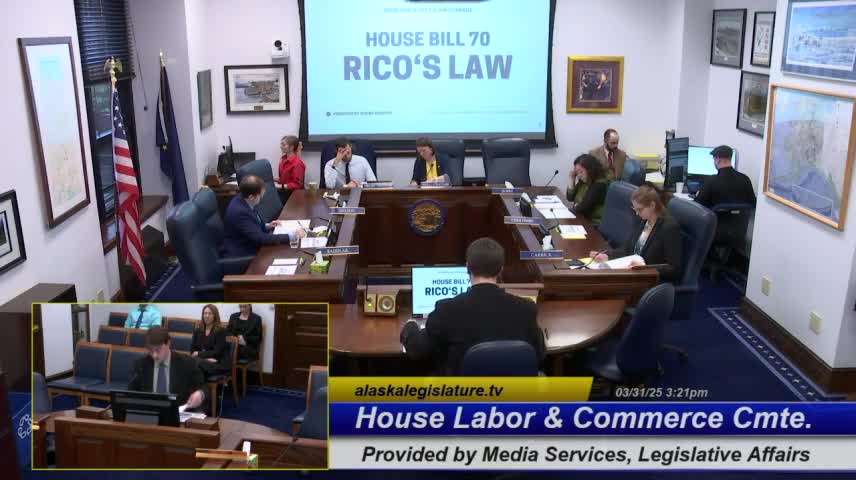
Committee hears 'Rico’s Law' to let EMTs provide emergency care, transport for operational K-9s
Summary
House Labor and Commerce Committee heard invited testimony on HB70 ("Rico’s Law"), which would authorize trained EMTs and paramedics to provide limited emergency care and transport to operational canines; bill was set aside for further consideration and public testimony was scheduled.
Anchorage — The Alaska House Labor and Commerce Committee held an initial hearing on House Bill 70, commonly called “Rico’s Law,” a measure that would authorize trained emergency medical technicians and paramedics to provide limited emergency medical treatment and transport to operational canines used in law enforcement and search-and-rescue operations.
The bill’s authorizing staff, Jeremy Houston, told the committee that current Alaska law exposes EMS providers to misdemeanor charges for practicing veterinary medicine and that HB70 would create statutory authority allowing EMS to render “point of injury” stabilization to injured operational canines and transport them to veterinary care. "So today I'll be presenting house bill 70, which is, colloquially named, Rico's Law," Houston said during his presentation.
Why it matters: Witnesses argued the change would address a real-world gap in remote areas where long transport times can make the difference between life and death. Paramedic Brian Webb, who described himself as having 46 years of paramedic experience including deploying with military working dogs, said EMS are often the closest clinicians to an injured K‑9 and that current law prevented legally sanctioned intervention in past incidents. "HB 70 ensures this never happens again by allowing trained EMS clinicians to provide emergency trauma stabilization and transport just as we do for humans," Webb said, citing the 2017 shooting death of Trooper K9 Rico as part of the bill’s backstory.
What the bill would do: Committee staff summarized the bill’s sections. Key provisions would: - Allow EMTs and paramedics authorized under procedures in statute (listed in the bill text) to provide emergency care and transport to operational canines without criminal prosecution; - Permit EMS to enter private property to render care when there is a report of serious injury or illness to an operational canine; - Direct the Department of Health to set training and protocol requirements developed by EMS medical directors in consultation with veterinarians; - Extend limited civil liability protection when EMS provide care to an operational canine in immediate danger, and require transport to a licensed veterinarian at the earliest practical opportunity; and - Include a telehealth section that limits remote consults to the EMS scope of practice and set definitions for "operational canine." The bill sets an effective date of Jan. 1, 2026.
Veterinarian testimony: Dr. Janice Baker, owner of the Veterinary Tactical Group and a veterinarian with military experience, told the committee medics in combat and tactical settings have successfully adapted human emergency procedures to dogs after limited, targeted training. She described procedures such as needle thoracostomy being adapted with small anatomical adjustments and cited peer-reviewed journals and military medical practice as supporting evidence.
Scope and safeguards: Testimony stressed HB70 is intended to be limited: authorization would be opt-in for EMS units that support law enforcement or search-and-rescue operations, subject to Department of Health protocols and veterinarian consultation. Staff emphasized training, oversight by EMS medical directors, and mandatory transfer to licensed veterinarians.
Next steps: The committee set the bill aside for further consideration. Committee staff announced public testimony would be taken on Wednesday of the same week and set an amendment deadline of Monday, April 7 at noon.
Ending: Committee members asked clarifying questions but did not vote on the bill at the hearing. Proponents asked the panel to advance the bill so implementing regulations and training requirements could be developed before the bill’s effective date if enacted.