Get Full Government Meeting Transcripts, Videos, & Alerts Forever!
Get email alerts on the Special Education Cesa topic
No spam. Unsubscribe anytime.
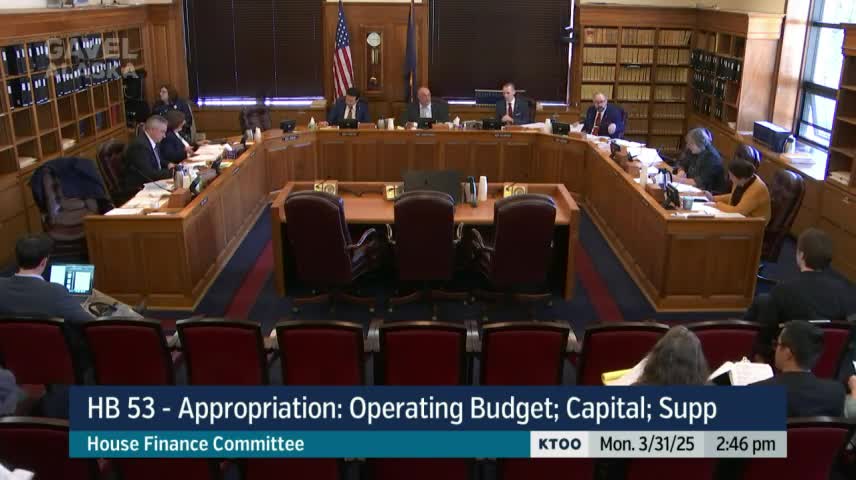
House Finance restores $482,000 for Special Education Service Agency after debate on rural needs
Summary
The House Finance Committee adopted Amendment 46 to add funding for the Special Education Service Agency (CESA), citing growing demand for services to students with low-incidence disabilities in rural Alaska and a reported $482,000 shortfall.
Co-Chair Josephson moved Amendment 46 to increase funding for the Special Education Service Agency, known in the hearing as CESA, and the committee adopted it by a 6-5 vote.
The amendment adds funding intended to help CESA serve students with low-incidence disabilities in smaller and rural districts. Co-Chair Josephson told the committee that CESA’s statutory role is to “provide special education services including itinerant outreach services to students who are deaf, deaf blind, intellectually disabled, developmentally disabled, hearing impaired, blind and visually impaired, orthopedically disabled, health impaired in other ways, and severely emotionally disturbed, and to students with multiple disabilities.” He said the agency faces “a funding shortfall of about $3 a child or $482,000.”
Committee members debated whether to add money to the budget this late in the process and asked where the added funds would originate. Representative Johnson said she was “not willing to go into the dividend any further” without backup on funding sources. Josephson and other supporters said possible sources include new revenue proposals, a constitutional budget reserve (CBR) draw, or other budget priorities to be weighed during the legislative process; they emphasized the program’s role serving rural students who lack locally available specialized services.
Legislative Finance staff explained CESA’s funding mechanism during the hearing. Alexi Painter of the Legislative Finance Division said that CESA’s statutory funding calculation is “based on the entire student population of the state,” while intensive special-education multipliers go to districts. Painter added that CESA may serve students who do not qualify for the 13x intensive multiplier and that, despite overall declining student counts, the population of students needing CESA services (low‑incidence disabilities, or LIDs) has grown in absolute terms.
Members raised legal and programmatic concerns. Supporters warned that without added funding CESA could be forced to implement a wait list and that a wait list could violate federal requirements under the Individuals with Disabilities Education Act (IDEA), which mandates timely special education services. Opponents cautioned the committee to avoid adding increments without specifying offsets or identifying funding sources.
After debate the committee called the roll on Amendment 46; the amendment was adopted by a vote of 6 to 5.
The committee’s action will be incorporated into House Bill 53 and carried forward through the budget process for final disposition by the full Legislature.
Sources at the hearing identified affected groups and places: testimony and written letters came from rural districts including Galena and Petersburg, and from the Governor’s Council on Disabilities. Supporters emphasized that CESA is primarily used by smaller and rural districts and by home‑schooled students who need specialized supports not available locally.
The committee then continued to other amendments on the HB 53 agenda.