Get Full Government Meeting Transcripts, Videos, & Alerts Forever!
Get email alerts on the Anwr Coastal Plain Leasing topic
No spam. Unsubscribe anytime.
Kaktovik leaders, AIDEA push for development after court reinstates coastal plain leases
Summary
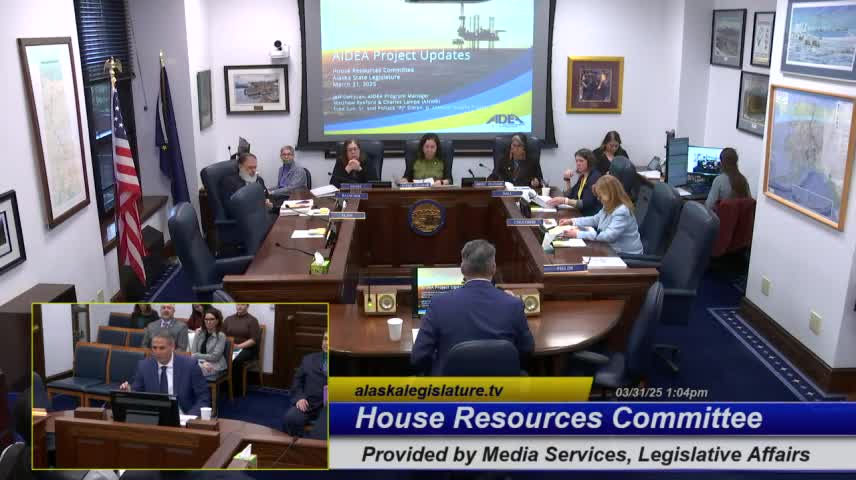
For the record, Jeff San Juan, program manager for the Alaska Industrial Development and Export Authority, told the House Resources Committee on March 31 that AIDEA is pursuing two large projects: oil and gas activity on the Coastal Plain (the ANWR “1002” area) and the Ambler Access Project.
For the record, Jeff San Juan, program manager for the Alaska Industrial Development and Export Authority, told the House Resources Committee on March 31 that AIDEA is pursuing two large projects: oil and gas activity on the Coastal Plain (the ANWR “1002” area) and the Ambler Access Project. “The coastal plain has significant economic benefits to the state of Alaska,” San Juan said, adding that the Bureau of Land Management’s final supplemental environmental impact statement estimated more than $2,000,000,000 in annual revenue to the state from development in the 1002 area.
Why it matters: Kaktovik residents and the Kaktovik Inupiat Corporation (KIC) framed the debate as one of self‑determination and local economies. Speakers said federal actions that blocked or delayed development have had long economic effects for their communities and that local corporations and tribal governments support leasing and exploration on the Coastal Plain.
San Juan told legislators that AIDEA litigated the previous Interior Department cancellations and that a federal judge (identified in the hearing as Judge Gleeson) recently ruled in AIDEA’s favor, reinstating the seven leases awarded in 2021. AIDEA says the leases total about 365,775 acres and that independent research estimates roughly 4 billion to 6 billion barrels of recoverable oil in the area. San Juan said AIDEA’s next steps include reestablishing lease status and planning a 3D seismic program; he estimated a seismic program could cost $25 million to $35 million.
Tribal testimony: Matthew Rexford (identified during the hearing as a tribal administrator and former leader connected with Kaktovik’s corporate governance) and Charles Lampe, president and CEO of the Kaktovik Inupiat Corporation, told the committee they and their community back leasing and development in the 1002 area. Rexford said the community’s institutions—tribe, village corporation and local government—are “in complete alignment with oil and gas exploration in the 1002 area.” Lampe said KIC and locals “have been unapologetically pro oil and gas” and described a history in which ANCSA and later federal conservation actions constrained local economic options.
Speakers stressed subsistence ties and local stewardship alongside support for development. Lampe described modern seismic acquisition as low‑impact when conducted on winter ice and snow, and he showed satellite comparisons the delegation said demonstrate little persistent surface disturbance after thaw. He also noted KIC lands total roughly 92,000 acres—about 6% of the 1002 area made available in the lease sale—and that the leases’ cancellation earlier had halted business plans and likely delayed jobs and community benefits.
Committee questions and context: Representative Sara H. Mears asked for the anticipated scale of exploration spending; San Juan replied that AIDEA is focused first on reinstating leases and that formal development budgets have not been finalized. Representative Fields pressed for details about a Ketchikan shipyard matter raised by other legislators; San Juan said he was not prepared to speak to that project and agreed to follow up to the committee.
What wasn’t decided: No formal motions or votes were taken on ANWR leasing. Committee members asked for follow‑up information about AIDEA’s seismic plans, the precise legal status of leases and what legislative support AIDEA or KIC would seek. AIDEA said it will return with additional information.
Ending: Committee co‑chairs adjourned after additional presentations; no committee action on ANWR or AIDEA proposals occurred during the March 31 hearing.