Get Full Government Meeting Transcripts, Videos, & Alerts Forever!
Get email alerts on the Regional Water Supply topic
No spam. Unsubscribe anytime.
West Central Regional Water District seeks East Grand Forks support for regional water study
Summary
Representatives from the West Central Regional Water District asked the East Grand Forks City Council to provide a letter of support and information on the city’s treatment capacity as part of a feasibility study to supply regional water to parts of Polk, Norman and Clay counties.
Representatives of the West Central Regional Water District asked the East Grand Forks City Council for a letter of support and for information about the city’s water treatment capacity as part of a regional water feasibility study.
Reid Hutton introduced Lucas Spathe of the West Central Regional Water District, who described the district’s multi‑phase effort to study and, if feasible, build pipelines and treatment facilities to supply fresh water to roughly 30 communities in western Minnesota and northwest Clay County, Minn. “They’re hopeful that East Grand Forks would be willing to participate in at least a study of a level of, whether or not our city could potentially be a supplier to the water district,” Hutton said.
The district is proceeding under a state statute referenced in the meeting. Spathe said the project would be phased and major construction—pipelines and possible treatment work—could cost “many millions of dollars.” He said the district has sought state bonding and requested $9.7 million in the current session while acknowledging it is unlikely to receive the full amount. Spathe noted the district has obtained some federal funds, including grants to Norman County and the city of Felton.
Council members asked how a regional supplier would affect existing agreements with neighboring districts. Spathe said his team has met with nearby systems, including Grand Forks, East Grand Forks and Crookston, and with multiple North Dakota regional districts, and that informal agreements and memoranda of understanding are being discussed to avoid duplicating service areas. He said the district aims to follow the statute’s feasibility process; if a court finds the project feasible, the court can order construction under that process.
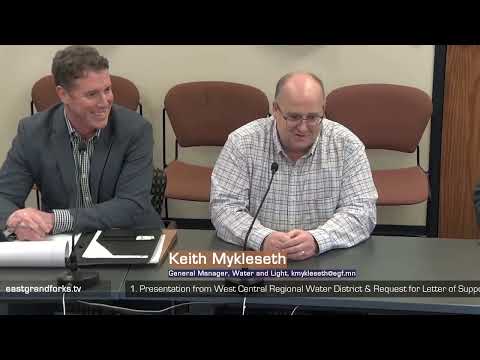
Council members also pressed technical and supply questions. Keith (Water and Light) said East Grand Forks holds an appropriation from the Minnesota Department of Natural Resources that allows it to withdraw more water than the city currently uses and said the city’s plant can produce up to about 3.5 million gallons a day and uses roughly 900,000–1,000,000 gallons a day on average. He said the city is monitoring Lower Red Lake release levels and Corps of Engineers coordination to guard against worst‑case drought scenarios.
Spathe and other presenters said water‑quality concerns (including arsenic in some rural wells) and operator shortages in small systems are drivers behind the district’s regionalization effort. Spathe said the district expects conservative estimates from suppliers and that any raw‑water transfers would be subject to permits, DNR review and engineering feasibility studies.
The presentation closed with council members expressing interest in the study and asking staff to review a formal information request from the district. No formal vote was recorded during the presentation.