Exploratory borings identify two promising replacement well sites; further design and testing planned
Summary
Consultants reported results of exploratory borings for Baxter's water system. Two locations showed favorable conditions and preliminary pump testing; staff recommended designing replacement wells (labeled well 5 and well 6) and continuing site-specific drilling because subsurface conditions vary across the area.
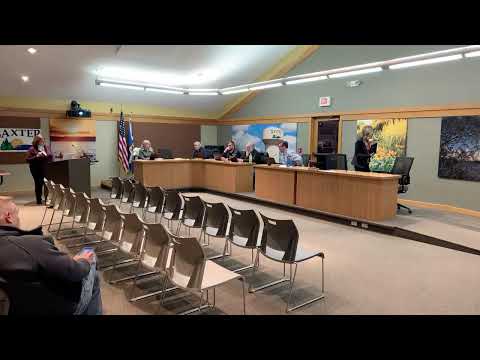
City engineering consultants reported the results of exploratory borings and monitoring at the municipal well field during a Baxter council work session, concluding that two locations appear promising for replacement water-supply wells and that further design and testing are needed.
The work matters for Baxter’s water supply: consultants said aquifer conditions at two exploratory borings were favorable, transmissivity at the promising site measured about 8,300 square feet per day in preliminary testing, and water quality at the new locations is comparable to existing wells — meaning no anticipated changes to treatment processes.
Consultants drilled four exploratory borings (EB1–EB4). EB1 and EB4 returned favorable lithology and were logged for future well design; EB2 and EB3 showed less favorable conditions (clay and lacustrine deposits). Monitoring wells (MW1–MW3) were installed and instrumented. Preliminary step-drawdown pump testing with temporary screens showed that the aquifer would respond, and the team measured a typical response time of about eight minutes at monitoring wells roughly 500–900 feet from the existing well field; drawdown at the monitoring wells during pumping was on the order of one foot in the favorable locations.
The consultant recommended sonic drilling for the full wells, using the soil logs and samples supplied to a well-design vendor (identified in the meeting as Johnson Scribe) to size screens and filter pack. Based on the findings the consulting team recommended designing and advancing two new production wells (referred to in discussion as wells 5 and 6) to replace lost capacity and to site them roughly 1,000 feet from existing wells where feasible.
Consultants cautioned that subsurface conditions vary substantially across short distances — a remnant clay till is present in places and erosional features create spatial variability — so each new well location must be drilled and evaluated before committing to a final design. Water-quality samples collected from monitoring wells showed only minor differences (iron and manganese varied among sites) and were judged by staff to be “comparable” to the 2019 baseline for the city’s existing wells.
The report recommended keeping the monitoring wells in place for continued observation while the city designs permanent wells and considers future options for expanding the treatment facility if pipe sizing or conveyance to an eastern site is required. Staff emphasized the work was intended to fast-track replacement capacity given observed well-screen degradation at older wells and interference between existing production wells.
The council paused formal acceptance of the report at the meeting and asked staff to finish remaining design questions before moving the item from consent: staff will finalize recommended well-screen lengths and filter pack design, confirm contractor and construction estimates, and return the final design and cost estimate to council for approval.
Next steps: complete final design per Johnson Scribe recommendations, proceed with formal well drilling and pump testing for the two candidate sites, and report back to council with construction costs and recommended development schedule.
AI generated
The text on this page is AI generated. Summaries, highlights, analysis, and video transcripts are all produced from the original source material.
AI can make mistakes, so if you spot one, and we will fix it for everyone.
Note: the source content is unaltered by us. Any content source we link to, be it a video, an audio recording, or a document, is presented exactly as its publisher released it. That publisher is usually a government body, sometimes an individual official or another organisation.