Get Full Government Meeting Transcripts, Videos, & Alerts Forever!
Get email alerts on the Transportation topic
No spam. Unsubscribe anytime.
MnDOT updates Baxter council on Highway 371 corridor safety study, seeks federal grant
Summary
Minnesota Department of Transportation officials presented an update on the Highway 371 corridor safety study to the Baxter City Council, describing crash patterns, short-term improvement concepts such as J‑turns and offset lefts, and a RAISE grant application that could fund near-term work.
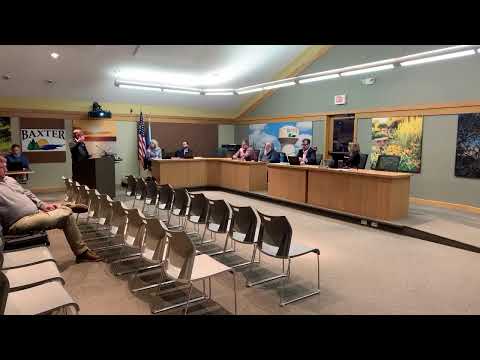
Minnesota Department of Transportation (MnDOT) officials on Monday updated the Baxter City Council on the Highway 371 corridor safety study and said they have applied for federal grant funding to advance several short-term safety improvements.
Bob Rogers, a MnDOT project representative, told the council the study examines Highway 371 from the Mississippi River crossing at the south end of Baxter north to County Road 18 at Nisswa and that teams from MnDOT, Baxter city staff, Nisswa and Crow Wing County have worked on the effort for about a year and a half. “We’re here to give an update on the 371 corridor safety study,” Rogers said.
The study reviewed about five years of crash data and traffic volumes, Rogers said. He reported more than 600 crashes in the study area over that period, with rear-end collisions the most common pattern and a smaller number of angle crashes that are generally more severe. Counts along the corridor ranged from roughly 13,000 vehicles per day on the far south end to as much as 30,000 vehicles per day through Baxter’s commercial strip. MnDOT staff said planners used forecast growth rates of roughly 0.5 percent to 2 percent annually in their modeling.
Why it matters: MnDOT officials said the crash history and some locations’ crash rates exceed statewide averages and warrant targeted interventions. The study is in phase three, which focuses on implementation planning and timing; officials said they expect to finalize the study in late spring or early summer and will coordinate with an upcoming interchange project and a MnDOT pavement project currently programmed for 2032.
What MnDOT proposed and evaluated MnDOT presented a toolbox of lower-cost, quicker-to-implement intersection treatments and longer-term, higher-cost options. Short-term concepts that appear in the study and the federal grant application include offset left-turn lanes at Pine Beach and Novotny within Baxter limits, and several restricted-access median and J‑turn (median U‑turn) treatments in the corridor’s middle and northern segments.
Rogers described J‑turns as a way to eliminate certain high-risk cross and left-turn movements and cited national studies showing large reductions in severe crashes, noting a MnDOT review of four recently installed J‑turn locations near Brainerd International Raceway that showed a 54 percent reduction in crashes over a 20-month period after installation; the presenter said those four locations had seven crashes in the after period, including one fatality. He also said more than 75 J‑turn installations statewide had been recorded on a national implementation website as of early 2024.
Signalized variants, a Michigan U‑turn and a tight-diamond grade-separation (interchange) also were analyzed. Rogers said the signalized J‑turn can increase mainline green time and capacity but that experience in other Minnesota locations shows learning curves for drivers and occasional early operational problems. The tight-diamond interchange would be the most permanent safety solution but would be disruptive to adjacent businesses and costly; MnDOT staff described interchange construction as a long-term possibility that generally is in the tens of millions of dollars and not likely in MnDOT’s near-term programming horizon.
Grant application and near-term actions MnDOT submitted an application in January to the federal RAISE discretionary grant program seeking $25 million for a package of corridor improvements, Rogers said. He told the council that if the RAISE award is successful, the Pine Beach and Novotny offset-left proposals in Baxter would be the likely near-term projects to implement; many of the proposed J‑turns and restricted-access medians were prioritized in the middle and northern corridor segments in the grant application.
Officials said some corridor changes may also be folded into a 2032 pavement project if scoping identifies compatible improvements. The study’s final report will document alternatives and recommend monitoring and follow-up steps, and MnDOT staff said they expect to continue public engagement and to post one-page summaries of proposed concepts to the project website.
Council questions and local concerns Council members and city staff asked whether MnDOT would buy private property to build backage/frontage road connections; MnDOT said local redevelopment and city-led actions would likely drive such connections rather than MnDOT proactively acquiring all property. Staff and council members also asked about pedestrian safety at locations where people must cross Highway 371; Rogers said the safest solution would be grade separation (a pedestrian bridge or underpass) but noted that detailed pedestrian accommodations would be addressed in later design phases and that some signalized J‑turn designs can reduce the number of crossing lanes a pedestrian must traverse.
Next steps Rogers said the study will be wrapped up in the months ahead and that MnDOT will continue coordination with local partners and the interchange planning effort. “If there’s ever a time you want us to come back … I’ll be more than happy to come back and answer questions,” he told the council. The council later moved to adjourn the meeting and scheduled a reconvene time.
Ending note: The MnDOT team encouraged Baxter officials and residents to review upcoming one-page concept sheets and to provide input during the remaining study months; MnDOT also asked local partners to consider supporting grant applications or funding partnerships if projects move to delivery.