Get Full Government Meeting Transcripts, Videos, & Alerts Forever!
Get email alerts on the Higher Education Foreign Funding topic
No spam. Unsubscribe anytime.
Senate approves law requiring University System to report certain foreign funding after cutting disclosure threshold
Summary
The Georgia Senate on March 31 passed HB150, directing the University System to report donations from designated foreign countries of concern. Lawmakers lowered the reporting threshold from $50,000 to $1,000 and debated whether the measure could unintentionally affect international students or routine tuition payments.
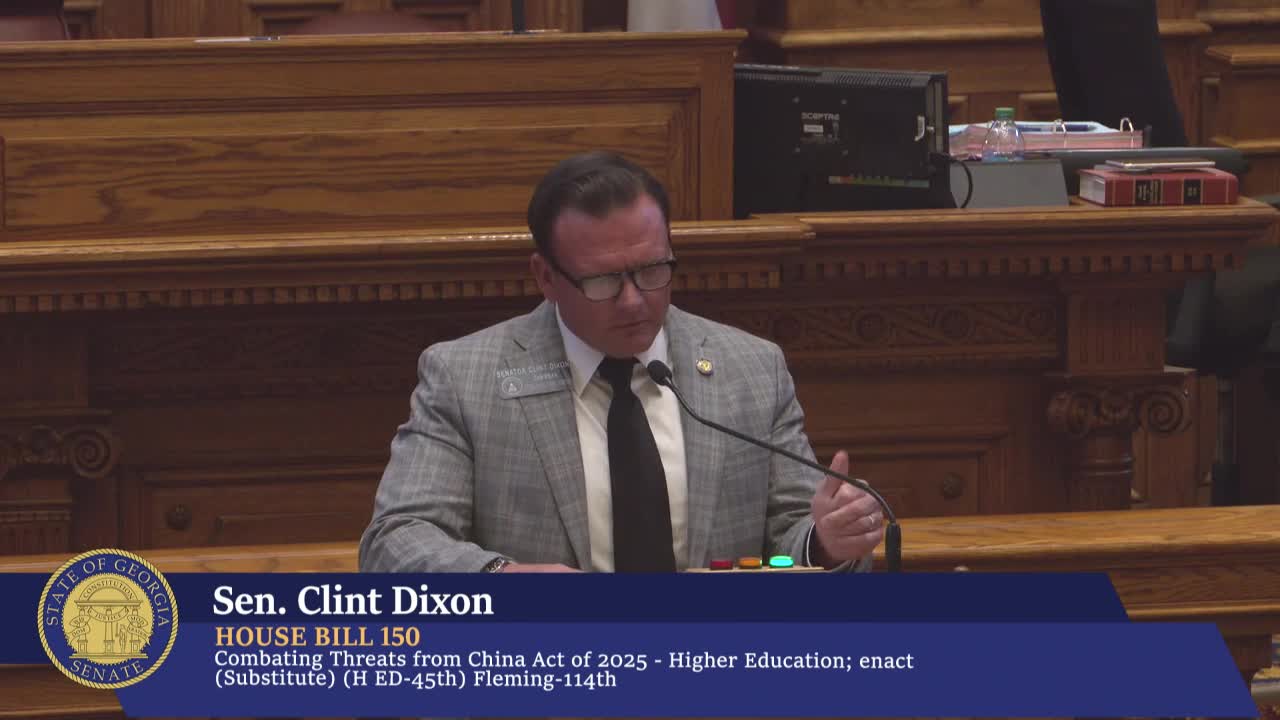
The Georgia Senate on March 31 passed House Bill 150, a measure requiring the University System of Georgia to report donations and other funding received from designated foreign countries of concern. The bill passed by substitute on a 32-19 roll call after senators adopted an amendment that reduced the disclosure threshold from $50,000 to $1,000.
Supporters said the bill is designed to increase transparency about foreign funding that could influence research or university operations. “This bill ensures that the legislature understands what our university system is doing in regards to countries with foreign concerns,” the bill sponsor, identified in debate as the senator from the 40th, said on the floor as members discussed the measure.
The bill requires semiannual reporting to the governor and the General Assembly of gifts, grants or contracts from foreign countries of concern and entities working on their behalf. The measure defines the list of foreign countries of concern by reference to a federal list in 15 C.F.R. §791.4 but, during debate, the sponsor stated the text as drafted ties the list to the list current on Feb. 4, 2025.
Debate focused on the scope of the reporting requirement. Opponents asked whether ordinary tuition payments or individual foreign students would be swept into the definition; the sponsor said the bill was not intended to cover routine tuition. Senator Bearden (30th District) offered and won an amendment lowering the reporting trigger from $50,000 to $1,000 (adopted 32-21 at the time of the amendment vote), a change proponents said would increase transparency but critics said could make the list overinclusive.
Senators also debated whether the list of covered countries would update automatically with changes to the federal regulation or remain static; the sponsor said the measure as written points to the list current on Feb. 4, 2025. Critics warned a static list could become outdated and inadvertently bar beneficial collaborations.
The bill passed by substitute and will return to the House; the Senate recorded a final passage vote of 32 in favor and 19 opposed.
Clarifying details and legislative safeguards were discussed on the floor but the final text limits the measure to reporting and transparency; it does not alter visa status, student admissions, or immigration law. The sponsor said the measure “does not contemplate or include tuition” and is aimed at large donations that might create influence or risks to research integrity.
Votes at a glance: HB150 passed by substitute, 32-19. Amendment lowering the disclosure threshold to $1,000 was adopted.