Get Full Government Meeting Transcripts, Videos, & Alerts Forever!
Get email alerts on the Long Term Care Regulation topic
No spam. Unsubscribe anytime.
State audit finds nursing-home complaint investigations often late or incomplete; ADHS says improvements underway
Summary
The Auditor General told JLAC that Arizona Department of Health Services failed to investigate or timely investigate many long-term care complaints, but ADHS said staffing, new quality controls and improved prioritization are narrowing the gap; auditors await an unredacted CMS data agreement to complete investigation-timeliness testing.
A long-term chain of Auditor General reviews and follow-ups on Arizona Department of Health Services’ (ADHS) handling of nursing-home complaints concluded March 12 with auditors reporting progress on some fronts and persistent, serious gaps on others.
Auditor General findings
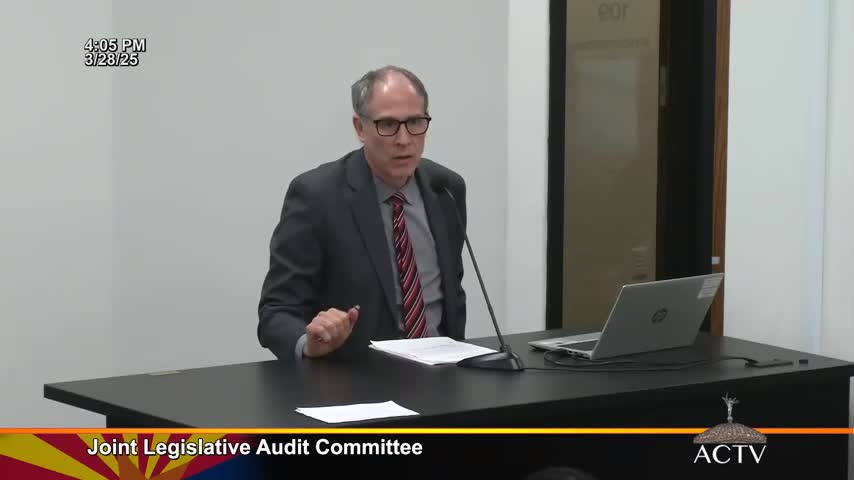
Jeff Gove of the Auditor General’s office summarized a series of audits dating to 2019 that found the department failed to investigate many complaints alleging abuse, neglect and hazardous conditions. The 2019 audit identified 70 complaints and self-reports in a sample; auditors said 50 of those files had no evidence of a completed investigation. ‘‘Of the 70 complaints and self reports we reviewed, we found that 50 were not investigated and did not contain any evidence that the department had completed an investigation,’’ Gove said.
Auditors said ADHS often misclassified complaints, assigning a large percentage as medium priority even when allegations met federal criteria for higher priorities that require faster on-site responses. The committee heard examples in which complaints involving serious injury or likely harm were prioritized too low; auditors’ contractor found 28 incidents in a random sample that should have been classified as immediate jeopardy and 23 that should have been high priority.
Why the review stalled and what’s needed
Gove said auditors could not complete a full assessment of investigation timeliness because ADHS had not provided unredacted records tied to federal CMS files. The Auditor General reported it had worked with CMS and that the federal agency had approved a data-use approach, but ADHS had not yet returned a signed data‑use agreement for the Auditor General to sign. ‘‘At the end of the week of March 10, CMS approved us to enter into the agreement with the department… However, as of today, we are still waiting for the department to sign and send us the agreement for Auditor General signature,’’ Gove told the committee.
ADHS response and improvements
Tom Salo, assistant director for licensing at ADHS, said the department has focused on hiring and retaining qualified compliance officers who hold the Surveyor Minimum Qualifications Test (SMQT) required to prioritize and investigate complaints independently. ‘‘We have not had anyone in that bureau leave in the past 6 months,’’ Salo said, and the department reported it has raised the percentage of complaints prioritized as high (A/B) from single digits in earlier years to more than 40% in its most recent reporting period.
ADHS reported a larger workload: more than 6,700 complaint intakes in state FY24, roughly 560 per month, and said it is increasing investigations and improving quality-control checks, including monthly spot-sampling of intakes. Salo said the department has completed hundreds more investigations in the current year compared with earlier years and that some capacity increases are producing results.
Remaining gaps and next steps
Auditors said ADHS still needs to improve consistent prioritization, ensure comprehensive initial information gathering and document unsuccessful attempts to obtain prioritization details from reporters. Until the Auditor General obtains the unredacted CMS material and can perform investigation-timeliness analyses, two recommendations about investigation timeframes remain unassessed.
The committee pressed ADHS to expedite the data‑use agreement process; chair Mark Finchem asked for an update by the committee’s next meeting. Lawmakers emphasized urgency, noting the findings relate to health, safety and potential criminal investigations involving facility care.
Ending
ADHS said it will continue hiring, increase training, and work with CMS and the Auditor General to provide the required data for a full audit. Auditors said they will begin the investigation-timeliness review as soon as the signed data-use agreement is in place.