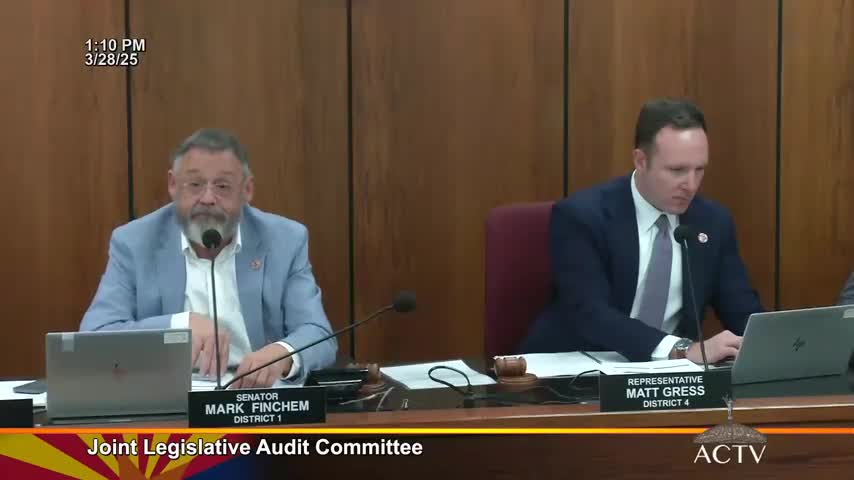
Auditors find mixed progress at Arizona School for the Deaf and the Blind; JLAC orders forensic and performance audits
Loading...
Summary
The Joint Legislative Audit Committee heard that ASDB has implemented some audit recommendations but still lacks full compliance on capital planning, fee policy and conflict-of-interest recordkeeping; JLAC contracted separate forensic and performance audits due Oct. 1, 2026.
A legislative audit presentation on the Arizona State Schools for the Deaf and the Blind (ASDB) on March 12, 2025 showed partial progress implementing prior Auditor General recommendations while raising fresh questions about fees, capital planning and public disclosure of conflict-of-interest filings.
The Auditor General’s office told the Joint Legislative Audit Committee that ASDB had implemented four of 15 recommendations from its 2022 performance audit, had taken steps on nine recommendations and had not implemented two. ‘‘We made 15 recommendations to ASDB. As of our 24 month follow-up, ASDB had implemented 4 of these recommendations,’’ Auditor General presenter Dale Chapman said during the meeting.
Why it matters: ASDB provides specialized education statewide, operates two campuses (Phoenix and Tucson) and an itinerant services program that sends teachers into public and tribal schools. The Auditor General said enrollment at the Phoenix campus fell about 37% since 2019 and itinerant program participation also declined, while some ASDB-held program funds grew substantially, prompting concern about whether fees and reimbursements match program costs.
Audit findings and agency response
Auditors said ASDB lacked a comprehensive multiyear capital improvement plan in the 2022 audit but has since developed a 3-year capital-improvement plan and contracted a master facility plan. The Auditor General told the committee ASDB’s FY26 capital plan includes project estimates that together top $100 million, including nearly $71 million for FY26–28 and two high‑priority projects: a Tucson campus consolidation and a new Phoenix birth‑to‑5 center.
ASDB Superintendent Annette Reichman told lawmakers the agency recognizes aging facilities and the shift in service demand. ‘‘We have been in the last couple of years going back to the original statutes for ASDB to determine what it is the statutes are requiring us to do,’’ Reichman said. She said the Tucson campus buildings average about 50 years of age and that a significant renovation or rebuild could require roughly $50 million.
Auditors raised concern about ASDB’s itinerant services fund. The report showed the cooperative services fund balance rose from roughly $4.4 million at the end of FY21 to more than $13 million at the end of FY24, while program revenues exceeded expenses by about $2.4 million in FY24. The Auditor General recommended ASDB analyze program costs and revise fees and voucher reimbursements accordingly; auditors said ASDB had begun analyses but had not yet adjusted fees. Chapman's office noted ASDB plans fee revisions in fiscal year 2026.
Conflict-of-interest and complaint policies
The Auditor General also found ASDB had revised conflict-of-interest procedures (for employees and board members) and increased completion of disclosure forms and training, but it had not yet stored substantial-interest disclosures in a single public file as required by statute. Reichman said ASDB had transitioned to an electronic HR records system and then implemented a separate paper file to ensure availability for public inspection.
Next steps and formal actions
At JLAC’s direction, the Auditor General issued two requests for proposals and contracted separately for a forensic audit and a performance audit of ASDB. The committee directed the office to complete a forensic audit (contracted to Forensic Strategic Solutions) and a performance audit (contracted to Sikich). The Auditor General said both reports and the sunset review are scheduled for completion by October 1, 2026.
The committee’s action aims to examine ASDB’s financial activities, operations and student outcomes more deeply than the prior follow-up could do.
What lawmakers asked and what remains open
Committee members pressed ASDB about whether the two-campus residential model still best serves a state that has seen declining birth rates and shifting educational models. Reichman said many students are already served through itinerant services and local IEP teams determine placement on a case‑by‑case basis. She also said some students still require campus-based or residential services because of the intensity of their needs.
Auditors and members flagged several remaining items that require evidence of implementation: (1) explicit procedures and documentation showing how ASDB will revise itinerant fees and voucher payments; (2) storage of all substantial-interest disclosures in a public file; and (3) formal documentation showing how ASDB will finance major capital projects.
The Auditor General said its forthcoming contract audits will report on outstanding recommendations and on educational outcomes, including comparative work with other states. ‘‘We will report on ASDB's efforts to address the outstanding recommendations as part of that review along with the results from both the performance audit and the forensic audit,’’ Dale Chapman said.
Ending
ASDB leaders pledged cooperation with contracted auditors and asserted the agency is taking steps to address the Auditor General’s recommendations while noting statutory constraints and funding limits. JLAC members said they will follow the contract audits and may consider statutory changes if lawmakers conclude Arizona’s delivery model should be adjusted.